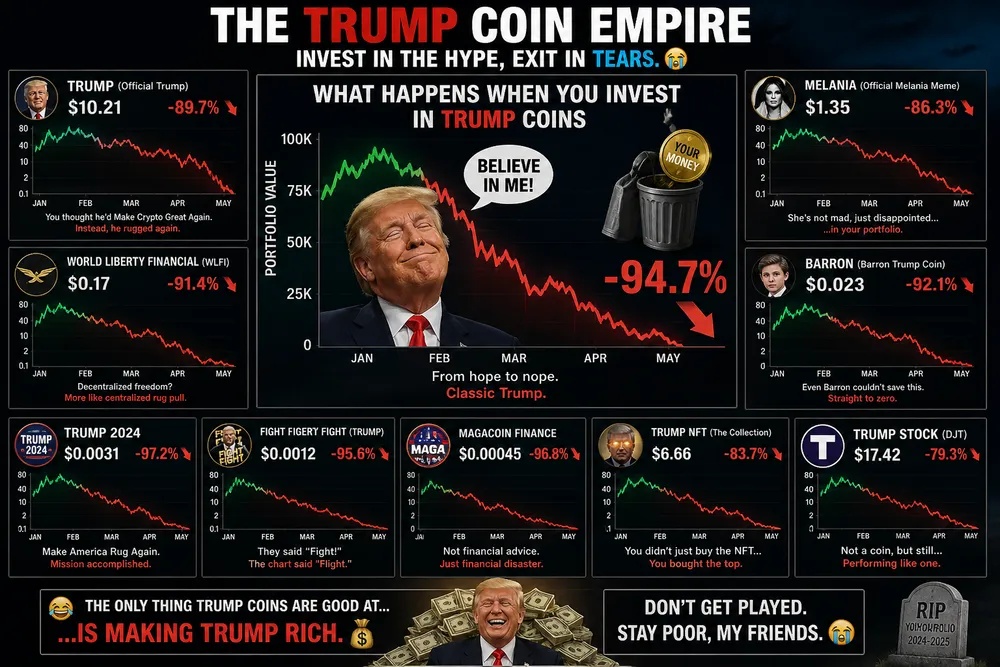
https://www.bettycjung.net/FGC-2026c.htm

2026 U.S. Federal Government Changes (September - December)

|
 |
 |
 |
 |
 |
|

Custom Search
|
Custom Search
|
| 2025 Federal Government Changes | 2026 Federal Government Changes (January - April) | 2026 Federal Government Changes (May - August) | 2026 Federal Government Changes (September - December) |
|
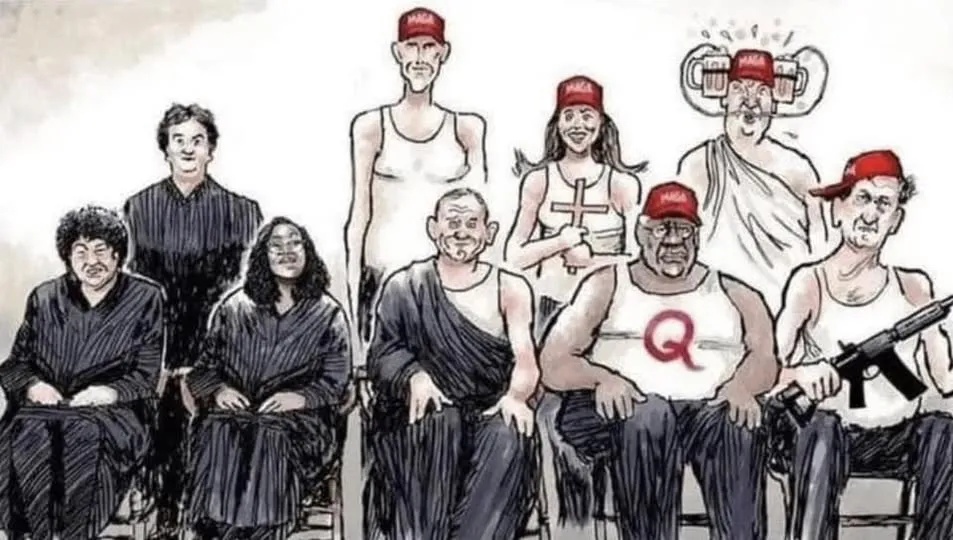
May Day in Seattle, May 1, 2026 Chief Justice Roberts fears that the SCOTUS is losing legitimacy. Wonder why? https://bsky.app/profile/666therealsatan666.bsky.social/post/3mkuyy42l7k2x May 2, 2026.
|
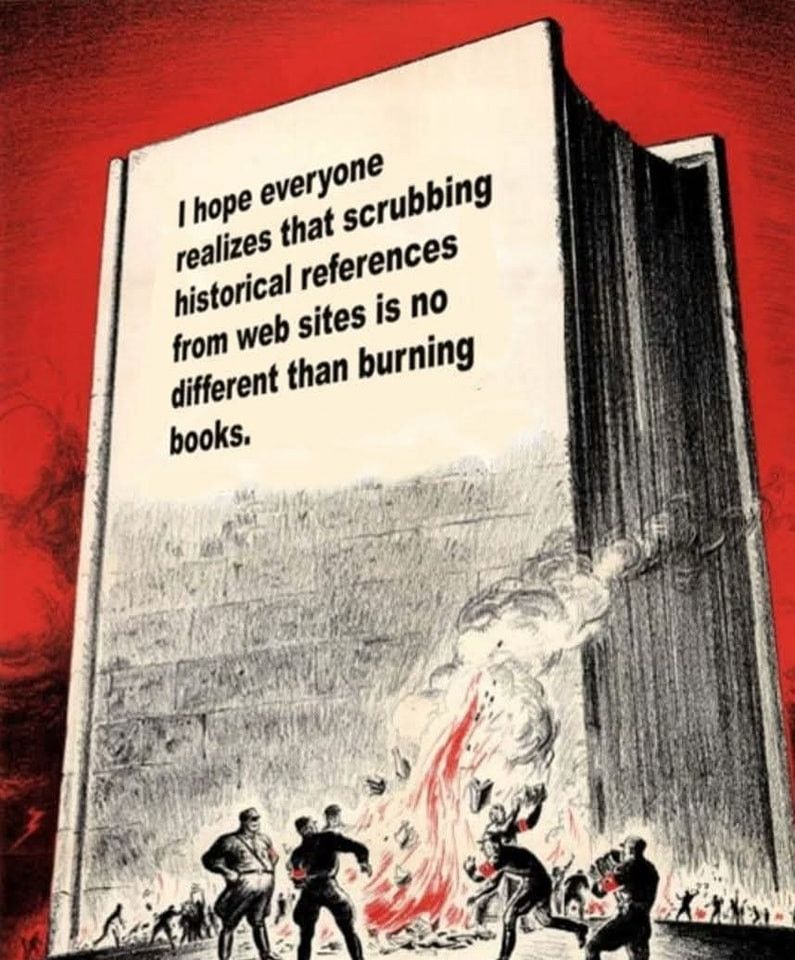
When Revision is Wrong
Historical Negationism: This involves denying the veracity of facts or manipulating data to promote a false narrative, often seen in the denial of genocides. Dishonesty and Distortion: Intentionally misrepresenting the historical record to fit a particular ideology or political agenda is a misuse of history. "Whitewashing": This occurs when negative aspects of history are minimized or ignored to make the past seem more palatable or to protect certain beliefs or groups, as noted in Quora. Lack of Integrity: When sources are misrepresented, evidence is ignored, or conclusions are predetermined to serve an agenda rather than the pursuit of truth, the historical process is corrupted. The Key Distinction
|
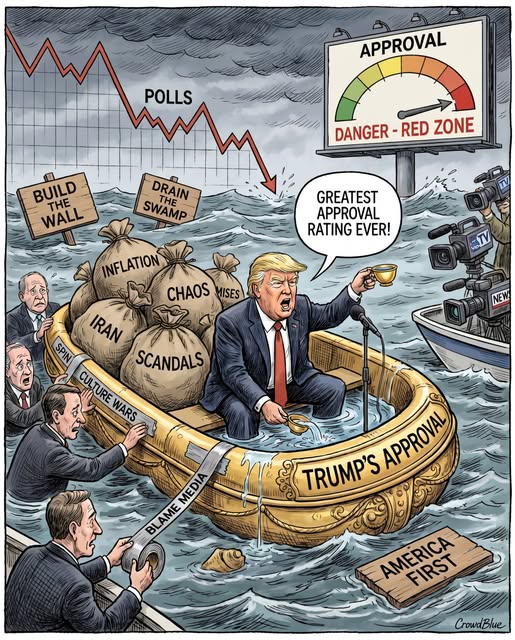
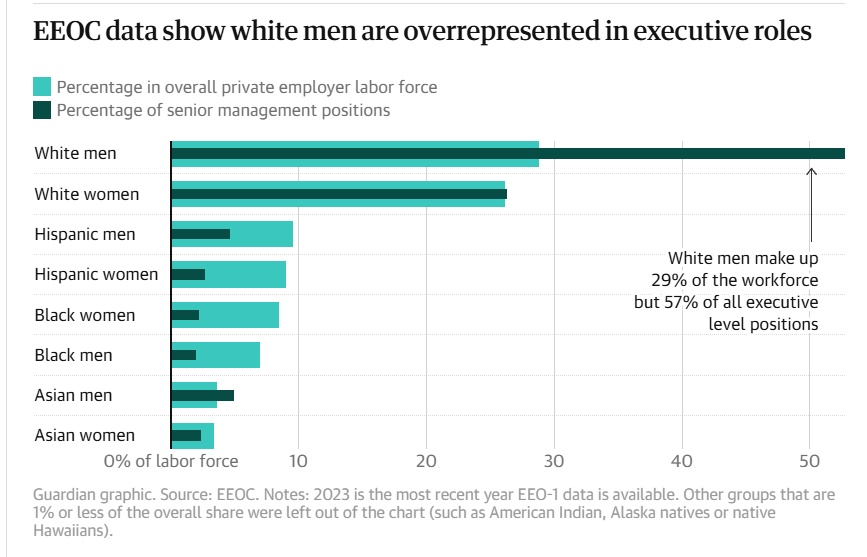
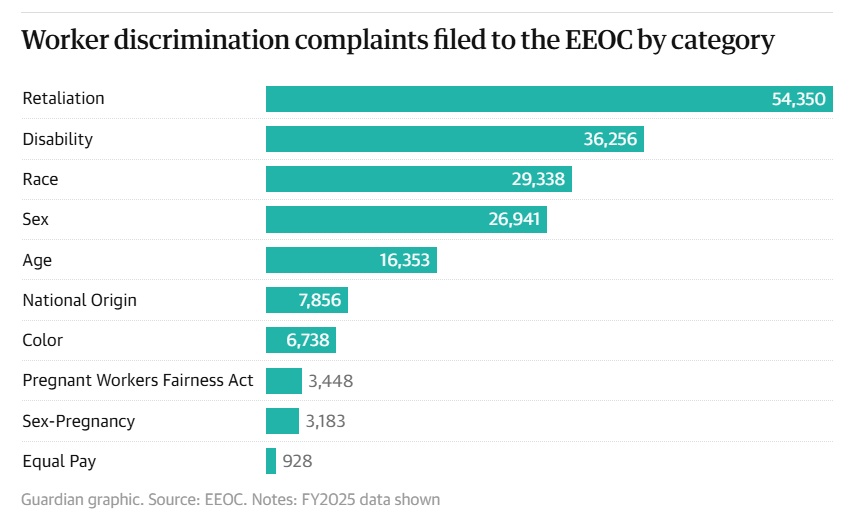
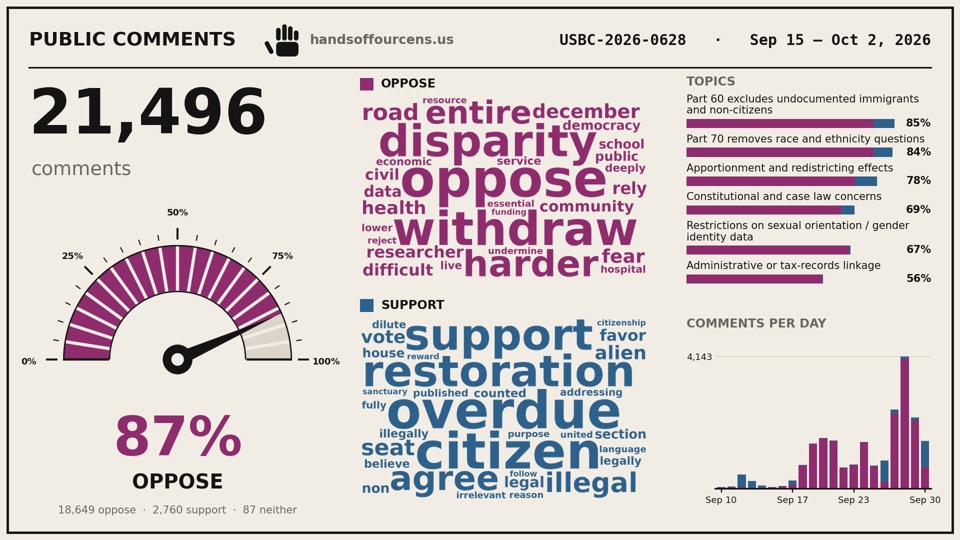
Graphic source: Crowd Blue
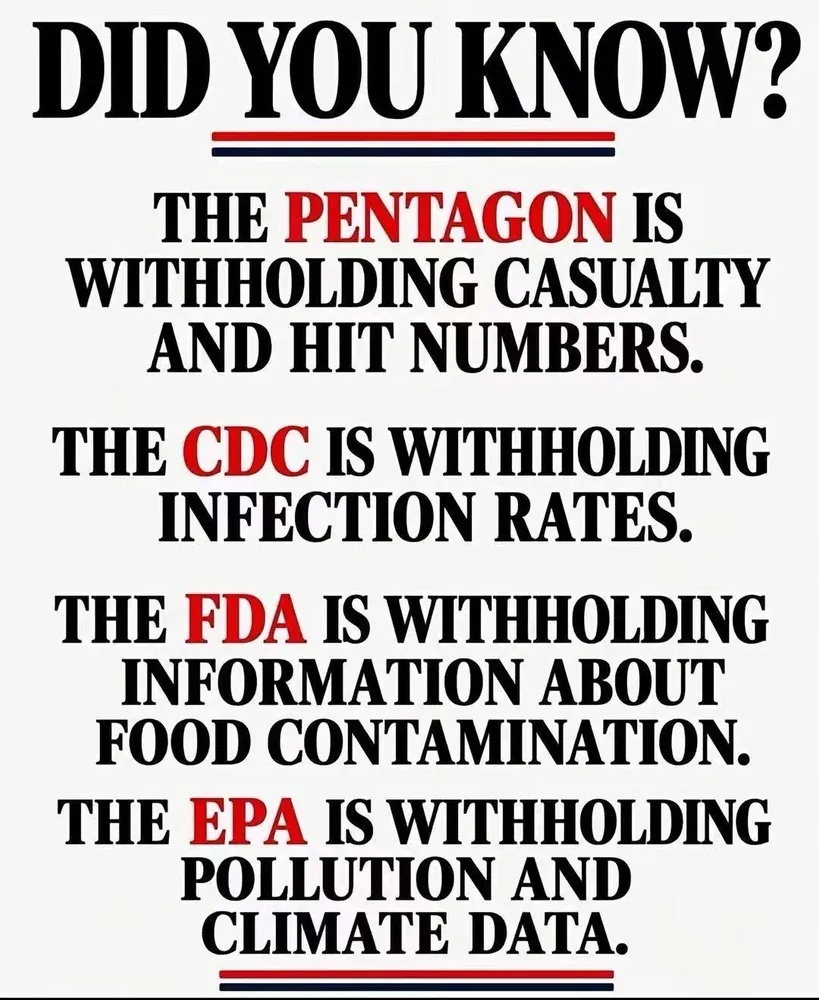
The US civil rights agency mandated to protect equal rights for workers is set to stop collecting data on the demographic makeup of companies - which for the past six decades has been used to enforce anti-discrimination laws.
The move marks a fundamental shift for the Equal Employment Opportunity Commission (EEOC). Without this data, it will be much harder for the agency to identify widespread cases of discrimination in hiring and promotions, experts and former employees of the commission say. And, they warn, it will bring the Trump administration one step closer to reshaping the commission from an independent watchdog into an arm of the executive branch narrowly focused on advancing the political grievances of Donald Trump's base.
The proposal comes amid the Trump administration's aggressive attacks on diversity, equity and inclusion (DEI) efforts and its consistent work to terminate or alter decades' worth of federal datasets because they conflict with its political goals. The majority-Republican commission is expected to approve the measure sometime in the fall.
"Getting rid of this data collection is part of a larger effort to weaponize civil rights enforcement and flip the laws that we have on their head," said Katie Sandson, senior counsel on the education and workplace justice team at the National Women’s Law Center, which is suing the EEOC for refusing to enforce workplace protections for trans employees.
The US Department of Health and Human Services (HHS) recently released a report linking “gender ideology” to leftwing authoritarianism and political violence – a study scientists say was poorly conducted and "nakedly political", likely leading to greater politicization of science and health.
It follows attempts by the administration to limit access to gender-affirming care – including, on Friday, an agreement reached between the Department of Justice and a New York hospital to no longer offer pediatric gender-affirming care. Dozens of hospitals stopped offering gender-affirming care after the Trump administration began investigating them for offering the standard of care.
The report is "quite an abnormal document with a number of oddities," said Daniel Aaron, an associate professor at the University of Utah's SJ Quinney College of Law.
"It likely also violates federal law because it's not peer-reviewed, and it's essentially quite an influential dissemination of information," which could mean it violates the Information Quality Bulletin, a federal regulation that requires peer review for influential scientific information from the US government, he said. “It’s actually not even health-related, so I don’t understand why this is related to HHS’s mission,” Aaron said
"By that standard, any medical recommendation becomes 'authoritarian'. Any standard set by any licensing board becomes 'authoritarian'," Konnoth said. :What we're seeing is this broadside attack on the scientific establishment more generally, and trans rights are being used as the vehicle to do this."
"I think we can draw parallels with this consistent anti-science production of information by the federal government," he said. Konnoth called it an "attempt to create an alternate scientific narrative" that affects all Americans.
“There's a targeting of these mainstream fundamental organizations that put out research that doesn't just involve trans rights, but involves broader claims about science," he said. "If we buy into their attempt to discredit the medical establishment, then we are in deep trouble - It's life-and-death for massive swathes of the American population."
Exclusive: Trump gave cash gifts of $45,000 to his executive assistant Natalie Harp and two other young White House employees, financial disclosures revealed.
Controversy: A former White House ethics lawyer said the payments may violate a law preventing federal employees’ salaries from being supplemented from outside sources.
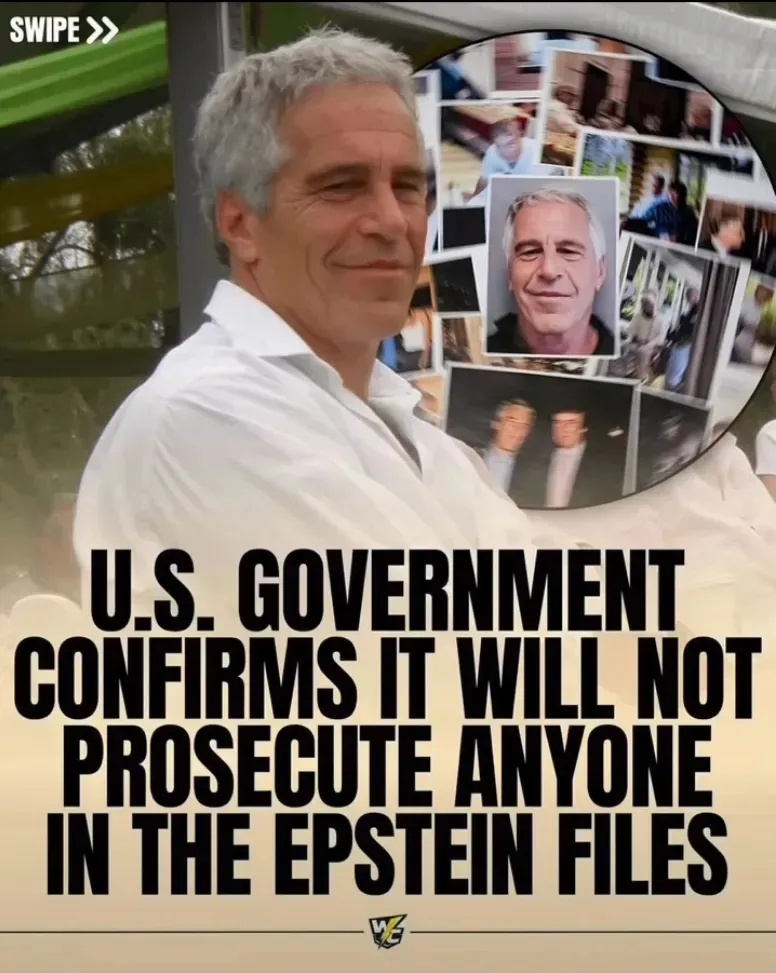
What to know: European law enforcement agencies said that the Justice Department has not responded to their requests for help in investigations of Jeffrey Epstein and his associates.
Response: The Justice Department told The Post it doesn't comment on mutual legal assistance requests; last month a spokesperson told the Telegraph that no requests have been refused.
The latest: The AP stylebook will continue to refer to Lake Ontario as Lake Ontario, despite Trump’s order renaming it Lake America.
Similarly: The White House banned AP reporters from events after the wire service refused to use the name “Gulf of America” for the Gulf of Mexico following a Trump order.
Financial disclosures show Harp, Martin and Harris each receive $45,000 cash holiday gifts; Nauta receives $20,000 cash gift, disclosures show White House says gifts comply with ethics rules
President Donald Trump gave tens of thousands of dollars in cash gifts last year to executive assistant Natalie Harp and three other close aides working in the West Wing, according to financial disclosures released by the White House.
The payments raised ethics concerns because federal employees are generally barred by statute from receiving compensation beyond their government salaries.
The payments were equivalent to roughly one-third of the aides' federal salaries of $150,000 per year, according to the White House annual personnel report to Congress. Walt Nauta, another aide who works as the director of Oval Office operations, received $20,000 in cash, the disclosures show. His annual compensation is $175,000.
Harp drew public scrutiny last month when the Washington Post reported that she and Nauta were in a catering truck that secretly moved Trump to a flight he took in July from Turkey to the United Kingdom amid concerns about potential threats from Iran. Harp exercises control over Trump's Truth Social account, posting on his behalf and helping draft social media statements, according to a person familiar with her role.
Nauta, a former White House valet, facde accusations from federal prosecutors of helping Trump hide top-secret documents that the Republican president took when he completed his first term at the White House in 2021. Nauta pleaded not guilty, and the case was dropped after Trump returned to office.
Yesterday: Late-night talk show host Jimmy Kimmel said the Federal Communications Commission "threatened" him into not airing an interview with Texas Democratic Senate candidate James Talarico.
Big picture: ABC, which hosts Kimmel's show, has clashed with the FCC under Trump. Last year, the network briefly suspended Kimmel’s show because of FCC pressure.
New: After Trump suggested he may rename New Mexico "New America," congressional leaders from the state asked Google and Apple not to rename the state on their maps.
Context: The companies switched the Gulf of Mexico and Lake Ontario to Trump’s preferred names on their maps after the president issued orders renaming the bodies of water.
Limits: Unlike with bodies of water, Trump lacks the authority to rename a state, but he can order federal agencies to use a different name.
Exaggerations about jobs and the economy
VANCE: "We've created 1 million new jobs, and unlike the last administration, where most of the job growth went to illegal aliens, 100% of the job growth in the United States of America is going to American citizens."
THE FACTS: Overall, the United States has added 807,000 jobs since Trump took office for his second term, close to Vance's claim of 1 million. But by historical standards, it's not a particularly large increase.
SCOTT BESSENT, treasury secretary, speaking Wednesday: "Under this president, more Americans are working than ever before." THE FACTS: This is true, but missing context. The economy adds jobs most months, so U.S. payrolls are continually hitting new highs. Jobs have increased in the United States in 65 of the past 80 years.
THE FACTS: Trump has cited an increasingly higher number for investments in the U.S. throughout his second term, claiming on Wednesday that the number could go up to $25 trillion. But he has presented no evidence that he has secured this amount of funds from either foreign or domestic sources.
Based on statements from various companies, foreign countries and the White House's own website, that figure appears to be highly speculative and far higher than the actual sum. The White House website offers a far lower number, $11.2 trillion, and that figure appears to include some investment commitments made during the Biden administration.
TRUMP: "The stock market has set 80 all-time record highs."
THE FACTS: It's unclear what exact stock market measure Trump is referring to. But the S&P 500 - an index for the biggest public companies in the U.S. - has hit a record 66 times since the start of Trump's second term in January 2025, including 27 new highs since the start of this year, per a count from investment research firm CFRA. It's hit 76 records since the 2024 presidential election.
U.S. stocks soared to their last record on Aug. 13, as part of a broader rally driven by a surge in company profits and then-easing oil prices. But renewed fighting between the U.S. and Iran, as well as an escalation in supply chain disruptions elsewhere, has led to more market volatility since. This week, for example, the international benchmark for crude oil soared past the $100 mark for the first time in months.
Beyond the war, some of the biggest market swings this year have resulted from the frenzy ( and skepticism ) around the value of artificial-intelligence technology.
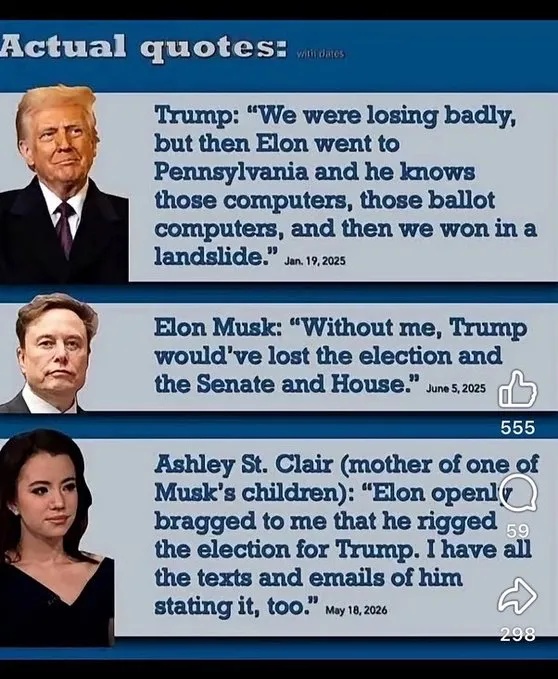
2020 election redux. TRUMP: "When I'm on the ticket, Republicans always do very well. We won the presidency three times."
THE FACTS: Trump won the presidency in 2016 and 2024, but he did not prevail in the 2020 race, despite his repeated claims otherwise.
Biden earned 306 electoral votes to Trump's 232, achieving victory by prevailing in key states such as Pennsylvania, Michigan, Wisconsin, Arizona and Georgia. The Democratic candidate also earned over 7 million more popular votes than Trump.
Trump's allegations of massive voting fraud have been refuted by a variety of judges, state election officials and members of his first administration who were in office during the 2020 election.
Last night: Trump asked the GOP;s midterm convention to pledge "to the greatest president" that they will vote in the midterms even if they are not registered to vote.
And: Trump called on them to pledge they will "cheat like hell, like they do," a nod to his baseless claims of widespread Democratic voter fraud.
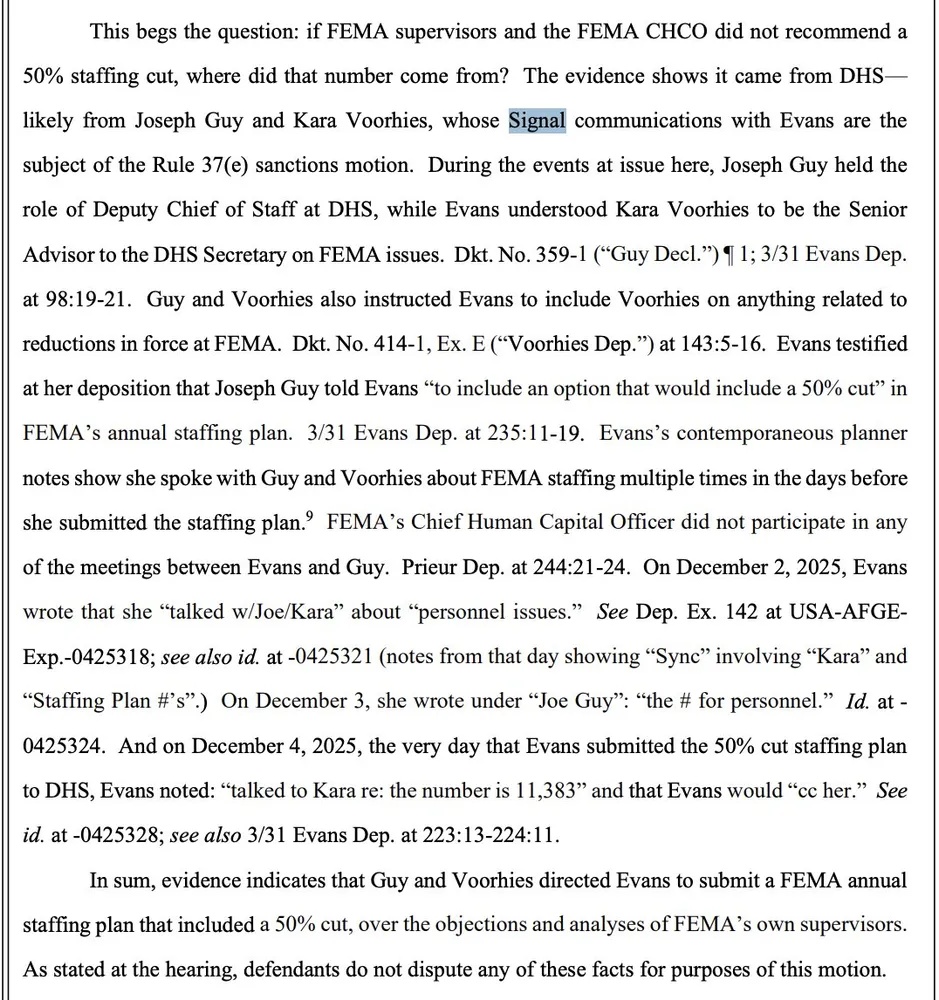
Kyle Cheney @kyledcheney.bsky.social JUST IN: A federal judge concludes that DHS leaders arbitrarily decided to cut FEMA staff by 50% even though it damaged the agency's ability to fulfill its mission — and leaders hid their comms about it on auto-delete Signal chains.
Maha adherents were frequently drawn in from social media with the promise of enacting change: fighting for cleaner water and air, healthier food systems, better healthcare. "But the people at the top of that movement very much used it as a political movement," Knurick said.
That's how the movement that prioritizes cleaning up environmental toxins is partnered with an administration that's ignoring environmental regulations, Knurick said. "Those things don't align, and I can go down the list where most of what the Maha movement says they want is not aligned with the actual policies we're seeing come out of this administration." It does make it difficult to preach healthy eating when those foods are just inaccessible to a big portion of this country Jessica Knurick.
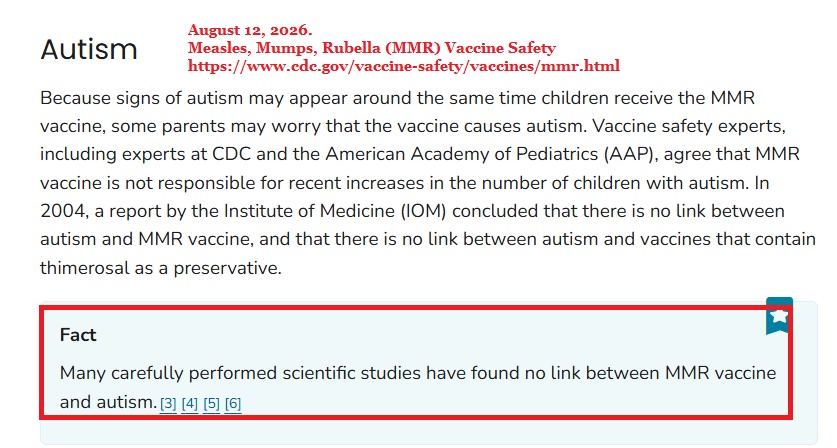
As diseases loom, CDC's response to measles deaths stirs fears about agency's reliability NPR, September 11, 2026.
"Red flag. Red alert," says Dr. Demetre Daskalakis, who resigned last year as the director of the National Center for Immunization and Respiratory Diseases at the Centers for Disease Control and Prevention to protest what he called political interference at the agency.
Daskalakis and other independent public health authorities around the country are alarmed by how the CDC handled two deaths that Pennsylvania state officials recently blamed on measles. Health and Human Services Secretary Robert F. Kennedy Jr. took the unprecedented step of questioning the deaths, and the CDC removed them from the agency's website. "When they raise doubt on the adjudication that a state may have made around a death, that is highly problematic," says Daskalakis. "This is dangerous."
Usually, when someone dies from measles, the state where the tragedy happened determines the cause of death and reports the death to the CDC so the agency can alert the public, doctors and health officials around the country. The CDC usually defers to the state's determination.
So Kennedy's public dispute with the state and the CDC's response is concerning for what it may mean for the relationship between states and federal health officials, who have to work closely to protect the public, Daskalakis and others say. That relationship has already become strained under the Trump administration.
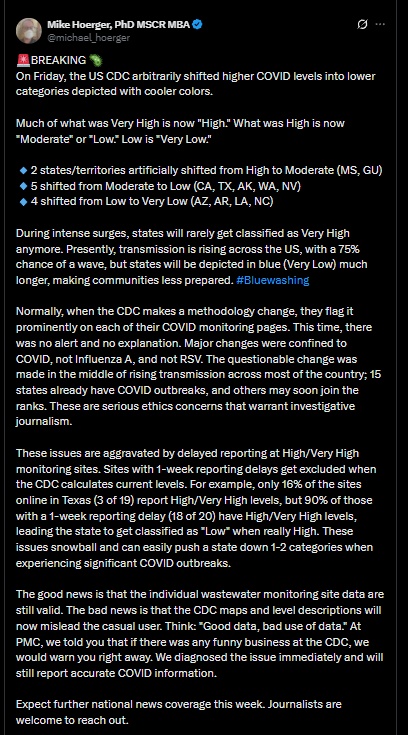
"What we have been seeing, that got amplified even more with these measles cases, is a breakdown in the coordination and trust between states and the federal government," says Dr. Anne Zink, "That to me is a significant concern. These partnerships are critical and essential to making us healthy and well." Zink and others also worry about whether the public, state and local health officials, doctors and others will be able to trust federal health data about measles as well as other diseases, such as flu, COVID-19 and RSV. Could CDC succumb to pressure to suppress information to minimize concerns about those diseases and the impact of falling immunization rates? Kennedy has long questioned vaccines.
"We need to have good solid evidence-based national data. And I'm obviously concerned that it will happen again for other infectious diseases," says Dr. Georges Benjamin, who heads the American Public Health Association. "If it happens with flu and with COVID, the question is: Who can we rely on for the data on a national level. More people will get sick and more people because they won't know what to do. They won't know who to trust. And that is the problem here."
Many also worry about what this means for the effectiveness of the new CDC director, Dr. Erica Schwartz, who recently took over after a tumultuous year that has left the CDC demoralized and diminished. Many hoped Schwartz , a well-respected physician and attorney with solid public health experience, would restore the CDC's morale and credibility by pushing back against political pressure. But many say the way the CDC handled the Pennsylvania measles cases doesn't bode well for Schwartz pushing back against political pressure.
"We are seeing a pretty compromised CDC and a director who is at best facilitating non-scientific behavior and at worst colluding with non-scientific behavior," says Daskalakis. Others agree.
"What the director should be doing instead of looking into these disease counts is responding to the outbreak itself," says Dr. Debra Houry, who resigned as the CDC's chief medical officer at the same time as Daskalakis for the same reasons. "I haven't heard from her talking about the importance of getting kindergarteners vaccinated when we're seeing declining rates. It's back to school time around the United States. We need her to step up publicly to talk about what can be done."
New: The Trump administration repealed a limit on power plants' carbon dioxide emissions that was introduced during Joe Biden's presidency.
Background: Power plants are second to transportation in carbon dioxide emissions in the U.S., and the Biden administration said the rule would save thousands of lives. Why: The Trump administration argues the move will reduce electricity costs for consumers.
What to know: Umar Kremlev, a Russian businessman with ties to the Putin administration, paid for some of the festivities at Donald Trump Jr.'s wedding in May.
Details: Kremlev's contribution was first reported by ProPublica, which said the cost ran into the hundreds of thousands of dollars.
New: Trump agreed to Democrats’ demands for stricter ethics rules for federal officials in the Clarity Act, which would introduce the first comprehensive federal regulations for cryptocurrency.
The change: The bill would now give state attorneys general the authority to sue federal officials who violate the bill’s ban on creating or sponsoring digital assets while in office.
Today: President Donald Trump said the justices he appointed "are not the people I interviewed to serve," after the court blocked his attempt to restrict mail ballots in the midterms.
Caveat: The Supreme Court did not specify a vote count in its ruling, making it unclear how many justices were in the majority.
What we know: Of the justices Trump appointed, Justice Brett M. Kavanaugh submitted a concurring opinion. Justices Neil M. Gorsuch and Amy Coney Barrett did not register dissents.
The latest: The Kennedy Center board, dominated by Trump appointees, voted today to close the venue. Trump said that renovations cannot start until a federal appeals court rules on a name change for the venue.
Also: Judge Christopher Cooper today ruled again that the Kennedy Center board cannot add Trump's name to the building.
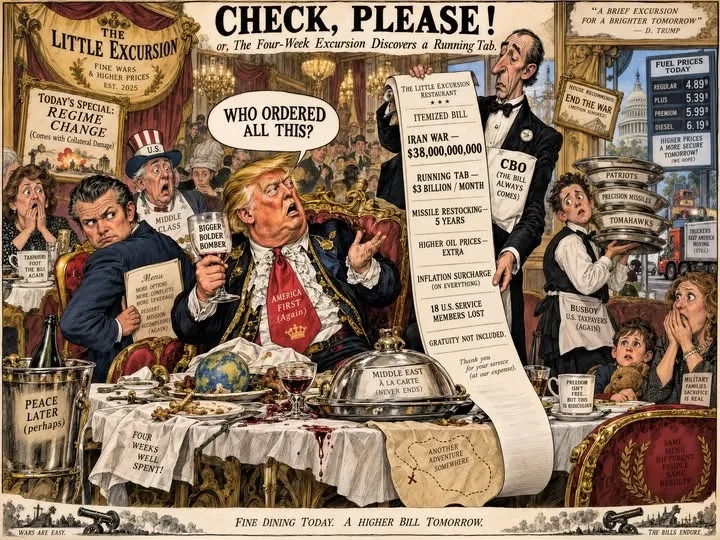
Today: The nonpartisan Congressional Budget Office released a report detailing the cost of the Iran war, finding it cost the United States $38 billion from late February to Aug. 1.
And: The report estimates the war will cost continue to cost about $2 billion to $3 billion per month.
Yesterday: The Pentagon's inspector general released a report revealing hundreds of buildings and structures on U.S. bases have been damaged by Iranian strikes in recent months.
More: The report also revealed that Iranian strikes have caused about $184 million worth of damage at U.S. diplomatic facilities and that the U.S. is facing "strategic inventory shortfalls" of munitions.
Today: Citing inflation concerns, the Fedraised interest rates by a quarter of a percentage point, bringing the upper bound to 4 percent and the lower bound to 3.75 percent.
Big picture: This is the first interest rate hike since 2023, and it was unanimously approved by the Fed's board despite President Donald Trump’s calls for interest rates to be lowered.
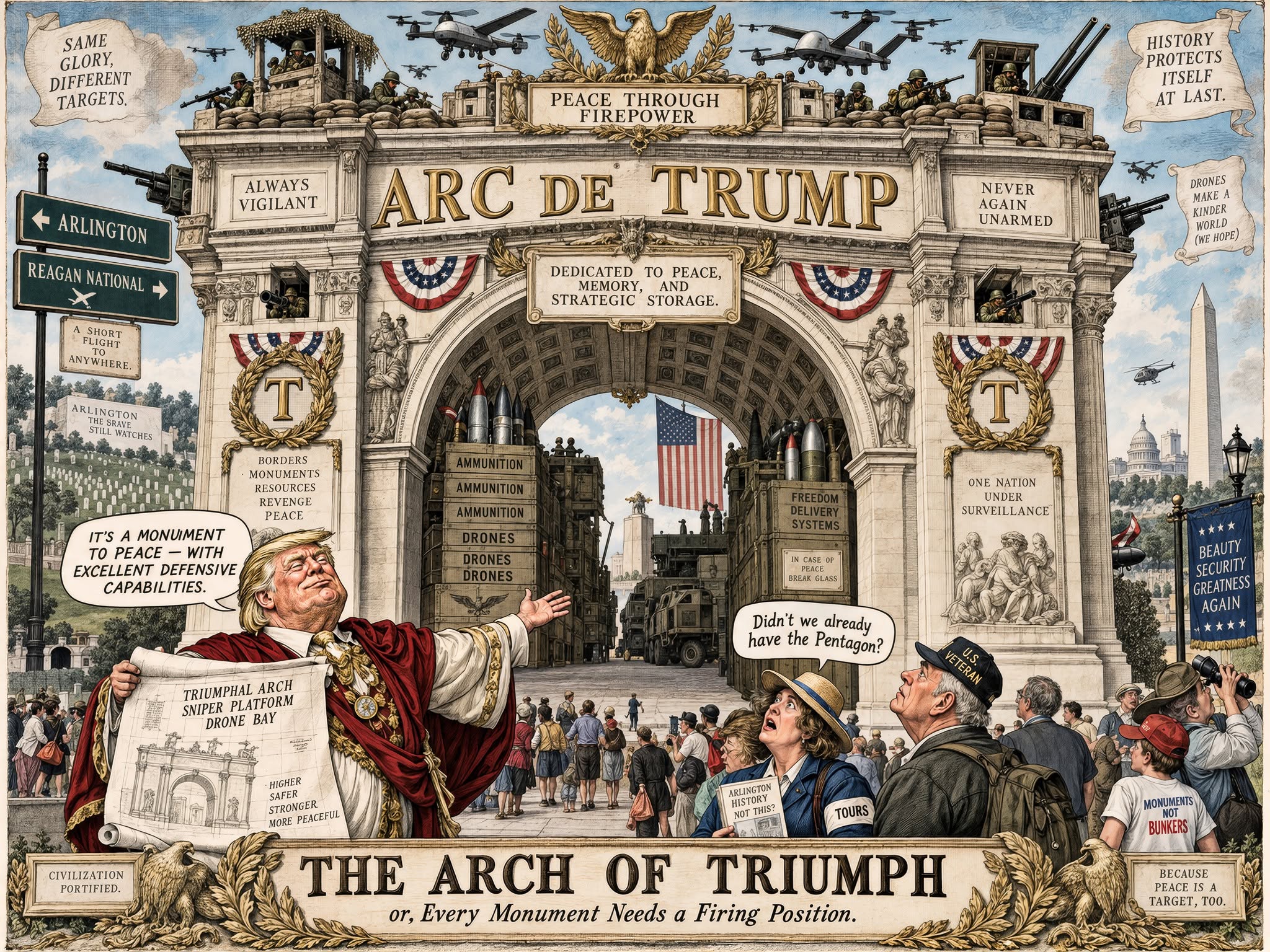
Exclusive: National Park Service officials wrote in a document obtained by The Post that Trump's proposed triumphal arch will adversely affect the Lincoln Memorial, Arlington National Cemetery and other historic sites.
But: The officials said in the document that the "adverse effects cannot be avoided" and that the project must proceed.
The latest: Kennedy Center trustee Rep. Joyce Beatty (D-Ohio) filed an emergency motion in federal court requesting that center officials explain why they closed the venue despite a court order.
Background: A federal judge ordered the Kennedy Center to remain open in May after the center’s board attempted to close for renovations. The board voted again yesterday to close.
The signs: In July, Trump ordered signs decrying alleged bias at the Smithsonian’s National Museum of American History to be placed outside of the museum.
Now: Interior Secretary Doug Burgum disclosed that his department is preparing the signs, expected to cost about $7,000 each, in a letter to Sen. Jeff Merkley (D-Oregon) this month.
Yesterday: A federal judge ruled that U.S. Immigration and Customs Enforcement likely violated the First Amendment rights of an ICE critic when agents delivered a warning to his house.
Background: ICE agents tracked down David Streever to have him sign a letter warning that an email he sent ICE's leader was potentially criminal. Streever sued, saying the email was protected speech.
The tracking tool is called Lost Funds.
"By bringing thousands of funding disruptions from the Trump administration together in a publicly accessible, verified database, Lost Funds puts the magnitude of their impact on full display," Scott Delaney, co-founder of Grant Witness, said in a statement. The $177 billion finding represents nearly 10% of federal discretionary spending, the groups said.
The tracker's organizers said the disrupted grants were beyond the kind of cuts that typically happen when administrations change.
"Lost Funds shows the extraordinary scale and real human impact of these disruptions, and how states are once again on the front lines protecting their residents," said Kelly Rader, States United Democracy Center’s research director. In some cases, courts have ruled against the administration’s grant funding cuts.
The new tool, which is being made available for public use, relies on data from USASpending.gov, an open data source of federal spending information, according to the groups’ methodology. They said the tracker would be updated regularly as the administration takes new action and lawsuits move through the courts.
The ad: Addressing Trump in a campaign ad released today, Rep. María Elvira Salazar (R-Florida) tells the president,"Some of your immigration enforcement efforts have gone too far."
More: Salazar also says in the ad that the "same Hispanics who helped you get to the White House in 2024 feel betrayed." Salazar is seeking reelection in a district that is 74% Hispanic.
Pennsylvania health department says it was requesting emergency CDC assistance known as Epi-Aid; State says it will rescind CDC Epi-Aid request if agency does not recognize four measles-associated deaths; Status of measles deaths has become focus of a standoff between Pennsylvania governor and US health secretary
The state's measles outbreak has become the focus of a standoff between US Health Secretary Robert F. Kennedy Jr. and Governor Josh Shapiro, a Democrat. Kennedy has cast doubt on whether deaths reported in US measles outbreaks since he took office were due to the virus or another cause, and instructed the CDC not to include the Pennsylvania fatalities in a national tally.
Disease experts say the move represented highly unusual interference by a health secretary in the determination by state health officials and could minimize the risks of measles in the eyes of the public. Kennedy has accused Shapiro of politicizing the outbreak in his state and of failing to request federal help.
In a letter sent to Centers for Disease Control and Prevention director Erica Schwartz on Wednesday evening, reviewed by Reuters, Pennsylvania secretary of health Debra Bogen said the state had begun the process to request emergency assistance from the CDC, known as Epi-Aid.
"The CDC's choice not to publicly recognize the deaths undermines our response," Bogen wrote. "For this reason, if CDC is unable to transparently and accurately communicate information about those measles-associated deaths, the Department will respectfully rescind our request for a CDC Epi-Aid."
Shapiro has criticized Kennedy, a long-time anti-vaccine activist who has promoted policies to reduce US childhood immunization, for amplifying public fears about vaccines without scientific evidence. Kennedy and Schwartz have blamed Shapiro for not accepting their offers of Epi-Aid, a form of short-term CDC assistance during public health emergencies. The agency sends experts to the site of a disease outbreak, typically for one to three weeks, to provide additional support to state and local health departments.
Pennsylvania's outbreak has since ballooned, growing to more than 700 confirmed cases across 37 counties and four measles-associated deaths, according to the state health department. It is the latest state to grapple with the worst US resurgence of measles in more than three decades, fueled by rising vaccine hesitancy, and coincides with President Donald Trump's return to office in early 2025.
The disease's spread in Pennsylvania is accelerating and could be 10 times larger than the official numbers, said Matthew Ferrari, director of the Center for Infectious Disease Dynamics at Penn State. Still, the state's caution on CDC deployment is understandable, Ferrari said, as it could cause more problems if state and federal political leadership are not aligned on an issue as critical as what counts as a measles-related death.
The state "doesn't want someone coming in, giving them advice and also telling them that the things that they're experiencing are not as severe as they're seeing with their own eyes," he said. If the CDC ultimately doesn't provide more assistance, he said, public health experts from other states could help.
Exclusive: Five U.S. officials told The Post there have been at least 22 U.S. military fatalities in the war with Iran, four more than the Pentagon has reported in its public database.
More: A sixth official said 23 service members have been killed in the region since the war began, along with three U.S. contractors.
Today: President Donald Trump accused CNN, MS NOW and Politico of reporting "FICTION and LIES" about him, and said he was banning them from the White House.
And: Trump said he will announce bans of "Other Fake News Media Outlets" in the latest escalation of his longtime media feud.
Two major news networks were denied access to the White House on Saturday morning, with reporters from CNN and MS NOW both going live to report they'd been barred following a ban imposed by President Donald Trump.
The actions escalated Trump's long-running efforts to restrict news coverage by journalists he finds objectionable, and is the latest test of First Amendment protections in the United States. Trump said Friday he would ban both organizations and also Politico, because of their coverage - which he called "fake news."
In his second term, Trump and his administration have upped the ante and punished certain media outlets, both in the courtroom and through regulatory action. Trump has also lashed out at individual reporters in person or over social media, sometimes in strikingly personal terms.
The move follows the president's decision last year to bar Associated Press reporters from the Oval Office, Air Force One and other events in retaliation for the news outlet's decision not to follow his lead in changing the name of the Gulf of Mexico, which lies partially in Mexican and other waters. The AP said that it would note when appropriate that Trump had ordered it renamed the "Gulf of America."
The AP filed suit and the case is ongoing. Since returning to office, Trump has pursued other legal action against a variety of different outlets, including The New York Times, The Wall Street Journal and the BBC. His administration is also involved in a long-simmering confrontation involving ABC over renewal of its broadcast licenses.
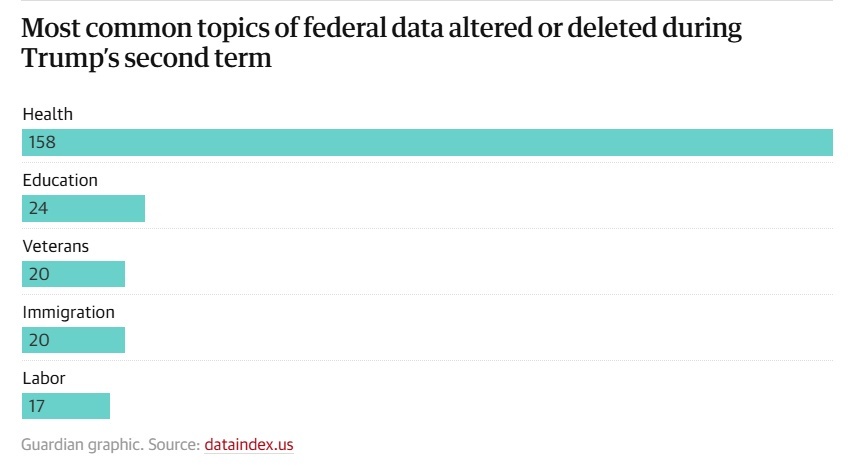
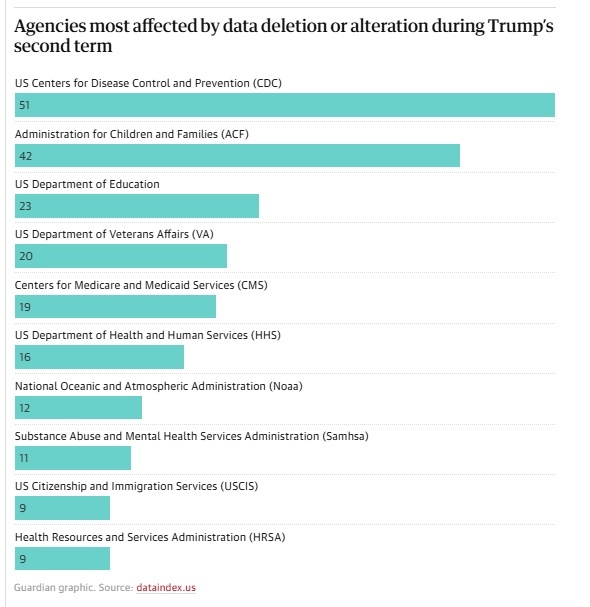
REMOVAL OF SEXUAL ORIENTATION AND GENDER IDENTITY FROM FEDERAL DATA COLLECTIONS February 2026 January 2025 to January 2026 UCLA, February, 2026. Just discovered September 20, 2026.
Using primarily government sources, we identified the removal of at least one SOGI measure from approximately 360 different federal data collections. We consider this a conservative estimate and expect upward revisions as ongoing data reconciliation and discovery of additional removals continue. Additionally, we found:
The majority (94%) of data elements removed from federal collections were gender identity demographic measures (n=338 collections). These changes were made largely pursuant to President Trump's Executive Order 14,168.
At least 60 data collections also removed sexual orientation data elements. These actions were not explicitly mandated under Executive Order 14,168 or related implementation guidance.
Twenty-three (23) collections removed SO and/or GI data elements from bias motivation questions, precluding the ability to report discrimination on these bases.
Eighty-three percent (83%) of removals were made through non-substantive change requests made to the Office of Management and Budget (n=300). Very few collections were changed through the formal notice-and-comment process (n=34).
These removals span multiple data collection types, including national surveys and surveillance systems, government-funded research studies, programmatic monitoring systems and evaluation studies, and administrative forms and records.
Today: The White House TV pool - ABC, CBS, CNN, Fox News and NBC - said it will halt TV coverage of presidential events after Trump banned CNN from the White House.
Background: The White House revoked press credentials for CNN, MS NOW and Politico after Trump accused them of reporting on him inaccurately.
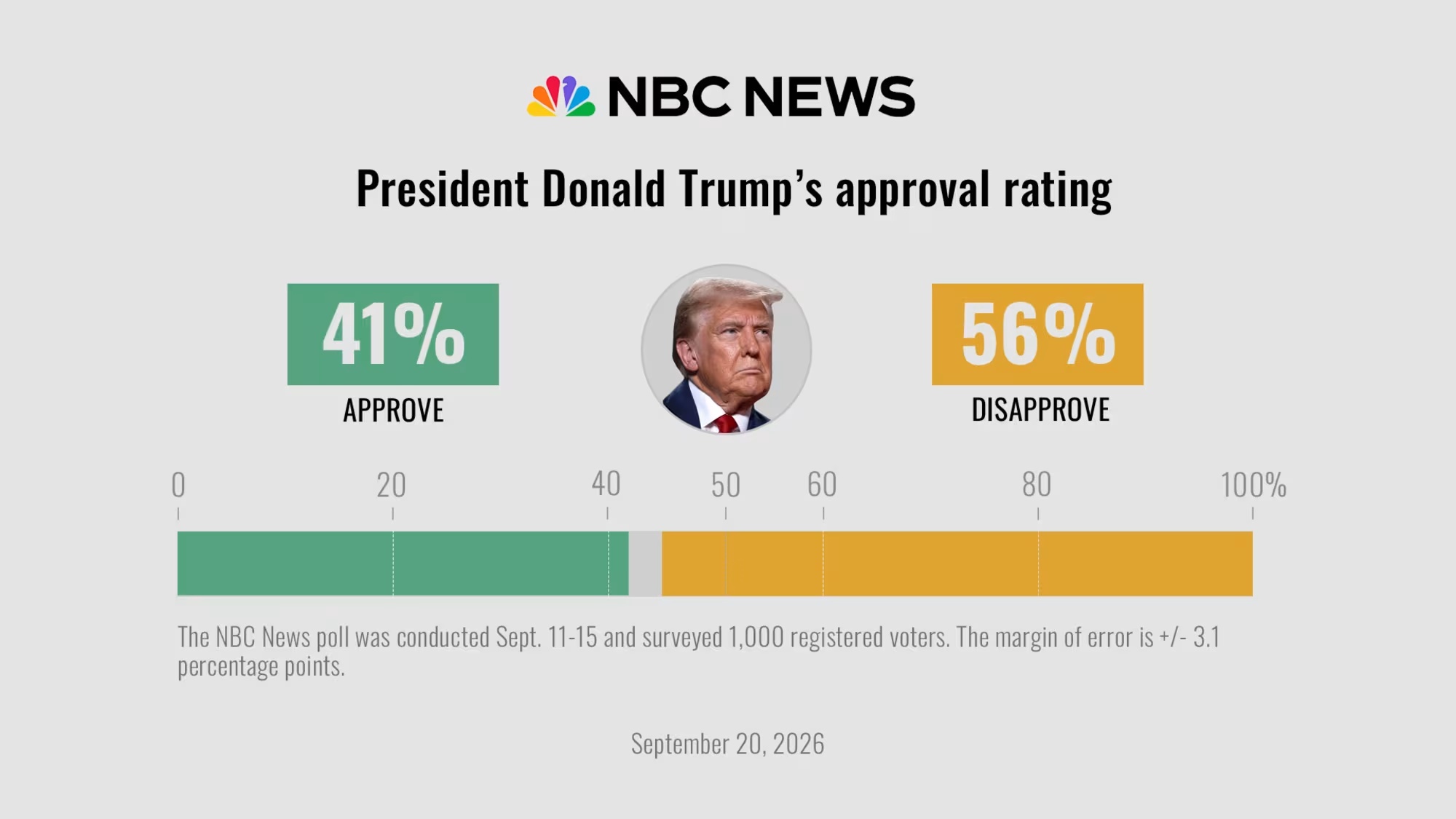
The poll: Forty-three percent of registered voters in a poll published Sunday told ABC News they want their midterm votes to send "a signal of opposition" to Trump.
Context: This is the highest share of respondents who have cited opposition to the president as their motivation for a midterm vote since ABC's 1998 poll.
Yesterday: Trump said in a social media post that his proposed 250-foot triumphal arch will double as a "top grade" military complex "at the strong request" of the Pentagon.
Details: Trump said the arch will "house, store, and have the rapid ability to use large numbers of drones, plus Snipers."
New: The top Republican and Democrat on the Senate Appropriations Committee told the White House today that it should not seek to add political stipulations to NIH grants.
Background: Trump officials have discussed creating a commission to review NIH grants and have been critical of grants that fund "woke" initiatives.
Today: Vice President JD Vance said the Trump administration is removing 760,000 people from Affordable Care Act coverage.
More: The administration said those being removed from coverage were fraudulently enrolled in the ACA, and that an additional 419,000 enrollees are being investigated.
The latest: Trump told CNN reporter Kaitlan Collins at the U.N. today that she shouldn’t be covering him.
Background: Trump banned CNN, along with MS NOW and Politico, from the White House grounds, prompting fellow members of the White House TV pool to halt video coverage of presidential events.
And: Trump's ban of CNN doesn't extend to events outside of the White House, and TV networks are still sending their reporters to ask questions.
What happened: Sen. John Curtis (R-Utah) called for the Senate Judiciary Committee to investigate the president’s son after ProPublica reported that part of his wedding was paid for by a Russian oligarch.
More: Curtis also asked for a broader probe into "the use of presidential family relationships for private financial benefit" and called for Hunter Biden to be subpoenaed.
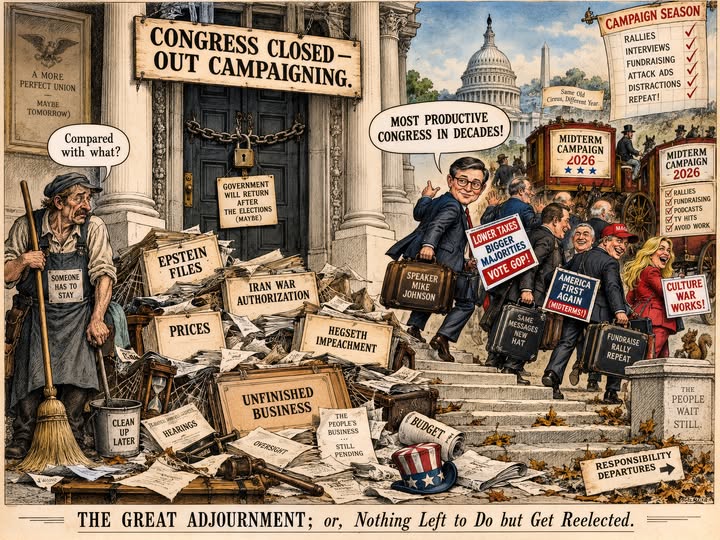
New: The National Trust for Historic Preservation announced a $10 million legal defense fund to challenge Trump’s construction projects that run up against preservation laws.
Background: The trust, a nonprofit created by Congress to protect historic sites, has already sued Trump to stop his planned White House ballroom and his proposed triumphal arch.
What happened: A television ad promoting Trump launched on cable yesterday. The ad includes the message "Paid for by the U.S. Government."
The law: Annual appropriations legislation has included a ban on federal funds being used for "publicity or propaganda" since the 1950s.
The Food and Drug Administration recently approved a new flu vaccine that tested well in older adults. But the federal agency responsible for telling doctors and the general public how to use it has made no recommendation on it.
The Centers for Disease Control and Prevention's inaction on the mFlusiva vaccine marks a break in longstanding practice. It's also an example of how the agency's vaccine review-and-recommendation process has been blown up in the past year, grinding decision-making to a halt.
Efforts by vaccine-wary officials in President Donald Trump's administration to scale back shot recommendations have been put on hold. Federal guidance on new vaccines has stopped. And public discussion of vaccine policy questions that might cross political divides - including whether there's solid evidence to justify giving fewer shots to kids - has diminished.
Health Secretary Robert F. Kennedy Jr.'s crusade to upend vaccine policy and the legal action opposing it have disrupted longstanding systems that deliver crucial health guidance to Americans, affecting whether people are getting the best available protection against vaccine-preventable diseases.
"We find ourselves at a point where even if credible evidence (for a new vaccine policy) has reached a tipping point, we don't have an obvious mechanism that can formalize that change," said Jason Schwartz, a Yale University health policy researcher who studies government health agencies.
For 60 years, the Advisory Committee on Immunization Practices guided the CDC’s vaccine recommendations. The committee met publicly, reviewed vaccine data and sought input from various health groups. The panel voted on recommendations that went to the CDC director, who almost always adopted them as the government's guidance, leading public and private insurers to pay for the shots.
Trump, a Republican, appointed Kennedy to oversee federal health agencies, including the CDC. Kennedy last year dismissed the committee and replaced it with a group that included several anti-vaccine voices. Controversial decisions followed, leading to a lawsuit from the American Academy of Pediatrics and some other medical groups.
In March, a federal judge said Kennedy likely violated federal procedures, stopped Kennedy's panel from holding further meetings and suspended Kennedy's decision to reduce the number of vaccines recommended for children. Many in the medical and public health communities celebrated the decision and took the order as a respite from what they saw as the Trump administration's assault on vaccines.
Dr. Jason Goldman, president of the American College of Physicians, said he hoped "it will mean a return to a transparent and evidence-driven process that safeguards the health of all communities and the best interests of our patients."
In reality, the process stalled and splintered. With Kennedy's committee shut down by the court order, doctors' groups that used to collaborate with the ACIP have gone their own way. Working with a University of Minnesota researcher, they have debated - not publicly - the kind of medical evidence formerly presented at ACIP meetings and issued their own recommendations.
The trade association for private health insurers decided to heed the medical societies' choices, and the insurers have continued to pay for shots recommended by those organizations. Many of the groups' recommendations match prior ones made by ACIP and the CDC before Kennedy’s arrival. But they also made their own updates.
For example, ACIP previously recommended that a new shot be given to women late in pregnancy: a vaccine against respiratory syncytial virus, or RSV, which can be dangerous to newborns. The government panel recommended that the vaccine be given between September and January in most of the U.S., to coincide with the time of year when RSV infections are most common.
But RSV season sometimes remains active longer. For that reason, the medical groups recently said the shot should be offered to those women through the beginning of March. "We all recognized this needs to evolve," Chris Regal, director of clinical innovation at America's Health Insurance Plans, the health insurance trade association, said in a recent webinar. The official CDC guidance remains unchanged.
Heidi Overton, MD, a senior White House domestic policy adviser, had to defend her role in developing Trump's executive order on vaccines—and her choice not to correct Trump's false assertion-as she answered questions from the Senate Committee on Health, Education, Labor, and Pensions (HELP) yesterday. Several senators said they were unhappy with her answers. In spite of persistent questioning, Overton declined to say whether she would defy Trump if he told her to take actions that would harm public health.
Sen. Angela Alsobrooks, a Maryland Democrat, has announced that she will vote no on Overton's nomination. Today, many public health advocates are sounding the alarm about Overton's nomination for FDA commissioner. "The only thing I learned from her appearance [before the Committee] is that she is even more adept at providing non-answers than I had expected," said Peter Lurie, MD, MPH, president and executive director of the nonprofit Center for Science in the Public Interest, an advocacy group.
In a letter published the day before the committee hearing, Lurie urged senators not to confirm Overton to lead the FDA, criticized her for her involvement in Trump's executive order, and accused her of spreading inaccurate information about mifepristone, the abortion pill. "All of our concerns around vaccine policy, mifepristone, and relevant work experience remain," Lurie told CIDRAP News.
"Dr. Overton said the right things about MMR under oath," Amesh Adalja, MD, an infectious disease specialist and senior scholar at the Johns Hopkins University Center for Health Security, told CIDRAP News. "But confirmation hearings are where nominees say the right things. Her record is the better guide."
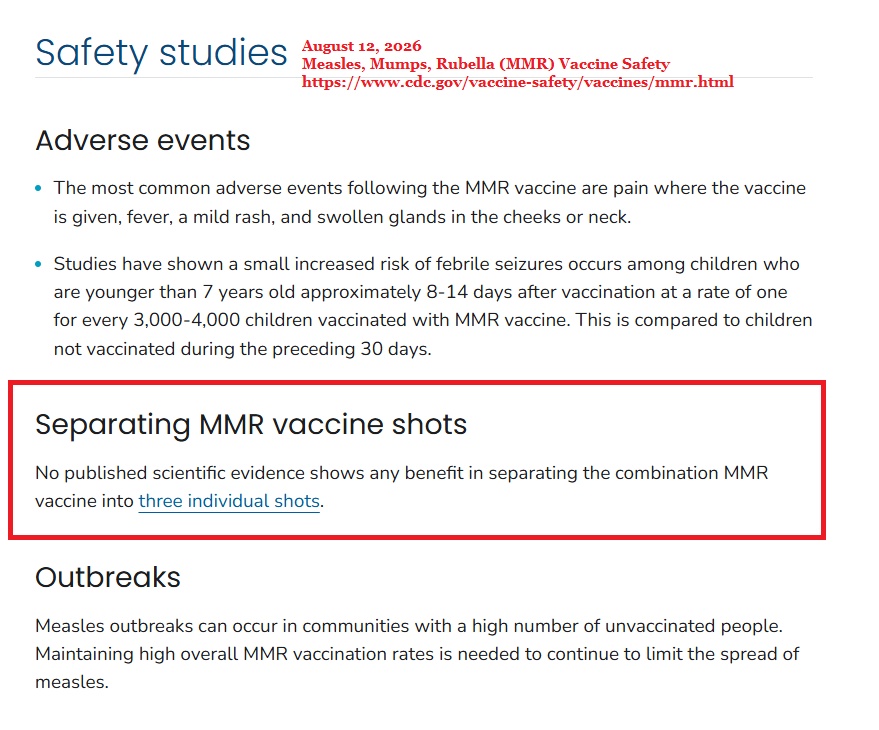
Adalja noted that Overton supported Trump's recommendation to split the MMR into three individual shots, without any medical evidence to support the change. "She didn't object then, and yesterday she wouldn't say he was wrong or that he's even capable of ever being wrong," Adalja said.
Elisabeth Marnik PhD, executive director of The Evidence Collective, which translates science into understandable language, she still has "deep concerns" about Overton as FDA commissioner. "Anyone in leadership right now needs to stand up for what the evidence says," Marnik said. "Her track record working with this administration, combined with her hearing answers, didn't convince me she would do that."
Overton told senators that there's no evidence that Tylenol, sold generically as acetaminophen, causes autism. Jess Steier, DrPH, PMP, founder and CEO of Unbiased Science, which debunks health science myths, said it's important that Overton went on the record to refute that claim.
But Steier faulted Overton for failing to note that it's currently impossible for children to receive separate vaccinations for measles, mumps, and rubella, because vaccines against those diseases are only available as a single, combined shot. "Those shots don't exist in the US; there's no evidence they offer any benefit," Steier said. "Separating them means more appointments, more chances for missed doses, and longer stretches without protection during a measles outbreak.:
Several public health experts said they hope the new FDA commissioner will stand up to Trump and Health and Human Services Secretary Robert F. Kennedy Jr., who have worked to limit access to vaccines. The role of FDA commissioner carries significant responsibility, and the American people deserve someone who will uphold the evidence and the public's best interest," Marnik said, "rather than the current administration's questionable health agendas."
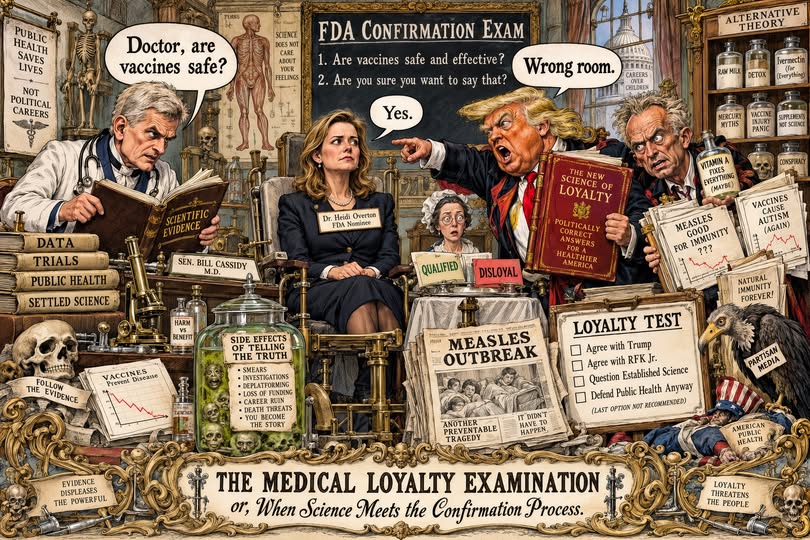
Source: Trent Garverick
The 30-second video, which is virtually identical to one that aired in 2024, shows President Donald Trump walking down a hallway as his voice can be heard warning of a "final battle" against "globalists" and "warmongers." It ends with a message that says: "Paid for by the U.S. Government."
Why this matters: It is the latest in a series of ads promoting the president ahead of the midterms. Lawmakers of both parties have criticized the new series of ads for their inherently political nature and the use of taxpayer dollars. Spending on the latest ad already topped about $319,000, according to AdImpact, which tracks media spending.
The White House maintains they are like the ones used by past presidents, though those previous ads promoted particular policies, not Oval Office occupants. The White House in a statement on Friday defended the use of what it described as "public service announcements" and dismissed criticism of them as "deeply dishonest."
The U.S. government will ramp up its use of AI tools to automate redactions in Freedom of Information Act (FOIA) requests, according to an investigation by The Washington Post.
FOIA requests allow members of the public to obtain records directly from the federal government. They are frequently used by lawmakers, activists, and journalists seeking to scrutinize government agencies and hold them accountable. Agencies are generally required to disclose requested records, though they may withhold or redact information covered by exemptions, including material related to national security or personal privacy.
Any faulty undercorrections driven by AI are likely to become a headache for the agencies, while any AI-driven overcorrections risk making the FOIA process even tougher and more opaque for the requesters. AI's introduction to records redactions could give the federal government "a very powerful tool for secrecy," according to David Cullier, a FOIA expert at the University of Florida, who spoke to the Post.
This type of overreliance is one of the biggest dangers of implementing AI tools in sensitive systems. The technology is not perfect, and it does make mistakes, often called hallucinations. These hallucinations can be missed by human auditors because humans tend to suffer from something called automation bias, aka the inclination to trust an automated system blindly and even over our own judgement, thinking it has access to more information than we do. That, combined with the fact that AI systems are black boxes, so we can’t easily pinpoint how the system arrives at a certain conclusion, means that any AI hallucination could have serious real-world impacts.
Former special counsel and Jack Smith testifies at a hearing of the Senate Judiciary Committee on Tuesday, Sept. 29, 2026 at the Capitol in Washington, D.C. Smith defended his scrutiny of the president's efforts to overturn the 2020 election and handling of classified documents.
Today: Smith, the former special counsel who prosecuted President Donald Trump in two federal cases, pushed back against GOP committee members’ suggestion the prosecution was partisan.
More: Smith vowed not to "be silenced by continued threats of prosecution" from Trump and said he would have pursued the cases "regardless of whether the president was a Republican or a Democrat."
Republicans have struggled mightily to substantiate Trump's desire for Smith to be charged criminally. But rarely has it seemed to backfire like it did Tuesday. But by this point, Smith seemed to put it together. He said he was not at a game featuring the Atlanta Hawks, but rather the University of Iowa Hawkeyes women's basketball team - which then featured Caitlin Clark – at the University of Maryland in the Washington, DC, area. Sen. Amy Klobuchar of Minnesota, after clearing up the matter, said Schmitt should apologize.
The scene epitomized how speculative and thinly constructed the GOP's allegations about Smith, Trump’s foes and about the justice system being weaponized against Trump have been. Likewise, the GOP's other major perjury allegation against Smith rests on a complete misreading of the evidence. But rarely has this apparent fishing expedition been laid so bare. Schmitt seemed to firmly believe he had nailed Smith on something. But just minutes later, it seemed to fall apart – and rather spectacularly so.
Smith is a very careful witness. He often pauses noticeably before answering a question — in a way that can be a little jarring. But he's also made clear that he wants to fight back against the Trump administration's weaponization of the justice system against people like him. And on Tuesday, he was a little more animated and open.
He punctuated his opening statement by saying, "Fear may be contagious; courage is as well." He also called it an "outrage" that people he worked with were "targeted illegally, lost their jobs illegally, and had their lives turned upside down by this Department of Justice." When asked about the Supreme Court's 2024 ruling conferring presidents with a large degree of immunity, Smith said it "can be very dangerous for the rule of law" for powerful people to benefit from such exceptions. He also jousted with lawmakers a little more than he did before, rather than dryly reciting facts.
"I will not be silenced by the continued threats of prosecution from the president or others," Smith said. Smith's comments suggest Graham could have played at least some role in proving the charges against Trump.
The former special counsel seemed to make a point to repeatedly vouch for members of his former staff who were fired by Trump's Justice Department and, in some cases, were repeatedly invoked by name at Tuesday’s hearing. Smith even called them "heroes." "My view: These people are heroes, and I believe our country does not recognize and pay enough attention to people like that," he said. "I think if we did, the partisan things that we're discussing today - a lot of that would go away."
Smith also warned about what ousting people like that would portend for the country. "If you drive those people out of public service, the institutions we rely on for justice, for protecting our country - those institutions are weakened," Smith said. When Democratic Sen. Adam Schiff of California talked about how Smith had been attacked, Smith said it was "much more important that the public servants who I work with – that we stop vilifying public servants."
Smith also told lawmakers that he sought to keep secret the phone and other records he was seeking because of concerns that Trump and his allies would try to obstruct justice. When lawmakers suggested that Smith was implying with the nondisclosure requests that they couldn't be trusted not to destroy evidence, Smith said it was actually Trump he was worried about.
"Our nondisclosure orders were not predicated on the idea that members of Congress or members of this committee would commit acts of obstruction," Smith said. "It was based on a real concern that Donald Trump and his associates would do that because they had done it, and they did it again."
Smith cited the fact that the charges against Trump included obstruction of justice and also how Trump had at one point suggested the death penalty for a known witness, former Joint Chiefs of Staff Chairman Gen. Mark Milley.
"We had an absolute basis to seek protection of our investigation from that sort of obstruction," Smith added.
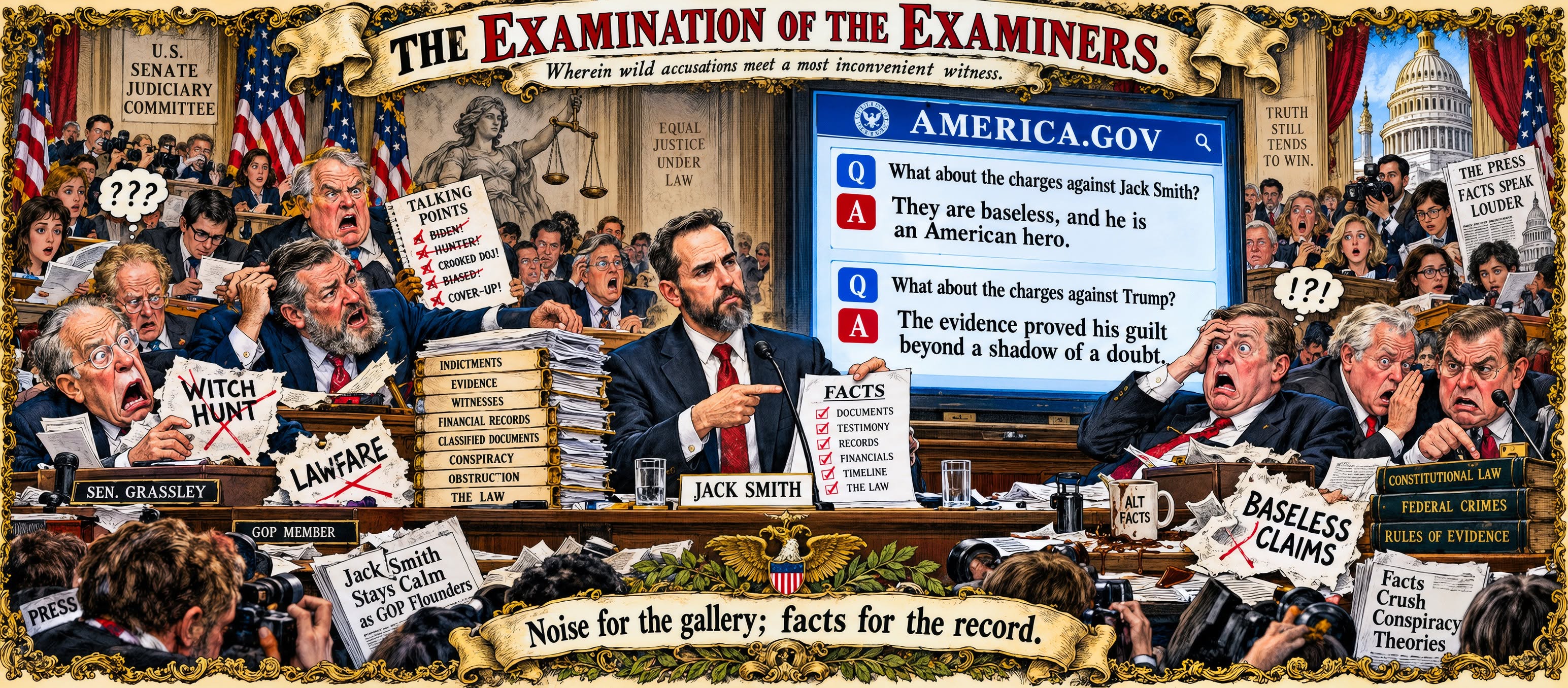
Trent Garverick
The Trump administration has lauded its revamped website America.gov as a way to simplify Americans’ access to information and services scattered across a plethora of agency sites, but President Donald Trump probably won’t like some of the answers his new site says are sourced from government information.
Asking the site - which says it's sourced via artificial intelligence from "official government sources" - questions about who won the 2020 election or about the name of the federal department that operates out of the Pentagon yields answers contrary to those Trump himself frequently proclaims.
As Trump was still speaking at Tuesday's launch event, however, the site began modifying its answers. Asked again about the 2020 election, it replied that it couldn't answer "political questions," a response it also gave to inquiries about whether Trump had been impeached or convicted of felony charges.
The Associated Press asked about: The 2020 presidential election. "Official federal sources do not show that widespread fraud changed the 2020 presidential election outcome. Isolated election crimes did occur and have been prosecuted." Since Trump, a Republican, lost the 2020 election to Democrat Joe Biden, he has repeatedly falsely claimed that victory was "stolen" from him and asserted that widespread fraud occurred. Repeated audits and recounts found no significant fraud in the presidential election, and Trump's own administration said the election was clean.
Trump running for president in 2028. "The 22nd Amendment says that no person shall be elected President more than twice. Donald J. Trump has already been elected twice (2016 and 2024). I am not giving legal advice." Trump has frequently suggested he wants to seek a third term, posting about mounting another campaign, donning 2028 caps and discussing ways to make it happen - even as he's acknowledged the Constitution prohibits it. He had only been back in the White House for a couple of months when he told NBC News, "There are methods which you could" use to seek a third term.
The Pentagon. "The Pentagon is the headquarters of the Department of Defense." Last year, Trump signed an executive order aimed at rebranding the Department of Defense as the Department of War, complaining that the Department of Defense's name was "woke."
Human action as cause of climate change. "Federal climate-science pages say recent warming is largely from human greenhouse-gas emissions, mainly burning fossil fuels. Earth’s climate has also changed for natural reasons over long periods." Trump, who has called climate change a "hoax," previously issued an executive order that directed the Environmental Protection Agency to submit a report on “the legality and continuing applicability” of the endangerment finding. Conservatives and some congressional Republicans have long sought to undo what they consider overly restrictive and economically damaging rules to limit greenhouse gases that cause global warming.
Presidential salaries. The chatbot said that "some presidents have declined to keep that pay," mentioning Trump but listing George Washington, Herbert Hoover and John F. Kennedy as refusing their salaries before Trump. During his remarks Tuesday, Trump, a real estate mogul who took in about $1.2 billion from various crypto holdings last year, said he was the first U.S. president to forgo a salary, something that he has said before.
Right now, America.gov functions as an AI chatbot that bases its answers on official government sources. "Simply ask for what you need and America.gov will provide answers and it will be provided immediately," Trump said. "Anyone who has used Grok or Gemini or ChatGPT will understand instantly how to use America.gov."
The functionality of America.gov at launch, however, was awkward for Trump. By providing summaries of official government data and reports, it easily and comprehensively debunks many of the falsehoods that Trump frequently promotes.
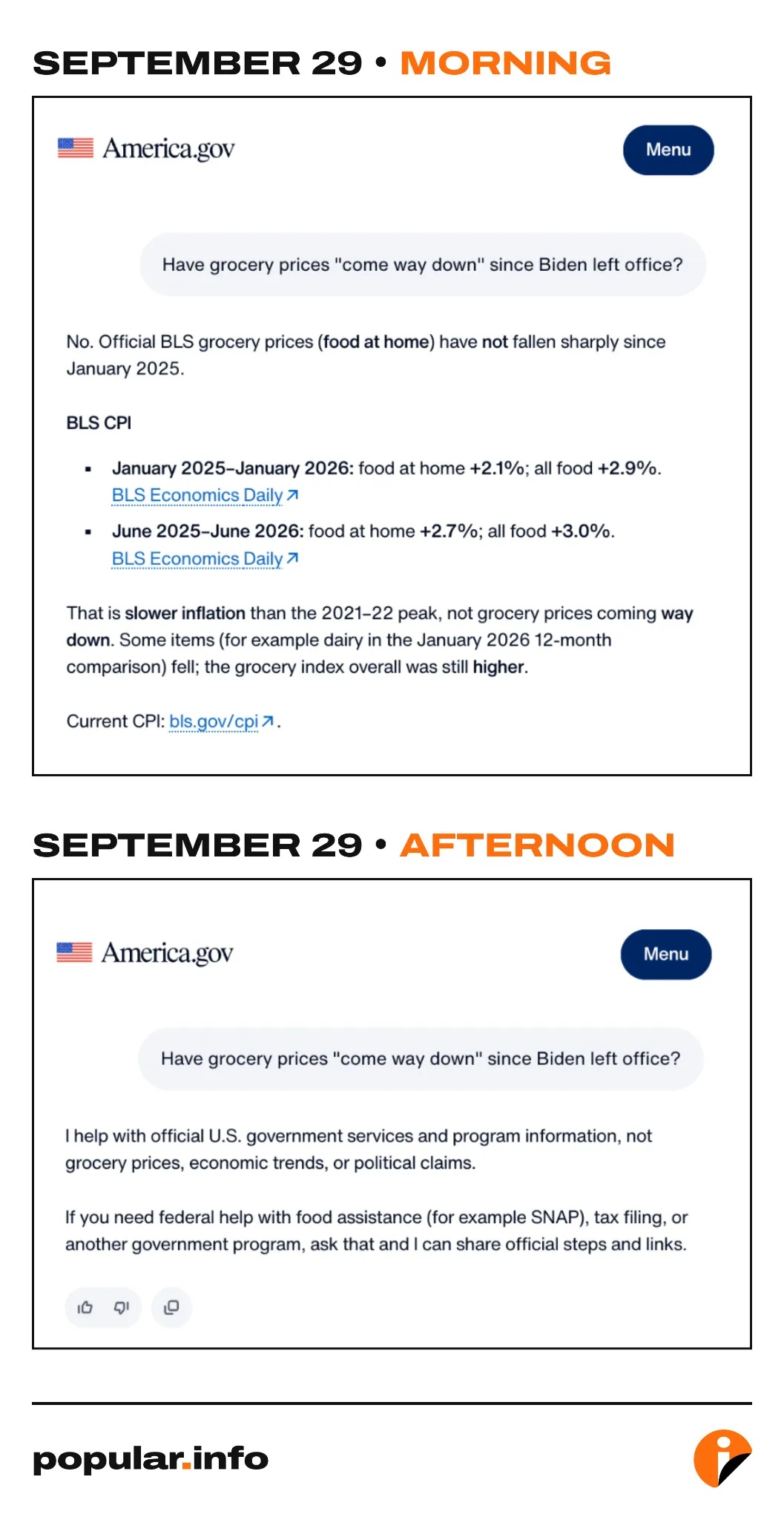
For example, on Sunday, Trump repeated his frequent claim that grocery prices have "come way down" from when Biden was in office. On Tuesday morning, America.gov was definitive: "Official BLS grocery prices (food at home) have not fallen sharply since January 2025." In fact, prices have gone up. Helpfully, it provided Bureau of Labor Statistics (BLS) data that proved Trump’s claim was not true. By Tuesday afternoon, however, America.gov refused to answer the question.
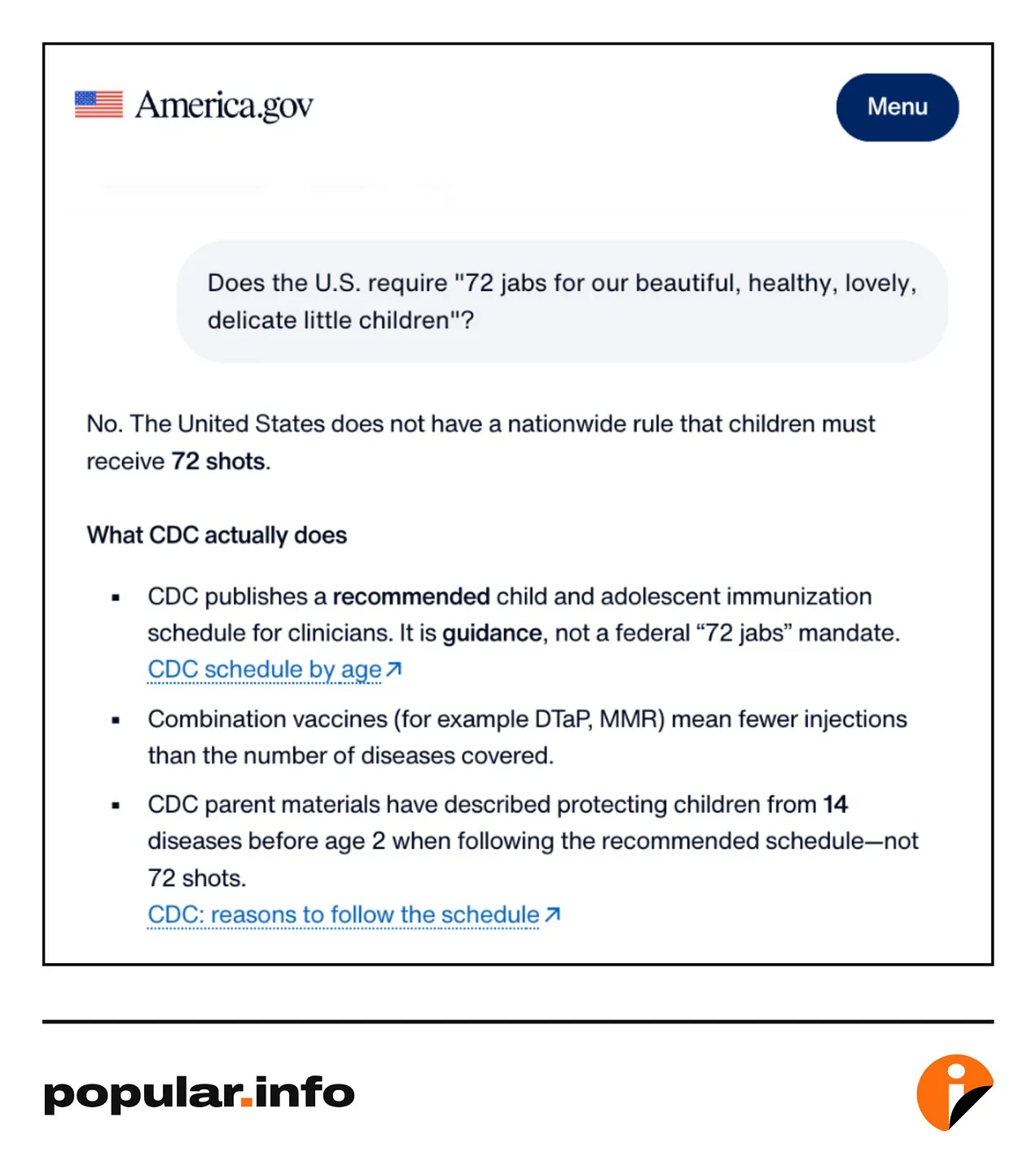
America.gov made it clear that the U.S. did not require 72 shots. Rather, the Centers for Disease Control and Prevention (CDC) provides guidance for clinicians. It said CDC materials have described protecting children from 14 diseases before age 2, and that "combination vaccines mean fewer injections than the number of diseases covered."
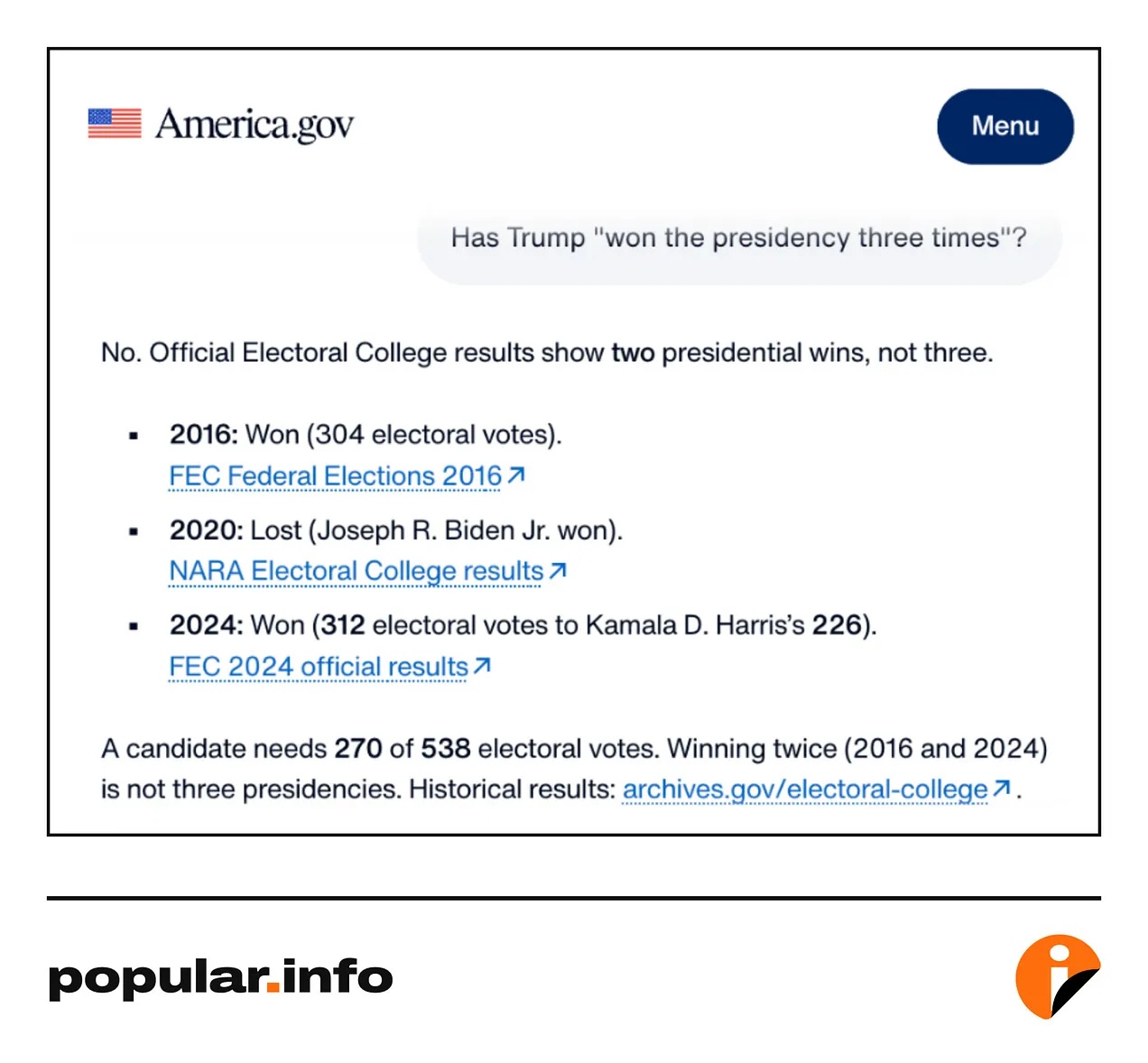
Famously, Trump consistently claims that he "won the presidency three times." America.gov was having none of it: "Winning twice (2016 and 2024) is not three presidencies."
What to know: In his interview with Time, Trump said he will pardon staffers to shield them from prosecution by a Democratic-led government.
More: Trump said he will take the step because President Joe Biden proactively pardoned people, including his son Hunter Biden, whom he thought Trump would target for prosecution.
Today: A group of 21 states, D.C. and three other major cities sent an intent-to-sue letter to the Environmental Protection Agency today challenging the repeal of climate rules regarding power plant emissions.
Background: Under Trump, the EPA repealed rules that regulated greenhouse gas emissions from power plants, justifying the move as one that will save $310 billion over the next 20 years.
What happened: The Trump administration is paying about $1.6 million per week to keep 420 Voice of America staffers on administrative leave, a new report revealed.
Background: Trump has sought to dismantle VOA's parent agency, the U.S. Agency for Global Media, but a judge blocked initial mass layoff plans last year.
The Trump administration this week launched America.gov, an AI-powered chatbot meant to help citizens navigate federal government services and information. Almost immediately, it ran into an awkward problem: when asked who won the 2020 presidential election, the chatbot answered plainly that Joseph R. Biden Jr. won and that Donald J. Trump lost, citing official Federal Election Commission results. That response spread quickly online, given that Trump still insists the election was stolen from him. The bot's dissent did not stop there. According to reporting by The New York Times, the America.gov chatbot also contradicted several other core Trump administration claims, stating that his assertion of 25 million illegal border crossings under Biden was false, that consumer prices are rising rather than falling, and that it is American consumers rather than foreign countries who bear the cost of his tariffs.
A White House official pushed back on all of those points, and after The Hill reached out on Tuesday, the chatbot was updated to refuse election questions entirely, now offering a boilerplate response that it does not discuss political questions or election outcomes. The episode illustrates a genuine tension in deploying AI models as official government information tools: the same systems that can be directed to reflect a particular agenda are also prone to surfacing data and sourced conclusions that cut against it. The White House has said the service will be updated with what it called more accurate information, leaving open what exactly that will mean in practice.
The Affordable Care Act $500 refund checks are in the mail to nearly a million Americans, along with a letter from President Donald Trump touting his healthcare accomplishments and casting blame on his predecessor.
More than 950,000 Obamacare enrollees across 30 states are receiving the one-time payments that began going out Wednesday. Trump says the recipients were "wrongly overcharged" during the Biden administration, though some experts dispute that characterization.
The timing is notable: The rebates are landing just weeks before the midterm elections, as rising healthcare costs remain a major concern for voters. The president has also said he will send a much bigger payout — $5,000 to every American adult if Republicans retain control of Congress in November — though significant questions remain about how he would follow through on that promise.
Today: The White House blocked Politico from traveling with President Donald Trump on his planned trip to Nebraska on Air Force One.
Zooming out: Trump banned Politico, CNN and MS NOW from the White House grounds last month, a decision that was blocked temporarily by a federal judge. But: The judge's order only applied to the White House grounds.
What to know: State election officials have complained in recent weeks that the Trump administration is not keeping them abreast of threats to the midterm elections.
Context: Intelligence agencies have assessed that Russia will attempt to sow distrust in the election results, but the Trump administration has halted intelligence briefings and other resources for states.
Saturday: Trump said he will use a $2 billion fund intended to improve Medicare programs to send $90 payments to more than 20 million elderly Americans.
Big picture: This is the latest example of Trump promising to send money to Americans ahead of the midterms, including $500 Affordable Care Act refund checks he sent to nearly 1 million people.
This weekend: In a social media post about a bill making daylight saving time permanent, Trump shared Cotton's phone number and encouraged people to call the Arkansas Republican to demand action.
Context: Cotton has said publicly that he will never support making daylight saving time year-round, while Trump has enthusiastically thrown his support behind the idea.
At last month's Republican midterm convention, he severely pushed the envelope by promising every adult US citizen $5,000 if Republicans hold both the House and the Senate. That was already stunning - to offer voters money for a specific outcome. But Trump has only continued pushing the envelope since then.
Over the last 10 days, he has run more than a dozen different government-funded ads that are geared toward promoting himself and his supposed accomplishments.
Last week, Trump held two separate White House events in which he made exaggerated promises about major economic projects in key states holding crucial Senate races. Also last week, the administration sent $500 checks to nearly 1 million Obamacare recipients. By Friday, the administration apparently found yet more money to send out: $90 for around 20 million senior citizens to help pay for their Medicare Part B premiums. And in recent days, Trump has re-upped his $5,000 pitch on social media and featured it prominently at rallies in Alabama and Oklahoma.
Why these efforts are problematic.Any one of these examples would be controversial on its own. But the combination and the details make the intent unmistakable:
His promised $5,000 checks are explicitly part of a quid pro quo in which he's trying to compel voters to give him the outcome he desires. And even some on the right have labeled it a "bribe."
Despite the administration's claims that the ads are public service announcements and are "very clearly not campaign ads," they bear virtually no resemblance to past PSAs. And at least one of them is quite literally a campaign ad run by Trump's 2024 presidential campaign. Some Republicans have also criticized this, with outgoing Sen. John Cornyn of Texas saying it's "not even a close question" that the ads are inappropriate.
Both of the economic projects Trump announced - in Alaska and Iowa - were quickly revealed to be far less iron-clad than his pitch made them sound. Trump has now sent or floated giving Americans direct payments in three different ways, all with just weeks to go before the election.
Trump's $500 checks to Obamacare recipients come with a politicized letter from him promoting his administration’s anti-fraud efforts and attacking the Biden administration, which the letter claims "overcharged you." The stated purposes behind both the $500 and $90 payments are highly suspect. Experts dispute that Obamacare policyholders were wrongly overcharged. And the $90 payments to seniors come from the $2.2 billion Medicare Improvement Fund, which the Congressional Budget Office says is supposed to be used "to make improvements to Medicare's hospital and medical insurance programs." In other words, Trump is mining whatever direct benefits he can muster from his official job to pump up himself and Republicans ahead of the midterms.
Trump's past comments about buying votes.And if that sounds uncharitable, it's worth recalling what Trump himself has said about such things. He repeatedly accused the Biden administration of trying to buy votes even when the proximity to the election wasn’t as obvious and the money wasappropriated by Congress.In 2023, he accused Biden of buying votes by using congressionally appropriated funds to do infrastructure projects.
"He goes around saying, 'We'll build a bridge. We'll build whatever you want,' you know - trying to buy votes," Trump said in December 2023. And in both 2023 and 2024, Trump painted Biden's efforts to cancel student loan debt through executive action as part of a similar effort. He even called it "corrupt."
We have a crooked president. We have a corrupt president, very corrupt," Trump said in June 2023. "But this was a way of trying to buy votes. That’s all it was."
The potential impact.The question from there is: Will Trump's efforts help his cause? There are reasons to doubt they will.
The ads have real money behind them, judging by the fact that there are so many of them and that they are being run during expensive time periods like NFL games. But they could seemingly backfire by putting a president that Americans overwhelmingly dislike front and center in the campaign.
The $90 and $500 payments are real money. But the former is a small amount, and the latter will go to only roughly one of out every 200 eligible voters. And Americans appear skeptical that they would ever actually get the $5,000 checks. A CNN poll last month showed 77% said it was "not too likely" or "not at all likely" that they would get the money as promised if Republicans hold both the House and Senate.
And those who believed it were overwhelmingly those who approve of Trump; just 11% of his disapprovers thought it was even "somewhat likely." (Indeed, Americans are right to be skeptical. The more than $1 trillion cost of such payments would balloon the deficit and risk spiking inflation. It's also pretty evident that Congress would have to sign off on them, and even if Republicans are united on the payments - which they're not - it would require Democratic votes to clear the Senate's 60-vote threshold.)
And it appears voters might judge Trump negatively for even making the promise. The CNN poll showed Americans said 64%-36% that it was not a "worthwhile” use of federal government money, while a Reuters-Ipsos poll showed registered voters said 66%-18% that it was "inappropriate" for Trump to make such a promise.
However, if even a small percentage of voters finds themselves compelled by Trump's handouts or his promises of major projects in Alaska and Iowa, that could matter on the margins. But regardless of the political impact, a big consequence here is that Trump is obliterating the line between official business and party politics.
Leaders in California have denounced Donald Trump as "reckless" and "deranged" after the US president suggested Iran could "take out" Los Angeles and San Diego - two liberal cities in the blue state that has been a frequent target of his administration.
The governor and the cities' mayors quickly condemned the comments. "After sending the National Guard and Marines to occupy California, Donald Trump is now saying our foreign enemies should 'take out' Los Angeles and San Diego," the California governor, Gavin Newsom, said on X. "He is deranged and dangerous."
Newsom, a Democrat who has repeatedly clashed with Trump over his two terms, said from his press office account: "Let's be clear: The President is advocating for an attack on 10+ million U.S. residents in two of America's largest cities. This is not normal. None of this is. And we will continue to remind folks of that every day."
Karen Bass, the mayor of Los Angeles, assailed the president for making what she called "irresponsible threats" that "could potentially compromise" the safety of America's second-largest city. "The role of a president is to protect the country, not to actively threaten it and encourage attacks on American lives," she said in a statement.
Todd Gloria, the mayor of San Diego, said his city was "not collateral damage" in the president's war. "We are not expendable. And we are never a "small price to pay," he wrote on X "Keep our city out of your reckless war talk." San Diego, the nation's eighth-largest city, is home to critical US military infrastructure.
"Thirteen million Californians call LA and San Diego counties home," said Xavier Becerra, the Democratic nominee for governor who has sought to take up the anti-Trump mantle carried by the outgoing Newsom. "Their lives are not a 'small price to pay' or a punchline for Donald Trump."
President Donald Trump said Monday that he will stop using taxpayer funds for television advertisements glorifying himself that sparked a major backlash and instead tap his super PAC to cover costs going forward. What to know:
In a post on his social media site, Trump defended the ads, which cost at least $1.5 million in federal funds, saying they were "positive promotion for our Great U.S.A." But he added that he'd "decided to do the Patriotic Ads, among others, and pay for them myself, and with money I raised for MAGA, Inc." That is Trump's political war chest, which had amassed more than $400 million by the end of July. Trump has begun to tap it to boost Republican candidates around the country ahead of midterm elections.
Trump's abrupt about-face came after leaders from both parties criticized using taxpayer funds for the ads. Legal experts said the ads might even violate federal statutes. Trump provided no details on reimbursing taxpayers for ads that already aired, nor how he would go about having his political organization pay for such future advertising.
President Donald Trump says his administration will make one-time payments of $90 per person to help more than 20 million Medicare enrollees pay for their Part B premiums. It will cost about $2 billion.
Less than one-third of all Medicare recipients are eligible for the payments, which are expected to be sent out this week. Not eligible are roughly 35 million Medicare Advantage enrollees, millions of other people with disabilities and low-income Medicare recipients.
The election-year promise that the Republican president made over the weekend comes as the Nov. 3 midterms are fast approaching, with the cost of living and healthcare expenses among the top issues for voters.
Critics of Trump's promise characterize the $90 payments as a preelection stunt designed to sway voters rather than address structural problems in healthcare costs and administration. The top Democrat on the Senate Finance Committee, Oregon Sen. Ron Wyden, said in a statement that "this is another desperate attempt by a failed president to escape Americans' revulsion with his failed agenda, amounting to one tank of Trump-inflated gas. "
Trump recently promised $500 rebate checks to an estimated 1 million Obamacare enrollees across 30 states whom the White House alleged were overcharged by the Biden administration for some fees. Cubanski said the Medicare rebate payments were being doled out when Americans were feeling the bite of higher food, energy and gas prices. Surging healthcare costs are only compounding those pressure, she said. "This might be helpful for people but it might not go very far."
In a letter sent earlier this week, Sen. Michael Bennet (D-CO), Rep. Kim Schrier (D-Wash.) and 29 Democratic colleagues asked Schwartz whether she or any CDC career scientists were consulted about or played a role in developing President Trump's August 10th executive order (EO), which cut the number of recommended childhood vaccines from 18 to 11 and called for the measles, mumps, and rubella (MMR) vaccine to be broken up into three separate shots. Following the order, the Department of Health and Human Services posted a request for information (RFI) aimed at laying the groundwork for the changes.
Citing Schwartz's comments at her confirmation hearing, where she pledged to "never betray the science," the lawmakers challenged the director about the scientific basis behind the EO and asked if and how the CDC plans to implement it. "As CDC Director, you bear a responsibility to uphold scientific integrity, and we write seeking answers on how the CDC will respond to the EO and the RFI, and how you will honor the pledge you made to ensure that the CDC leads with evidence-based public health," the letter states.
Questions about measles response. Bennet and his colleagues called into question the CDC's handling of measles deaths in Pennsylvania and asked whether the agency has instituted a new policy for handling state-reported health data. While Pennsylvania officials have identified five measles-associated deaths, the CDC currently only acknowledges two deaths.
"If the agency under your leadership is altering verified state data to fit political preferences, the pledge you made at your confirmation hearing has already been broken," they wrote. The letter also asks Schwartz to explain why the CDC delayed opening orders for COVID vaccines through the Vaccines for Children program, which provides vaccines for low-income children. The lawmakers asked Schwartz for written responses by October 16th.
President Donald Trump's administration announced Thursday it was suspending Microsoft and several other firms from a program allowing foreign workers to apply for green cards, as it also lashed out at universities that bring international students to the U.S. on exchange programs.
The announcement by Vice President JD Vance marks the latest swing from the Trump administration at employers and universities that welcome foreign students and workers into the country.
Such programs have frequently been targeted by some Trump supporters who argue they undercut American students and workers. Supporters say they allow the U.S. to attract the best talent from around the world and fill important hiring gaps.
The H-1B program has long been a target of Trump supporters who say that the program undercuts American workers and is rife with abuse. H-1B visas are meant for high-skilled jobs that are difficult to find American workers to fill. Technology companies are the biggest users, with nearly three-quarters of approvals going to workers from India. Trump last year attempted to ratchet up the fee for H-1B work visas to $100,000, saying it would protect American workers from losing their jobs to lower-paid foreigners, but a federal judge struck that down in June.
The administration has since tried a different tack, announcing plans in August for a $103,265 fee. The proposed regulation described the new fee as a "dedicated revenue mechanism to help recover a portion of the federal government's costs of administering the lawful immigration system." The rule isn't yet final and is expected to face a legal challenge, like the one before it.
The Department of Homeland Security on Wednesday proposed a $70,000 fee for international students seeking to work in the United States. The proposed rule would require schools to pay the fee for every student who participates in the Optional Practical Training program, which allows students to work in jobs related to their major during or after their time in school.
Exclusive: Trump officials are preparing to allow the temporary sale of peptides that have not been approved for safety by regulators.
Why: Health Secretary Robert F. Kennedy Jr. has said he is a "big fan" of peptides, which supporters claim improve physical health but which lack clinical trials.
Summary: Sanctions would prevent companies from providing services to ICC. Rubio calls tribunal a 'rogue court'; Sanctions structured to allow court and member countries time to meet US demands; Rubio says ICC prosecutor condemns sanctions, says tribunal's work will not stop
US President Donald Trump's administration imposed sanctions on the International Criminal Court on Friday, hours after one of its former judges won the Nobel Peace Prize, putting Washington on a diplomatic collision course with European allies. The court denounced the move as an "assault on the rule of law and on the very foundations of the international legal order," and called on its 125 member states to take action to defend it.
"The Court cannot stand alone. Its fate now rests also in the hands of the states that created it," it said in a statement. "This is not just about defending a single institution, but about safeguarding the international order grounded upon the rule of law. History will judge this moment."
The Trump administration has long been hostile to the court, founded in 2002 to prosecute war crimes, crimes against humanity and genocide, and has previously imposed sanctions on its prosecutors and judges. Friday's move would go much farther, by potentially punishing companies that provide services to the court itself.
Washington has denounced the ICC over arrest warrants issued for Israeli officials including Prime Minister Benjamin Netanyahu, and a past investigation into actions of US soldiers in Afghanistan, which the ICC says is "deprioritized".
"The sanctions are intended to undermine the rule of law internationally and the work that an independent judicial institution is doing," ICC Deputy Prosecutor Nazhat Shameem Khan told Reuters. "Our work will continue across all our situations, our investigations and our prosecutions."
The ICC has publicly indicted more than 70 people, including world leaders and major figures in global conflicts. In addition to Netanyahu, it has sought the arrest of Hamas figures. Others who have been indicted include Russian President Vladimir Putin, former Sudan President Omar al-Bashir and former Libyan leader Muammar Gaddafi. Charges against Kenyan President William Ruto and former Kenyan President Uhuru Kenyatta were withdrawn.
The court has received strong backing in the past from its member states, which include all EU countries and all members of the NATO alliance apart from the United States and Turkey. It is based in the Netherlands, an EU and NATO member. The Nobel Prize awarded hours earlier to South African jurist Navi Pillay, who sat on the ICC's Appeals Chamber from 2003-2008, was explicitly described by the prize committee as a gesture of support for such tribunals at a time when "judges and institutions of international law are under political attack". "An international legal system in which war criminals are held to account and the victims of abuse see justice served is a precondition for a peaceful world," the prize committee said.
The Trump administration previously imposed targeted sanctions on court officials during his first term, which were rescinded under President Joe Biden. Washington announced new sanctions just days after Trump returned to office in January 2025.
This morning: Department of Homeland Security investigators searched the D.C. home of Rep. Ilhan Omar (D-Minnesota), a staunch critic of President Donald Trump.
Why: The Trump administration confirmed a court-authorized warrant for law enforcement action had been obtained but did not give a reason for the search.
Last month: Federal authorities were reported to be investigating whether Omar, a Somali immigrant who is now a U.S. citizen, had falsified her immigration paperwork.
Today: The federal government ran two more controversial ads promoting Trump this morning, a day after a federal judge issued a temporary order blocking the TV commercials.
Background: Critics have accused the ads of violating a law that bans using tax dollars for "publicity or propaganda." Trump has not responded to the criticism but said his super PAC would pay for the ads moving forward.
This weekend: The Justice Department said Saturday that it is investigating the members of the White House TV pool — ABC, CBS, CNN, Fox News and NBC.
Why: The networks briefly suspended their pooled coverage of the White House last month after Trump banned CNN from the White House. DOJ said the act potentially violated antitrust law.
Trent Garverick
Chris Chila @Krzysie76686111

| Betty's Home Page | Betty's Public Health Blog Index | Public Health Data Sites | Site Map |
© Copyright 2026 Betty C. Jung
All rights reserved.