https://www.bettycjung.net/FGC-2026b.htm

2026 U.S. Federal Government Changes (May - August)

|
 |
 |
 |
 |
 |
|

Custom Search
|
Custom Search
|
| 2025 Federal Government Changes | 2026 Federal Government Changes (January - April) | 2026 Federal Government Changes (May - August) | 2026 Federal Government Changes (September - December) |
|
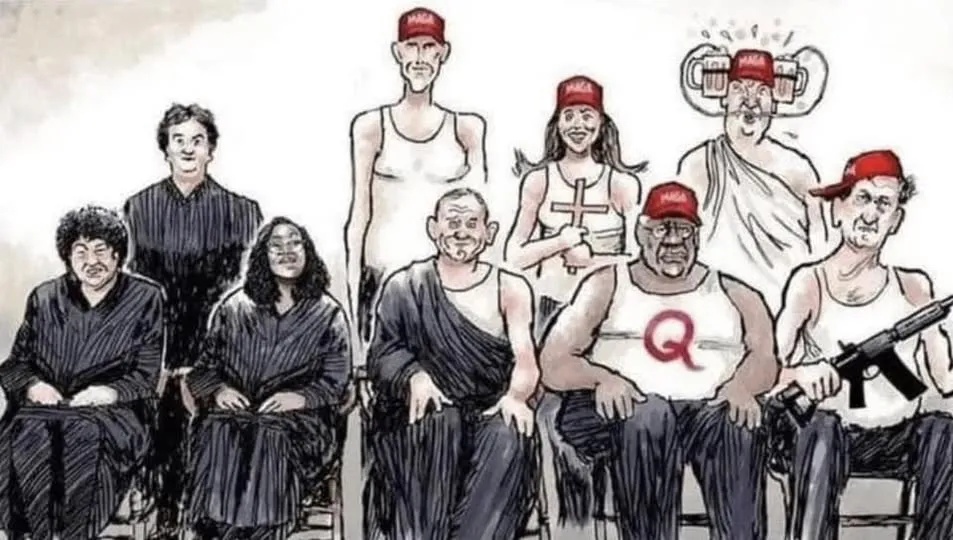
May Day in Seattle, May 1, 2026 Chief Justice Roberts fears that the SCOTUS is losing legitimacy. Wonder why? https://bsky.app/profile/666therealsatan666.bsky.social/post/3mkuyy42l7k2x May 2, 2026.
|
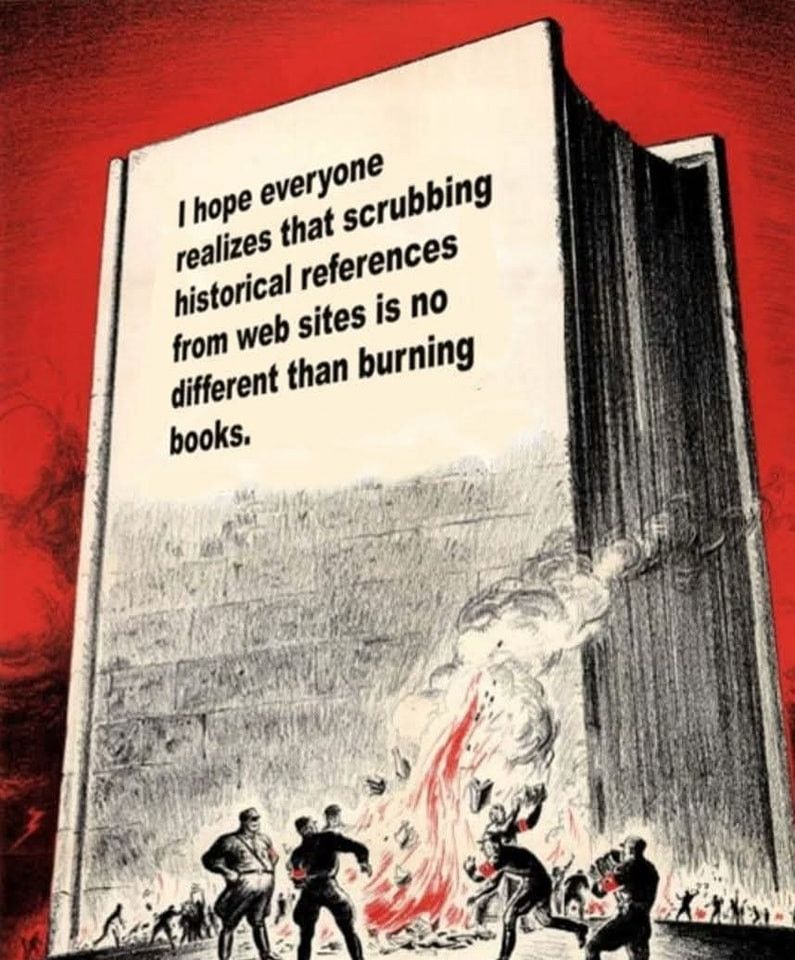
When Revision is Wrong
Historical Negationism: This involves denying the veracity of facts or manipulating data to promote a false narrative, often seen in the denial of genocides. Dishonesty and Distortion: Intentionally misrepresenting the historical record to fit a particular ideology or political agenda is a misuse of history. "Whitewashing": This occurs when negative aspects of history are minimized or ignored to make the past seem more palatable or to protect certain beliefs or groups, as noted in Quora. Lack of Integrity: When sources are misrepresented, evidence is ignored, or conclusions are predetermined to serve an agenda rather than the pursuit of truth, the historical process is corrupted. The Key Distinction
|
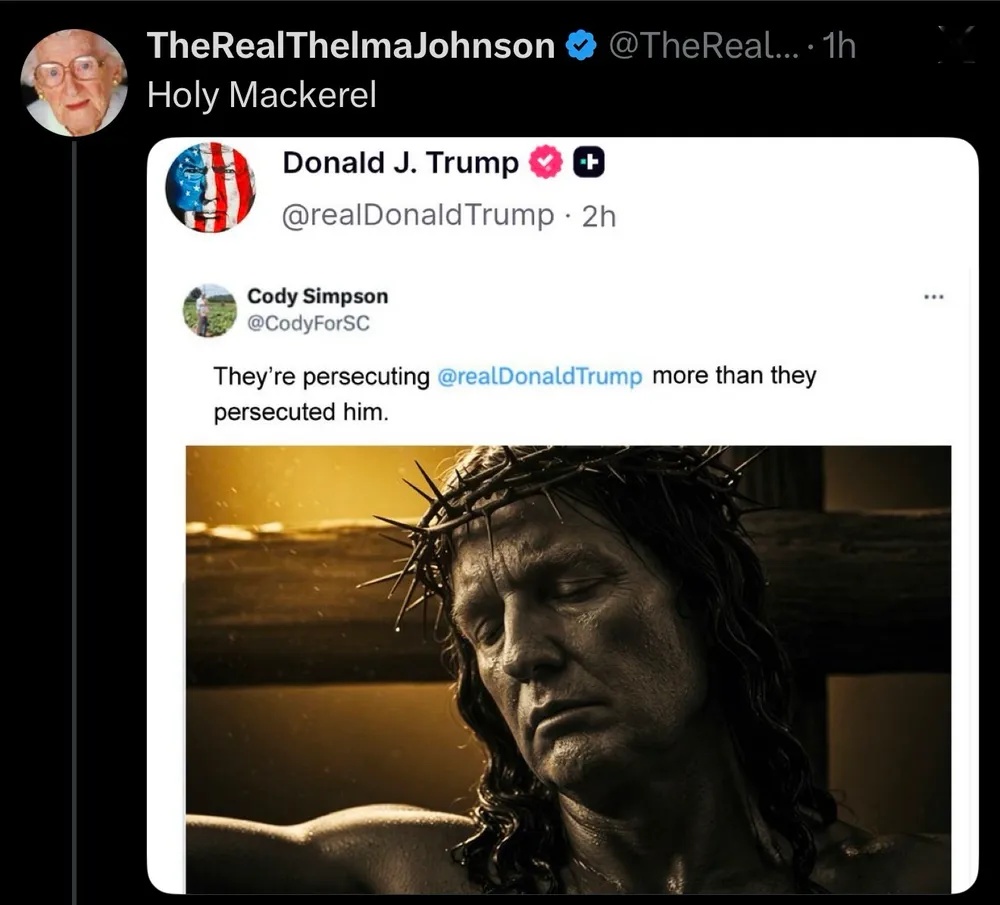
Not only is this in poor taste, it is sacrilegious. And, he calls himself a Christian? What a hypocrite. https://bsky.app/profile/bettycjung.bsky.social/post/3mkv6irdxuk2u
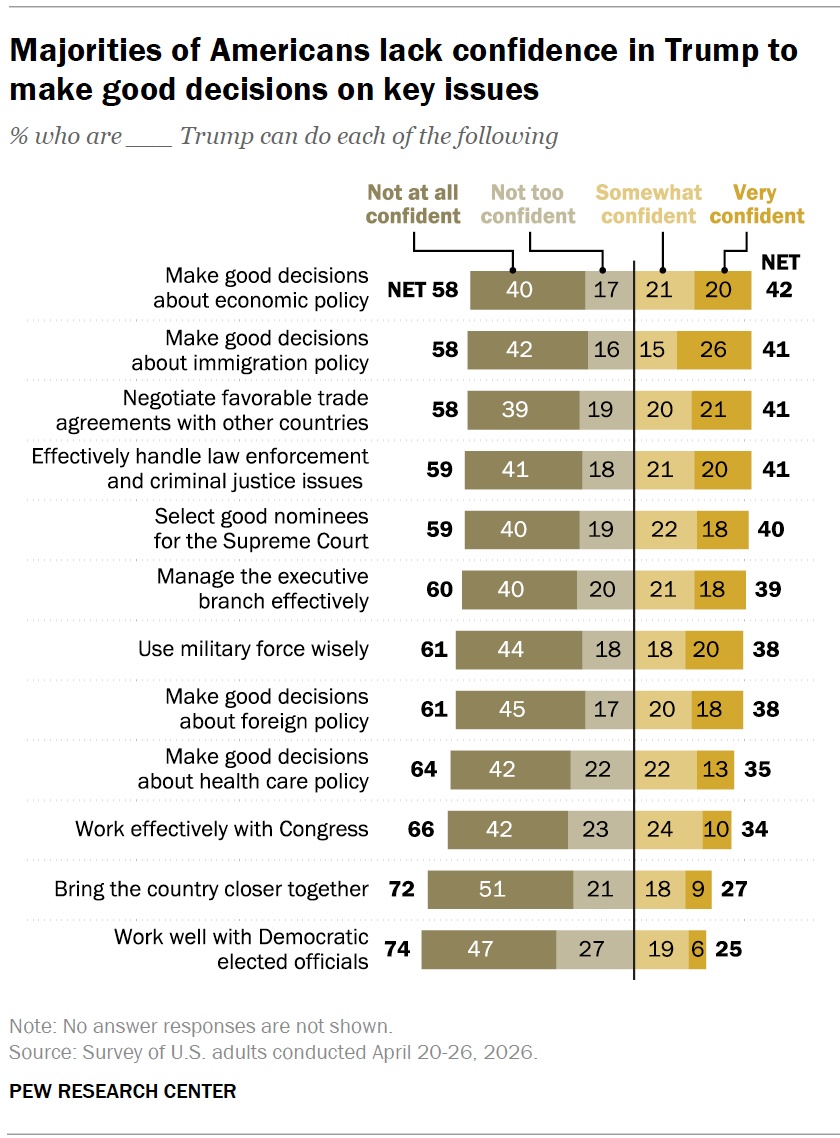
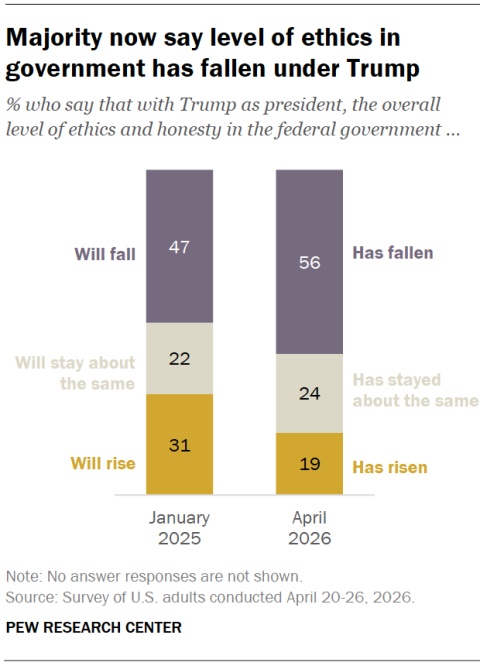
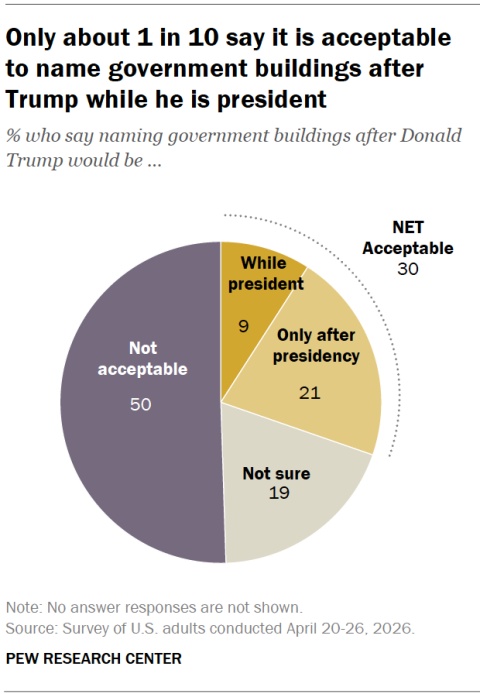
@FurkanGozukara 4/30/26. Absolute insanity. Donald Trump admits he judges the Chairman of the Federal Reserve not on economic policy or interest rates, but because the Fed didn't give Trump's real estate company a massive building renovation contract! The corruption is completely out in the open.
Conspiracy theories have been central to Donald Trump's political rise. He was a leading promoter of the "birther" conspiracy theory targeting then-President Barack Obama, embraced outlandish theories about a "deep state" in the government and still pushes false claims that the 2020 election was stolen from him.
But conspiracy theories, and the people who support them, are unpredictable and hard to control. Now, Trump is increasingly the subject of conspiracy theories on both the left and the right, with many of his onetime supporters viewing him with growing skepticism.
The U.S. is withdrawing approximately 5,000 troops from Germany, Pentagon officials said, after President Donald Trump was angered by criticism from the German chancellor over the war with Iran. Speaking to students in Germany this week, Chancellor Friedrich Merz said the U.S. has "no strategy" and was being humiliated by Iran's leadership.
A federal appeals court granted the state of Louisiana's request to reinstate a nationwide requirement that abortion pills be dispensed in person. The ruling limits access by blocking people's ability to obtain mifepristone - one of the two pills used in medication abortions - through telehealth and by mail. Telehealth prescriptions have been key to maintaining abortion access in states that outlawed or restricted the practice after the Supreme Court overturned Roe v. Wade in 2022.
The numbers: A Washington Post-ABC News-Ipsos poll found that 61% of Americans believe it was a mistake to use military force against Iran.
Comparison: It wasn't until three years into the Iraq War that Americans reached a similar level of disapproval (59%).
And: Gallup found that 61% of Americans disapproved of the Vietnam War in 1971, after more than 50,000 U.S. troops died over years of fighting.
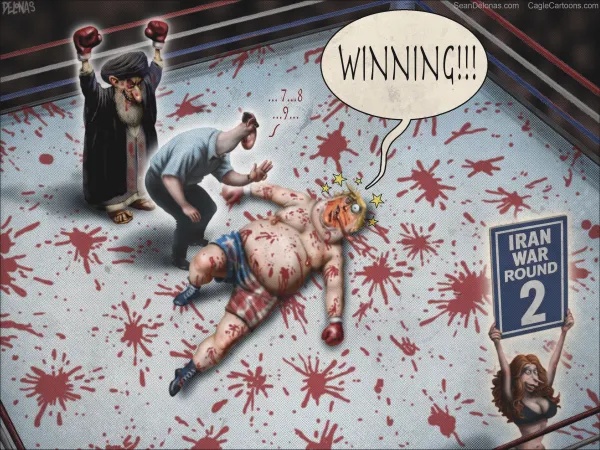
What to know: Today marks 60 days since the start of U.S. strikes against Iran. The president is required to seek congressional authorization for any military conflict past 60 days.
But: President Donald Trump told Congress today that the conflict "terminated" with the April 7 ceasefire, which he told reporters he believes gives "additional time" before he must seek congressional authorization.
Exclusive: Construction crews expanding Trump's signature southern border wall ran machinery through a 1,000-year-old, 200-foot-long ground etching that looks like a fish.
More: The etching, known as an intaglio, is a significant cultural heritage site for Native Americans and lies inside the Cabeza Prieta National Wildlife Refuge.
Exclusive: The Centers for Medicare and Medicaid Services inadvertently included some health care providers' Social Security numbers in a public database.
More: A CMS spokesperson said that the problem was a result of some providers entering information "in the wrong places" and that steps were taken to "address it promptly."
Misinformation from top health officials in the Trump administration has created a "crisis of public trust" - and Congress should conduct oversight hearings and possibly impeach officials such as Robert F Kennedy Jr, the secretary of the US Department of Health and Human Services (HHS), according to a recently released report.
Experts say that officials in the past year have focused intently on both vaccines and autism, including efforts to connect autism to the use of acetaminophen (frequently sold as Tylenol) during pregnancy, despite growing evidence of no link, and replacing all members of the federal autism committee with advisers who have anti-vaccine and pseudoscientific histories.
Autism, HHS, and Public Health: Unpacking Robert F. Kennedy Jr.'s Year in Misinformation Autistic Self-Efficacy Network
The report includes a timeline of all HHS actions taken in the first year of the second Trump administration. Such changes have been "harmful to its mission" and "detrimental to the autistic community", such as widespread layoffs, reductions in force and terminations, cutting autism research by about $31m, and removing warnings about dangerous and unproven autism treatments from the website of the US Food and Drug Administration (FDA), said Zoe Gross, director of advocacy at ASAN.
Kennedy said in recent budget hearings that home health aides might be defrauding the government, because some caregivers were "getting paid to do things that they used to do as family members for free", Kennedy said. The assertion prompted "constant outrage" among disabled people and their loved ones, because paid family caregivers frequently can't work other jobs or support their family members without this assistance, Rosa said.
Last April, according to the report’s timeline, the administration made several high-profile moves, including issuing reduction-in-force notices and closing the office managing freedom of information requests, which diminished the capacity and transparency of health agencies.
Officials touted leucovorin, a B vitamin, as an autism treatment, and said that Tylenol use during pregnancy led to autism in a September announcement. Yet the FDA recently approved leucovorin only for a rare folate deficiency, not autism, and a growing body of research points to no link between autism and acetaminophen.
"We'd really like to see Congress hold RFK Jr and HHS broadly to account for everything they’ve done over this past year that has been so harmful to the autistic community and to public health generally, with oversight hearings," Gross said. "If, for example, RFK Jr is found in those hearings to have been derelict in his duty as secretary, then Congress should impeach him."
"Well, I wouldn't have to. I didn't say that," Trump responded. "I said that if we left right now, it would take them 20 years to rebuild. But we're not leaving right now. We’re gonna do it so nobody has to go back in two years or five years."
In reality, Trump did say - on camera - what the reporter told him he said. His denial was yet another case in which the president wrongly asserted he hadn’t said something he had said in a public forum.
It's one thing for the president to try to deny having made a remark someone claimed he made in a private meeting. For years, Trump has attempted something more brazen: denying he ever made remarks the public saw him make.
In December 2025, for example, when an ABC News reporter asked Trump on camera whether he would release the video of the US military's controversial follow-up strike on an alleged drug-trafficking boat in the Caribbean, Trump said, "I don't know what they have, but whatever they have we'd certainly release, no problem." But when another ABC News reporter reminded him five days later that he said he would have no problem releasing the video, Trump falsely claimed, "I didn’t say that. That's - you said that, I didn't say that. This is ABC fake news."
During his 2024 campaign, Trump falsely denied he had said “lock her up” about his 2016 election opponent, Hillary Clinton, though he had done so on multiple occasions at televised rallies attended by thousands of people. During the Covid-19 pandemic in 2020, he denied having made two remarks he had made on camera the previous week.
Trump has also tried to inaccurately portray the nature of some of his previous public remarks. In an interview with Time magazine in April 2025, he wrongly claimed he had "obviously" been speaking "in jest" and exaggerating when he promised during his 2024 campaign to immediately end the war in Ukraine if he was elected again - though he publicly made the promise on more than 50 occasions in an entirely serious manner.
The numbers: A Washington Post-ABC News-Ipsos poll conducted April 24-28 found that 62% of Americans disapprove of Trump's job as president.
More: Trump's handling of the cost of living (76%), inflation (72%) and the war with Iran (66%) received the highest levels of disapproval.
Officials at the Food and Drug Administration have blocked publication of several studies supporting the safety of widely used vaccines against Covid-19 and shingles in recent months, a spokesman for the Department of Health and Human Services confirmed. The studies, which cost millions of dollars in public funds, were conducted by scientists at the agency, who worked with data firms to analyze millions of patient records. They found serious side effects to be very rare.
In October, the scientists were directed to withdraw two Covid-19 vaccine studies that had been accepted for publication in medical journals. In February, top F.D.A. officials did not sign off on submitting abstracts about studies of Shingrix, a shingles vaccine, to a major drug safety conference. The withdrawal of the studies is the latest step by the administration to try to limit access to vaccines. It has sharply cut research funding for vaccine development, released unvetted information casting doubt on vaccines, and blocked other information supporting their safety, most recently a paper on Covid vaccine effectiveness by career scientists from the Centers for Disease Control and Prevention.
In February, top F.D.A. officials did not sign off on submitting abstracts about studies of Shingrix, a shingles vaccine, to a major drug safety conference. Last June, Kennedy's office asked career C.D.C. staff members to delete from the agency's website a 17-page summary supporting the safety of thimerosal, an additive largely removed from vaccines 25 years ago. Career scientists were later called into Health and Human Services legal offices and grilled about how the summary had been posted in the first place, they previously told The New York Times.
In posts on a website and on social media in August, Mr. Kennedy called for a prominent journal to "immediately retract" a large Danish study concluding that the vaccine additive aluminum salts was safe. Dr. Christine Laine, the editor in chief of the journal, Annals of Internal Medicine, said Mr. Kennedy did not directly contact the journal seeking a retraction. The study was not retracted.
In recent weeks, Dr. Jay Bhattacharya, who was serving as interim leader of the C.D.C., canceled the publication of a report concluding that the Covid vaccine sharply cut the odds of hospitalizations and emergency room visits last winter, saying the study had limitations.
Dr. Aaron S. Kesselheim, a Harvard University medical professor who studies F.D.A. regulation, said he had worked with the agency on a number of research papers and found its work to meet "the highest standards of scientific investigation." He suggested that the request to pull the papers was an act of "censorship." He added: "At any other time in history, this would be a major scandal that would lead to congressional hearings and resignations of leadership, and I hope that's what happens next."
The withdrawn F.D.A. studies examined the safety of the Covid vaccines used in 2023 and 2024. The agency's scientists worked with outside data firms that compile and analyze massive data sets under contracts that cost taxpayers millions of dollars each year. Both studies saw some light of day before they were pulled from publication. One, which examined the Covid vaccine in people older than 65, was posted on a preprint server, which is a repository for studies that have not yet undergone peer review. The study reviewed the records of about 7.5 million Medicare beneficiaries who got the vaccine. The researchers focused on the period of about 21 days after they got the vaccine and compared it to the next 20 days. They were looking to see if there were more health problems in the period right after vaccination.
The study looked at 14 health outcomes potentially caused by the vaccine, including heart attacks, strokes and Guillain-Barré syndrome, an autoimmune condition sometimes associated with vaccines. They only found a concern with one outcome, anaphylaxis, a severe allergic reaction affecting about 1 in a million people, from the Pfizer vaccine. "No other statistically significant elevations in risk were observed," the study said.
The study was withdrawn after it had been accepted by the peer reviewed journal Drug Safety, according to people familiar with the work. Michael Stacey, a spokesman for the journal, said it deems submissions to be confidential and would not comment on them. The Times obtained a copy of the Covid vaccine safety study of people who were 6 months to 64 years old. An abstract of the study appeared at one conference and remains online. Its withdrawal was first reported by STAT News. That study examined the records of 4.2 million Covid vaccine recipients and examined their later experience with 17 conditions, including swelling of the brain, major blood clots, stroke and heart attacks. The study found rare cases of fever-related seizures and myocarditis, or inflammation of the heart muscle, known to be associated with Covid vaccines. "Given the available evidence, F.D.A. continues to conclude the benefits of vaccination outweigh the risks," the study said.
Angela Rasmussen, an editor in chief of the journal Vaccine, said the paper had been withdrawn by the authors. Dr. Caleb Alexander, a drug safety and methodology expert at Johns Hopkins University, reviewed both studies at the request of The Times and said that "no study answers every question" but "there is nothing inherently problematic regarding these reports." "It's too bad that these haven't seen the full light of day," Dr. Alexander said in an email. "They provide useful information regarding the most commonly used COVID-19 vaccines."
Jeffrey Morris, director of the University of Pennsylvania biostatistics division, who also reviewed the study drafts at the request of The Times, said the studies were generally well done. "I think if there's any critique," he said, "it's that they don't do enough of these studies with the resources they have."
Dr. Jeanne Marrazzo, a former high-ranking National Institutes of Health official and chief executive of the Infectious Diseases Society of America, said that F.D.A. leaders withdrawing papers from publication is a "pretty active act of sabotage." "This black box of decision making around data suppression should be having people very alarmed and very worried," said Dr. Marrazzo. She filed a whistle-blower complaint against the N.I.H., was fired by Mr. Kennedy and has since sued the agency, claiming that she was ousted for objecting to its policies.
By contrast, Mr. Kennedy's team has had lower standards for releasing information critical of vaccines. A memo by Dr. Prasad, the former head of the F.D.A.'s vaccine division, drew widespread news coverage by claiming that the Covid vaccine had been linked to the deaths of 10 children, a conclusion the agency has not backed up or explained. In February, agency officials did not sign off in time for staff to submit abstracts on two studies of the Shingrix vaccine to a drug safety conference, according to two people familiar with the decision. A senior administration official said the studies were not moving forward at the agency.
One study found the efficacy to be in line with findings from the clinical trials done before agency approval. A safety study also aligned with what was known, finding an elevated but low risk for Guillain-Barré syndrome, an autoimmune disease already noted in the vaccine’s label.
Dr. Helen Chu, an infectious disease doctor who was among 17 scientists fired from an influential vaccine advisory body at the C.D.C. last summer, said large studies by health agencies are closely watched by doctors and professional societies. They are important, she said, because they can examine the effect of a vaccine on millions of people, far more than the thousands that were tracked in clinical trials. "You really do need these studies for us to truly be safe and to make sure that vaccines continue to be safe," she said. "These types of studies have to be done and the results have to be published."
What happened: The union yesterday accused Kennedy Center officials of violating its contract by laying off employees without first negotiating with the union.
And: The suit also claims the Kennedy Center is using a planned closure for renovations "as cover to permanently eliminate union jobs."
Background: Trump has taken particular interest in the Kennedy Center this term, overhauling its leadership and announcing a two-year closure for renovations amid falling ticket sales.
Donald Trump has issued another verbal attack against Pope Leo, accusing the pontiff of "endangering a lot of Catholics" because "he thinks it's fine for Iran to have a nuclear weapon". The remarks come two days before Marco Rubio, the US secretary of state, meets Leo at the Vatican in an effort to ease the tensions sparked by Trump's previous broadside against the Chicago-born pontiff over his condemnation of the US-Israeli war on Iran.
Speaking to Hugh Hewitt, a prominent conservative radio talkshow host on the US-based Salem News network, Trump said the pope "would rather talk about the fact that it's OK for Iran to have a nuclear weapon, and I don’t think that's very good".
"I think he's endangering a lot of Catholics and a lot of people," the president added. "But I guess if it's up to the pope, he thinks it's just fine for Iran to have a nuclear weapon."
Leo has never said that Iran should have nuclear weapons, but has repeatedly opposed the war on the country and the subsequent escalation of the conflict in Lebanon and the wider Middle East, calling for ceasefires and dialogue.
The numbers: A Washington Post-ABC News-Ipsos poll found 87% of Americans have a negative view of President Donald Trump's social media post appearing to depict himself as Jesus.
And: 69% also have a negative view of Defense Secretary Pete Hegseth praying for "overwhelming violence of action against those who deserve no mercy."
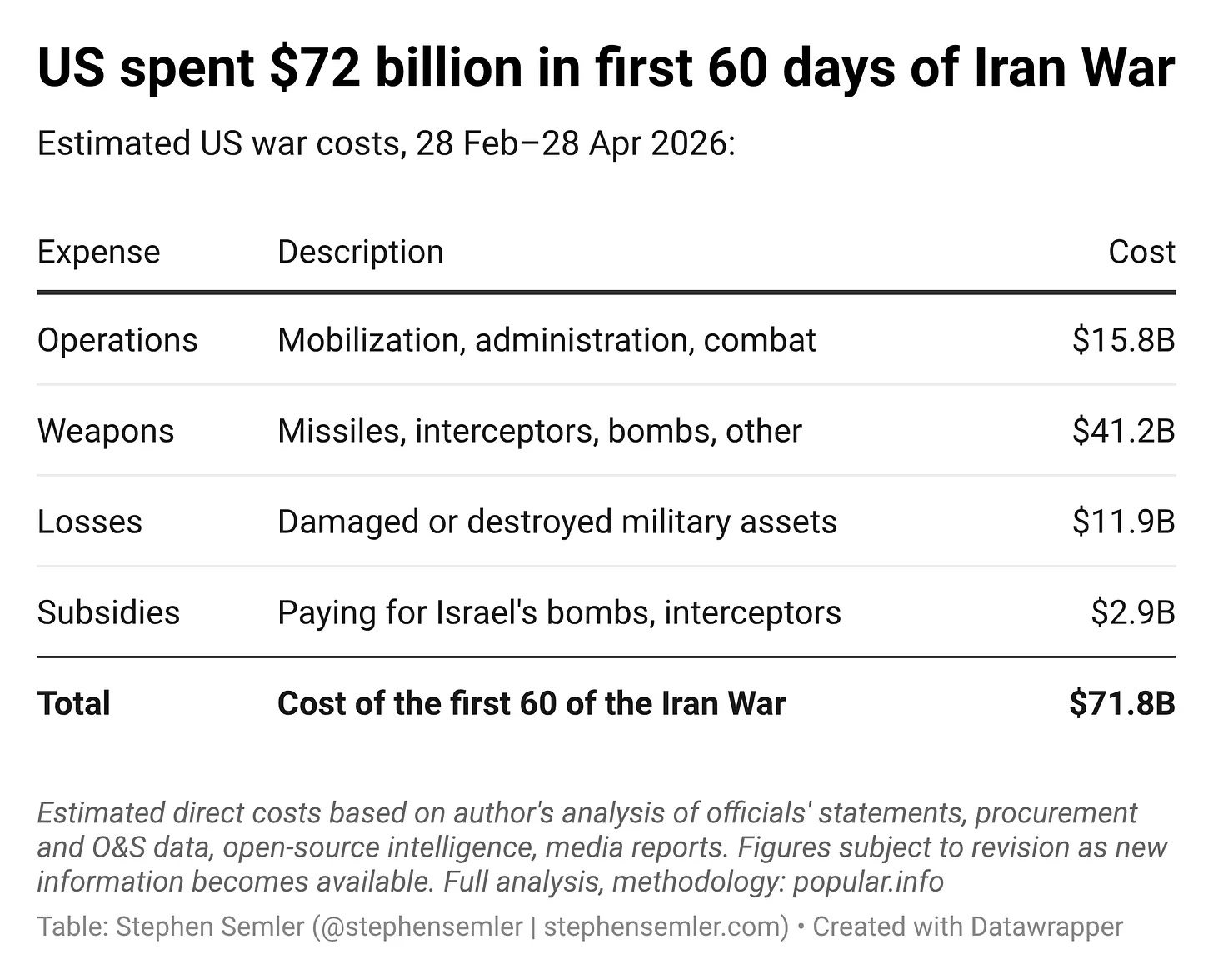
Exclusive: Iran has damaged or destroyed at least 228 U.S. military structures or pieces of equipment in the Middle East since Feb. 28, a Washington Post analysis of satellite imagery found.
Why it matters: The extent of Iran's damage to U.S. military assets since the start of the U.S.-Israeli war is far larger than the Pentagon has acknowledged.
New: The FEMA Review Council voted today to approve a report recommending the Federal Emergency Management Agency staff be cut by 50%, among other changes.
Background: Trump created the panel last year and tasked it with modernizing and streamlining the agency, which oversees federal emergency response and recovery.
Then-FDA Center for Biologics Evaluation and Research (CBER) Director Vinay Prasad forced FDA scientists to withdraw a paper that was undergoing peer review at Vaccine. This was among a number of unethical and deeply problematic actions being taken by Prasad and the FDA's triumvirate of malicious muppet podcasters power-tripping on literally having every Americans' access to lifesaving medication in their hands.
As Lawrence eventually reported, the paper concluded that the benefits of COVID-19 vaccination outweighed the risks for all people 6 months to 64 years old. Prasad blocked this manuscript because it showed that COVID vaccines are safe and everybody benefits from taking one.
Let me repeat that. The nation's top vaccine regulator forced FDA scientists to withdraw a study from peer review because it shows that COVID vaccines still work for everyone. I should add that this study was a routine study conducted as part of FDA's regulatory mandate to monitor vaccines as they are used in the real world. How well do they work? Did any major safety signals appear? Has anything changed with this update of the COVID boosters?
The FDA leads or contributes to many studies like this, in order to assess effectiveness in different populations with different risks. As an American taxpayer, I'm glad that my tax dollars go toward our national drug regulator staying on top of something as important as medicine to make sure it actually works and won't hurt us.
Christina Jewett/New York Times identified a similar study that was also pulled from the journal Drug Safety after it had been reviewed and accepted by the journal, under very similar circumstances to the study at Vaccine: at the direction of Vinay Prasad and his partners in unethical bad faith anti-vax regulatory shenanigans, FDA Commissioner Marty Makary and Acting Center for Drug Evaluation and Research Tracy Beth Høeg.
There were also two studies on Shingrix, the shingles vaccine, that were blocked from submission to a drug safety conference. It is becoming increasingly clear that FDA officials are actively interfering with established scientific processes to manipulate the evidence base. They are doing this to justify unsupported ideological policies at the expense of Americans’ health and well-being.
But this wasn't normal. There has never been a situation in our journal's history where the editors became aware that government scientists were forced by the nation's top vaccine regulatory official to withdraw a paper showing that COVID vaccines continue to work as they always have for the express purpose of stripping access to COVID vaccines for millions of Americans because of political demand.
Throughout the world, scientific, academic, and professional institutions have failed to meet the moment because they are unwilling to show moral leadership. They do not have the courage to say when something is wrong.
I think that FDA officials, who are supposed to be dedicated to serving the interests of the American people, should not commit scientific misconduct to justify ideologically-driven vaccine policies that will demonstrably harm or kill Americans. FDA officials should make regulatory decisions about drugs and vaccines based on what the evidence shows is most beneficial for the public, not for the FDA officials' political masters. This is naked, shameless corruption of processes put in place to protect people. I think this is morally wrong.
I think that if Vaccine is to be taken seriously as a leading specialty journal about vaccination, then we should make it clear that we will not quietly tolerate our journal being used by the FDA to contribute to morally and scientifically unacceptable vaccination policy. We cannot be complicit with corrupt regulatory officials attempting to prevent people from accessing vaccines for political reasons, because it is fundamentally wrong to do so. Telling Americans the truth about the science our most powerful vaccine regulator tried to suppress is the right thing to do.
Donald Trump has signed off on a plan to fire Marty Makary, the commissioner of the US Food and Drug Administration (FDA), the Wall Street Journal reported on Friday, after a series of high-profile agency decisions put the FDA head in the crosshairs of the White House and Republican lawmakers.
Makary's tenure at the FDA has been marked by several controversial decisions on drugs and vaccines amid plummeting staff morale over layoffs and the appointments of divisive officials. Recent political clashes include abortion, drugs and vaping, but decisions to pull back publications on the safety of shingles and Covid vaccines, among other immunization decisions, have also rocked public health. There have also been concerns about the transition from two clinical trials to one, the commissioner's new priority review vouchers and "data-free" regulatory decisions.
Trump "upbraided" Makary and made a series of calls over the weekend to pressure him into approving fruit-flavored vapes for the first time after Makary overrode agency scientists to halt the approval, according to the Wall Street Journal. The new flavours, reportedly part of Trump's plan to appeal to younger voters, were approved on Tuesday. The news release does not include any comments from Makary, which is unusual, and attributes moves like these to "President Trump's leadership".
Vaping is a divisive issue in public health, since it can be used as a smoking cessation aid but it also carries its own health risks. But the greater risk is political interference - or even the appearance of it = in regulatory decisions, experts say.
"Public trust is built up not over months, but over decades. On the other hand, you can destroy it in mere months," Peter Lurie said. "In a very short period of time, they have managed to undermine years of trust that the agency has built up with the public and industry because of their unpredictable practices and the general chaos."
There has been sharp backlash from the public to new restrictions on vaccines and how they are brought to market – and leaders are aware of the unpopular decisions, Lurie said. "Vaccines have really gotten their attention. They do understand that they've gone too far for the American people on vaccines."
"I think we're going to start seeing a big pattern of this," Rasmussen said of top-level interference with research publication. "It just seems like this is the tip of the iceberg, and the FDA is just a complete mess." The FDA may serve as a testing ground for leaders to override experts and staff since most people don’t pay attention to the inner workings of the FDA, Rasmussen said.
"They see what they can get away with administratively, and see what people notice," she said. While the FDA is "incredibly boring" to many members of the public, it's also "really powerful from a regulatory perspective", Rasmussen said. "So you could do something totally boring that nobody pays attention to and, boom, millions of people don’t have access to a drug or vaccine that they need."
The numbers: A NewsGuard survey found 24% of American adults believe the shooting at the White House correspondents' dinner last month was staged.
And: 24% believe the 2024 attempted assassination of Trump in Butler, Pennsylvania, was staged and 16% think the gunman found at a Trump golf course was fake.
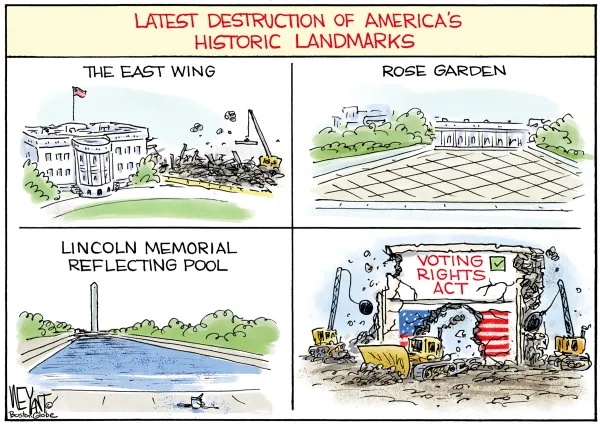
Today: The Cultural Landscape Foundation sued to stop the Trump administration from making changes to the Lincoln Memorial Reflecting Pool.
The changes: The Trump administration is working to resurface the pool to make its bottom "American Flag Blue."
Trump was ultimately sentenced to a non-punitive unconditional discharge 10 days before his inauguration in January 2025, which means the conviction remained on Trump's record, but he would pay no fines and serve no jail time.
And late Monday night, he unleashed a wild social media flurry that stood out even by his often-outlandish standards: posting and reposting more than 50 times in less than an hour. Those included long-debunked theories about Dominion voting machines deleting millions of votes in the 2020 election, posts about the decade-old Hillary Clinton email server controversy, a made-up claim about a GOP senator from a hoax website, unflattering AI images of prominent Democrats, three derogatory videos about Black people (including one captioned "Always scheming...") and two separate posts advocating for the arrest of former President Barack Obama.
It's the kind of behavior that undeniably prompts concern. But Trump, who turns 80 in June, has so far avoided a true reckoning about it. And that’s in large part because he’s spent more than a decade doing bizarre things in public, long before he was considered elderly.But there is increasing evidence that Americans are growing more concerned about his conduct.
The displays this week are hardly the only recent examples of Trump's odd behavior. Last month, Trump repeatedly claimed Iran had agreed to all of his demands, which to this day appears completely baseless. His rhetoric about the war has been consistently, remarkably detached from reality. At one point, he claimed his own vice president had departed on an airplane to Pakistan to negotiate an end to the war. Except JD Vance was still on terra firma (and ultimately didn't go).
Some former Trump allies even floated invoking the 25th Amendment to remove him from office after he threatened to destroy a "whole civilization" and commit apparent war crimes in Iran. And earlier this month, Trump had a series of public appearances where his speeches were meandering and often puzzling, including a particularly disjointed May 1 appearance in The Villages in Florida, where he cursed several times and yelled about a malfunctioning microphone.
Trump's incessant lies and other falsehoods - like on the Iran war - have also frequently been met with shrugs as he repeats them. After notching more than 30,000 false and misleading claims in his first term, Trump botching the facts isn't even news anymore.
But people can only suspend their disbelief for so long. When the flubs become more obvious and frequent, observers often start to wonder what's going on and whether age is playing a role. Plus, voters may have a harder time overlooking Trump's gaffes as he becomes less popular - as recent poll numbers show is happening. Indeed, in addition to his high disapproval ratings, the data is clear that Americans increasingly see Trump as, well, a bit off.
A recent poll from Reuters and Ipsos showed 61% of Americans and even 30% of Republicans said Trump had become "more erratic with age." Another showed Americans said 71%-26% that Trump is not "even-tempered" - wider than the 62%-37% split that the Pew Research Center showed after the 2024 election.
A Washington Post-ABC News-Ipsos poll last month showed 59% of Americans said Trump didn't have the mental sharpness required to serve as president - the highest such number to date and a full 16 points higher than in 2023. And the same poll showed 67% of Americans said Trump doesn't carefully consider important decisions. Even 30% of Republicans agreed with that statement.
Just think about what that's saying: A majority of people believe the leader of the country, who is entrusted with making life-and-death decisions, doesn't do so with care. That's a remarkably dim view of Trump as president. And it's one that not coincidentally has set in as Trump's popularity has hit an all-time low. It's not that people never noticed these things - they're just getting more difficult to ignore.
The Supreme Court ruled this evening that a widely used abortion medication could continue to be prescribed by telemedicine and sent to patients across the country by mail. The two most conservative justices, Clarence Thomas and Samuel Alito, dissented.
The court's order halted a lower-court ruling that would have made it much more difficult for women in states with abortion bans to access the medication, called mifepristone. That decision will now remain blocked, perhaps for months, while litigation continues in the lower courts.
With Dr. Makary's departure, the F.D.A. is leaderless. It's not alone: The Centers for Disease Control and Prevention hasn't had a permanent director in months (and the most recent one lasted only four weeks). There is no surgeon general. Over the past year and a half, many parts of the U.S. public health system have been dismantled. Staff members have been fired, seemingly haphazardly; funding for core data systems, logistics and community partnerships has been cut; research funding is moving at a glacial pace; and longstanding guidelines have changed on a dime.
But overall, we've witnessed the erosion of the agency's prestige and capacity - inconsistent standards, showy headlines at the expense of serious priorities, and immense confusion about what scientific evidence does and does not say. Under Dr. Makary's leadership, the agency refused to review a new flu vaccine (and then reversed course), introduced a program meant to speed up the approval process for rare-disease medications and then ran it in a way that opened it up to political interference and shared unsubstantiated hunches (such as linking Tylenol to autism). Along the way, the United States lost countless high-quality staff members of impeccable integrity whose work kept us all safe from diseases and from unsafe food and medicines.
The decisions at the top determine whether people get safe and effective treatments faster than they do today; whether the food, drugs and devices in our homes are demonstrably safer; and, most of all, whether we can trust what we're being told.
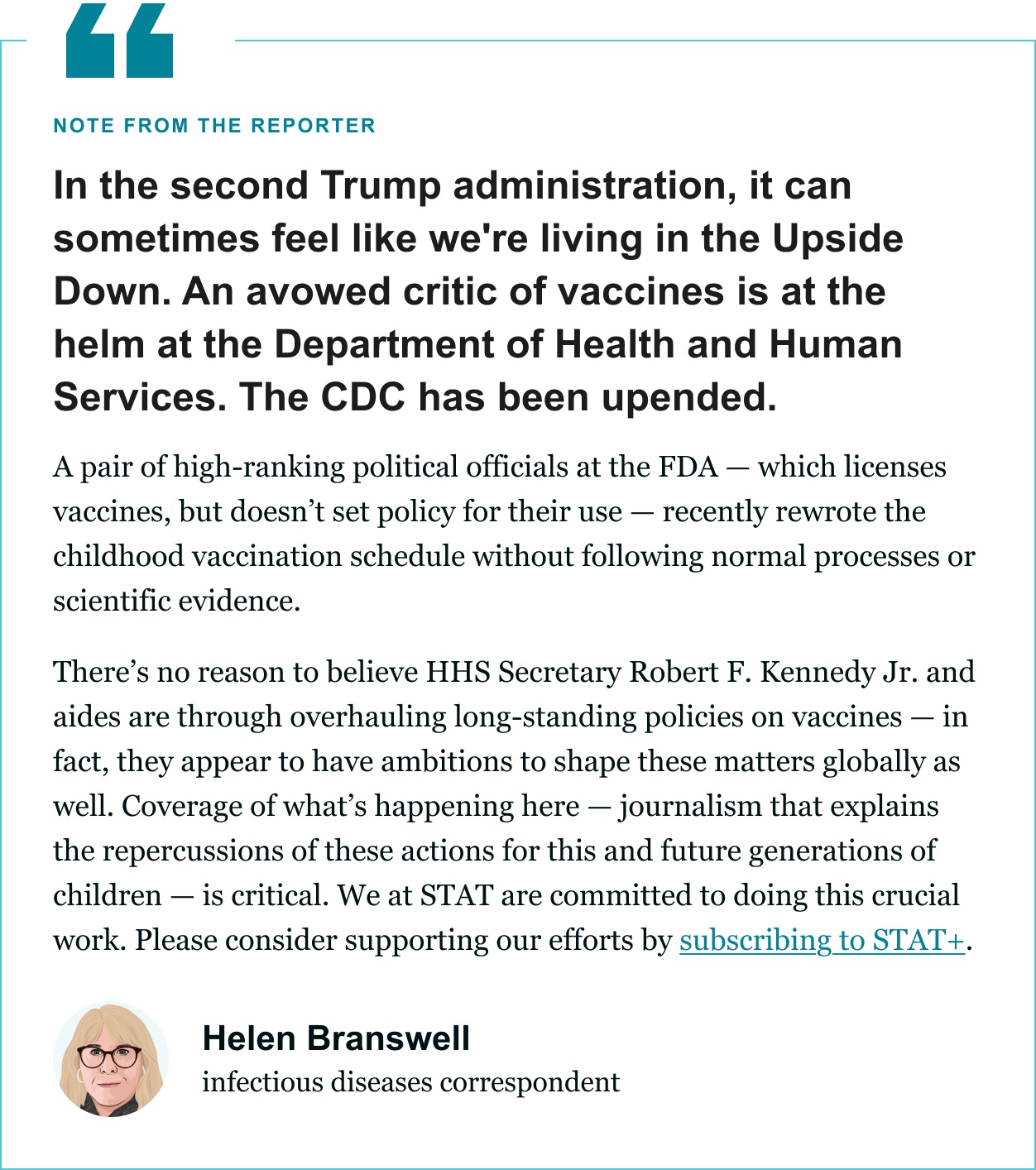
President Trump has for weeks downplayed the economic toll of his war with Iran, citing a bevy of inaccurate statistics. His remarks to reporters in recent days underscored his approach, as he asserted that the economic hardship Americans might face was not a factor in his negotiations to end the conflict. "I don't think about Americans' financial situation," he said. "I don't think about anybody. I think about one thing: We cannot let Iran have a nuclear weapon. That's all." Kush Desai, a White House spokesman, said the president had always been clearabout the war's temporary disruptions to the economy as inflation rises. "The administration remains laser-focused on cutting costs and accelerating growth on the home front," Mr. Desai said. "As these policies continue taking effect,and as traffic in the Strait of Hormuz normalizes after the Iranian nuclear threat is neutralized, both energy prices and inflation will drop again."
Here's a fact check. Trump Cites Inaccurate Data to Downplay Economic Toll of Iran War. False. Mr. Trump is exaggerating the rate of inflation under the Biden administration and understating the rate of inflation under his own administration. Inflation did reach the highest point in four decades - not in the "history of the country" - in the summer of 2022, at about 9 percent that June. But inflation reached higher points in the 1910s, 1970s and 1980s. Inflation had fallen to 3 percentin January 2025, when Mr. Trump took office.
In the three months before the United States attacked Iran on Feb. 28, inflation reached 2.7 percent in December, 2.4 percent in January and 2.4 percent inFebruary - not 1.7 percent, as Mr. Trump said. After the war began, inflation increased to 3.3 percent in March and again to 3.8 percent in April. Those figures are all higher than inflation at the end of the Biden administration.
This is misleading. Mr. Trump shared a chart that showed the price of oil at $120 a barrel under Mr. Biden and $90 under Mr. Trump, comparing the highest point of gas prices under the Biden administration with a recent low under his administration. The price of Brent crude, the global benchmark for oil, rose to $120 per barrel in June 2022, but had fallen to about $80 a barrel by January 2025, when Mr. Trump took office. The price continued to fall in Mr. Trump's first year back in office, before surging at the onset of the war in Iran.
False. Government and independent data sources show that the opposite is true.Gas prices have continued to climb. Gas prices rose to $4.56 a gallon on May 7, according to the AAA motor club, from $4.54 a day earlier. That was about 53 percent higher since the start of the war on Feb. 28, when the national average price of gas was $2.98. Gas prices averaged $4.45 per gallon in the week ending on May 4, according to the Energy Information Administration, a government statistical agency. That was about 52 percent than the $2.94 in the week ending on Feb. 23.
This is exaggerated. Mr. Trump has a point that a tiny amount of oil imported to the United States travels through the Strait of Hormuz. But he is wrong that the United States does not use the waterway at all. The Energy Information Administration estimated that in 2024, the year with the latest available data, the United States imported about 500,000 barrels of crude oil per day through the Strait of Hormuz, equal to about 7 percent of total crude oil and condensate imports and 2 percent of consumption.
The United States also relies on the strait to import and export other goods. The United States imports about 12 to 17 percent of several commonly usedmaterials for fertilizer (monoammonium phosphate, diammonium phosphate andurea). About 22 percent of aluminum imports and about 25 percent of helium imports also travel through the Strait of Hormuz. The Persian Gulf accounts for nearly 20 percent of all American exports of sauces and condiments, 20 percent of waterborne passenger cars and 15 percent of trucks, according to the Congressional Research Service.
Høeg is leaving her job three days after Makary resigned as FDA commissioner following a flood of news reports about internal tensions within the agency, including disagreements over a recent decision to approve flavored e-cigarettes. A source familiar with the matter told CBS News that Makary left due to the e-cigarette dispute, adding that the commissioner didn't want to approve flavored products but had been forced to do so by other members of the administration.
Høeg's appointment as the head of CDER had drawn controversy and sparked alarm among senior FDA officials due to her history of vaccine skepticism, CBS News previously reported. She helped write a memo last year linking several children's deaths to the COVID-19 vaccine, without providing data to back up the claim, and she was involved in a controversial effort to reduce the number of recommended childhood vaccines.
Summary: Pro-vaccine groups successfully lobbied Republican lawmakers to block anti-vaccine bills; Both sides expect more anti-vaccine bills in future legislative sessions; White House directed Kennedy to pause anti-vaccine actions before midterms.
The failures show a limit to the political power of the MAHA coalition groups that had set out this year to pass laws against mandatory vaccinations in at least 10 states, hoping to capitalize on a rise in anti-vaccine sentiment and their role in helping elect President Donald Trump.
Pro-vaccine groups and medical associations including American Families for Vaccines, the American Academy of Pediatrics and others lobbied in statehouses against bills seeking to end policies like school vaccine mandates, according to Reuters interviews with seven organizations. Vaccine advocates used polling data and personal appeals to convince lawmakers in Republican-controlled states such as West Virginia, Louisiana and Florida that their constituents support vaccination and that the MAHA-backed bills posed a threat to public health.
"Even though this is an increasingly partisan space, Republicans across the board are not anti-vaccine and there are lawmakers that really just want sensible, transparent vaccine policy," said Dr. Erin Abramsohn, executive director of the Infectious Disease Prevention Network, which fought anti-vaccine bills in 10 states this year. A February Reuters/Ipsos poll found that a bipartisan majority of Americans support school vaccination requirements and think vaccines are safe for children.
Kennedy, a long-time anti-vaccine activist, has used his post to advance several actions against mandatory inoculations including removing some shots from the childhood immunization schedule. While anti-vaccine bills have been proposed before, more emerged this year due to the coordinated efforts of MAHA groups, the groups told Reuters.To convince Republican lawmakers to oppose the bills, the pro-vaccine groups pointed to polling that showed constituents value vaccine mandates as a public health tool and said the elected officials could face political consequences if they supported anti-vaccine legislation."There's a lot of people running for office, so this could potentially hurt them... in future elections if they were to vote against public health," said Elizabeth Faber, director of programs at the Iowa Public Health Association.
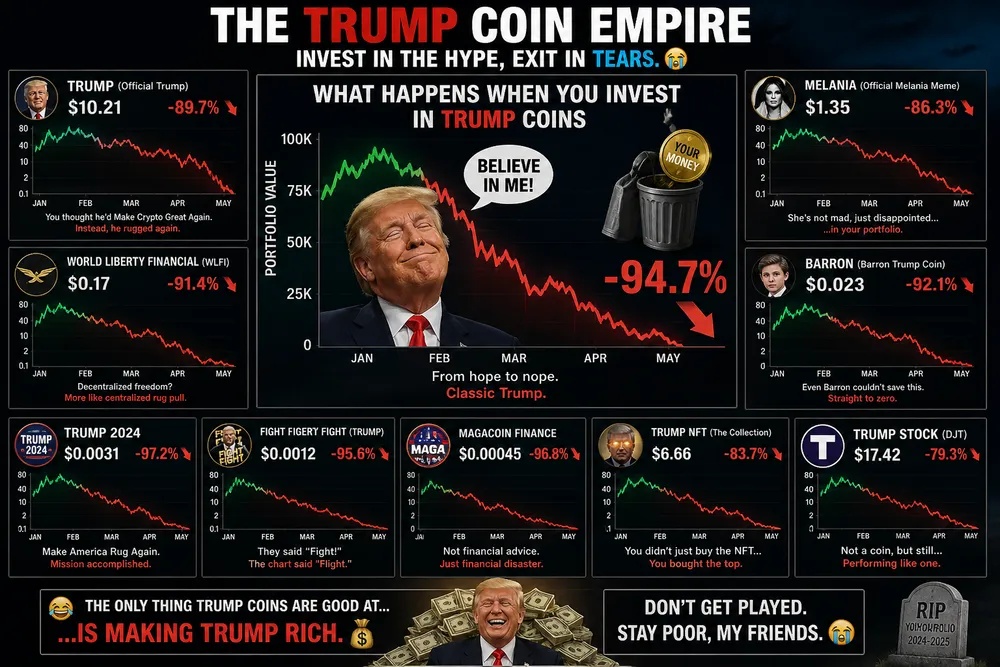
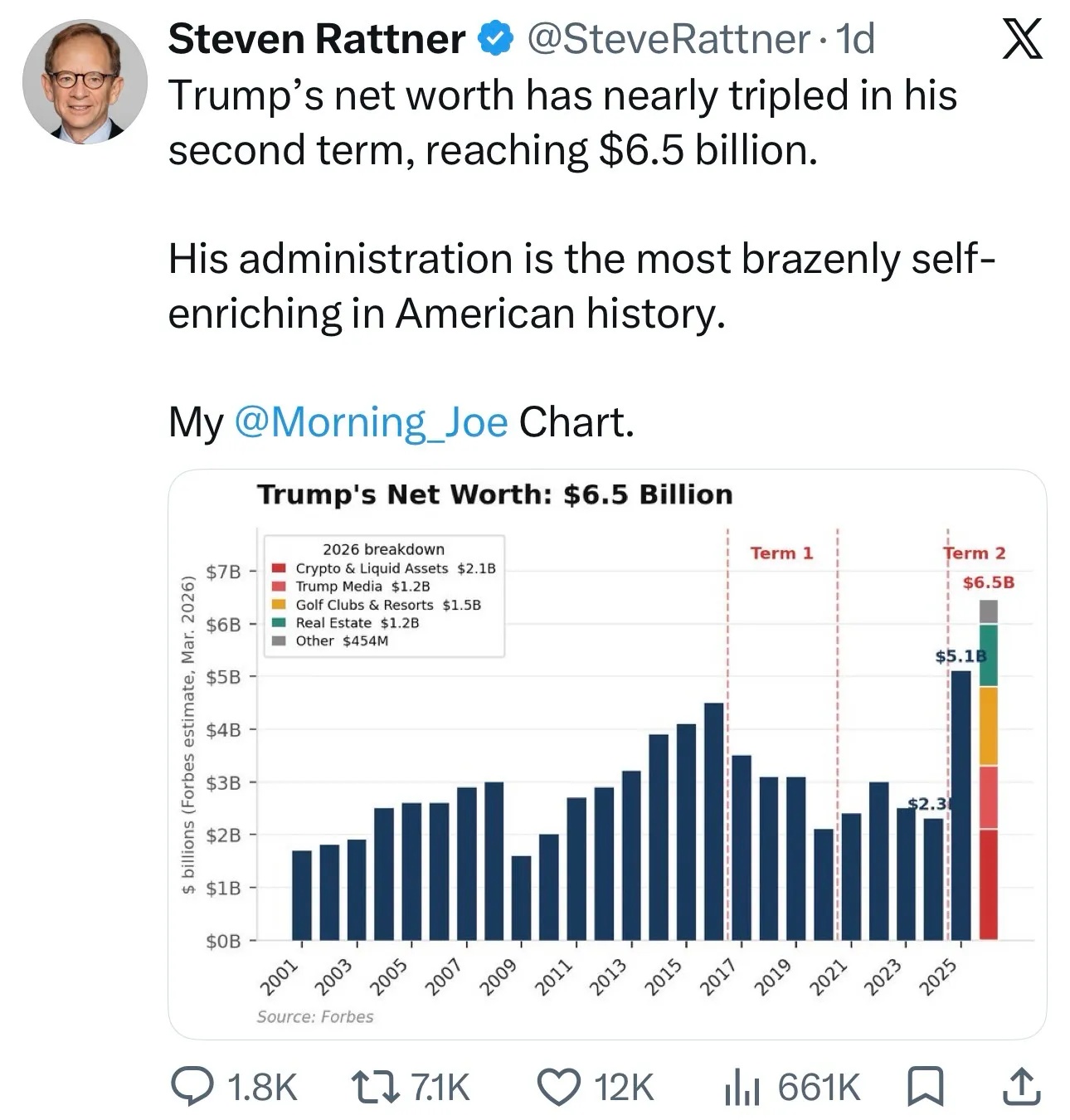
Iranian money has kept moving through those two digital ledgers during the U.S. and Israeli war against the Islamic Republic. Sun and Binance, the crypto exchange owned by Zhao, are both prominent backers of World Liberty Financial, the crypto firm co-founded by Trump and his family.
Still, the Iran transactions highlight the potentially conflicted position in which the Trumps' sprawling business interests have placed the U.S. presidency. The family-owned Trump Organization real-estate empire, for example, continues to pursue foreign deals. The use of the blockchains by institutions in a country the United States is at war with is a "dramatic irony," said John Reed Stark, a former chief of the Securities and Exchange Commission's Office of Internet Enforcement. "The entities doing crypto financing through these platforms are the very ones that the president is trying to defeat in the war."
The administration denies that Trump's businesses pose any conflict of interest. About three-quarters of the Iranian funds that passed through Binance were in Tron's cryptocurrency. Nobitex encouraged clients to use Tron's crypto to trade anonymously without "endangering assets due to sanctions," Reuters reported.The Iranian company has publicly said it switches addresses to make tracing and intercepting transfers harder.In statements to Reuters, Nobitex denied having direct Iranian government connections or assisting the state, and said that any illicit funds moving through the exchange did so without management approval or awareness.
It is unclear whether Tron and BNB Chain were aware their networks were used by the central bank and Nobitex, which has not been specifically sanctioned. Doing business with Iranian entities falls under general Western sanctions. Reuters could not determine why the United States has not sanctioned Nobitex. Since taking office, Trump has launched a suite of crypto-friendly policies and U.S. regulators have paused enforcement actions against crypto companies and moguls. The Securities and Exchange Commission settled a lawsuit against Sun for alleged fraud in March for $10 million without Sun admitting any wrongdoing.
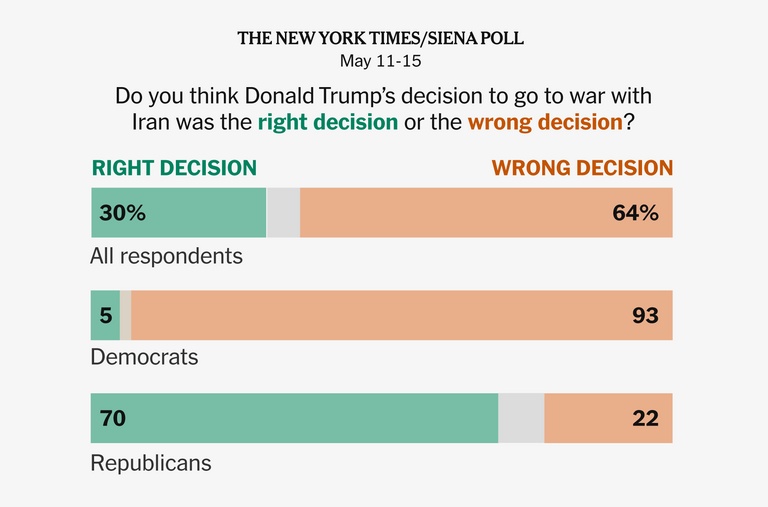
The Trump administration announced today that it had created a new $1.8 billion fund to compensate people who say they were unfairly targeted by the Biden Justice Department and Democrats. The move could funnel taxpayer money to President Trump's political allies.
The unusual fund was created in exchange for the president dropping his $10 billion lawsuit against the I.R.S. It was an apparent effort to skirt oversight by a judge, who had expressed concern that the suit represented self-dealing between the president and a department run by his former defense lawyer, Todd Blanche.
New: Emails between the Government Accountability Office and Trump officials showed that agencies refused to cooperate with a probe into the U.S. DOGE Service's handling of sensitive data.
Notable: The GAO has determined that the Treasury Department violated its security rules in giving a DOGE staffer access to the government's payment system.
President Donald Trump earlier this year bought as much as $680,000 in stock of Eli Lilly, the maker of blockbuster obesity drugs, as the agencies he oversees undertook an agenda that largely benefited the company. In healthcare, however, the trades for Lilly - a company valued by the stock market at just under $1 trillion - stand out. That's because the timing of Trump's purchases coincides with several favorable government decisions benefiting the drugmaker's GLP-1 business, including progress toward a long-held goal: qualifying the drugs for reimbursement from Medicare, the government health insurance program primarily serving seniors, when they are prescribed for weight loss.
The disclosure forms -which bear Trump's distinct signature - give ranges rather than exact dollar amounts for the trades. They show seven purchases of Lilly stock made on the president's behalf through the end of March, the first of which occurred on Jan. 6.
The appearance of a potential conflict of interest is enough to trouble ethics experts. "A president who buys or sells the stock of a company whose value is affected by his administration's actions undermines the public's trust in two ways," said Kathleen Clark, a legal ethicist at Washington University in St. Louis. First, she said, the public should believe government actions are motivated by common good, not personal enrichment. And second, the public should believe that those within government aren’t benefiting from inside information. A ban on stock trading by the president would require an act of Congress, though some lawmakers have resisted such legislation. Members of Congress are also permitted to buy and sell stocks.
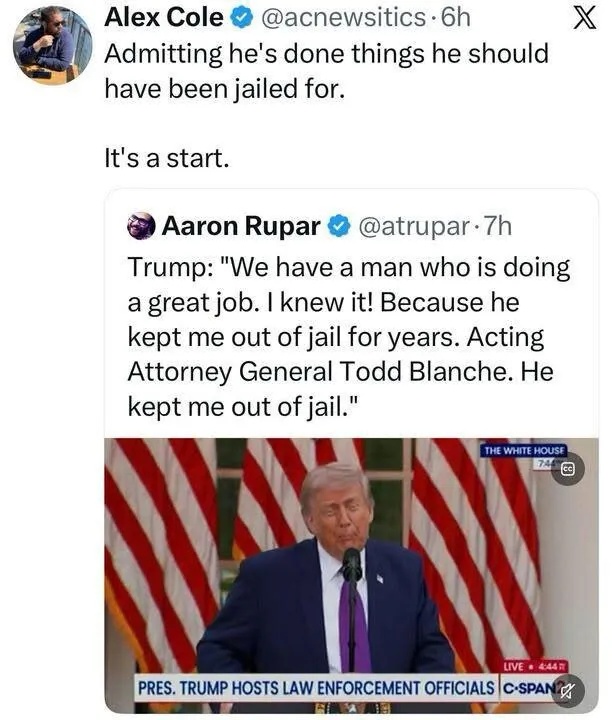
The Justice Department revealed today that President Trump, his family and his businesses will be shielded from being investigated or prosecuted over their taxes. The provision was signed by acting Attorney General Todd Blanche and quietly posted on the department's website. It's part of an extraordinary new agreement the president struck with his own administration to settle his lawsuit against the I.R.S., where officials had mapped out a plan to fight Trump's claims.
Protection from audit could be quite beneficial for Trump. In 2024, my colleagues found that a loss in an I.R.S. audit could cost him more than $100 million. Also part of the deal is a $1.8 billion compensation fund for people who claim to have been the target of politically motivated prosecutions. That fund has been loudly criticized by Democrats as a way to funnel taxpayer money to Trump’s allies. Some Republicans in Congress also voiced concerns. John Thune, the Senate majority leader, rarely publicly criticizes Trump but said he "was not a big fan" of the fund.
That's the first thing they don't want you to know. And by "they," I'm referring specifically to the Trump administration's public health officials and the billionaires who helped elect them, including Musk. They don't want you to know they're likely responsible for the Ebola outbreak. If it winds up in the U.S., they'll be responsible for that, too. They would hate for you to know that.
So, the U.S. has spent the last year ignoring Ebola, letting it spread without detection. Now we have a major Ebola outbreak. How predictable... It's all over the news now, except for the important parts. The World Health Organization has declared a public health emergency of international concern over a recent outbreak in Uganda and the Democratic Republic of Congo. An American doctor has tested positive. Just over the last few days, cases and deaths have skyrocketed. Global health officials have reported that the actual numbers could be "much higher than reported." Yes, that makes sense, because Elon Musk and his tech goons dismantled the teams and tools we would've used to track and contain exactly that kind of outbreak.
Experts are going on the news and insisting that Ebola only spreads through direct contact with bodily fluids. There's a big but here. Here's the second thing they don't want you to know: Ebola has airborne potential. They also state that "Ebola viruses have the potential to evolve in the future into pathogens that spread mainly by the respiratory route," especially if the virus is allowed to spread and mutate. Topping it all off, the researchers also found evidence of Ebola "superspreader" patients, and that Ebola has an incredibly low "infectious dose." It takes as few as 10 particles to infect you. So, there you have it.
Here's the third thing they don't want you to know: As I wrote early last year, one simple tool can give you peace of mind regardless of what virus is making headlines. It's an N95 mask. Our politicians and media have gone to great lengths to convince us all that they're not necessary, or that they don't work, or that they can make things worse. It's all baloney.
Maybe the super rich don't want to actively depopulate the earth, but they certainly do want to withdraw all of their money and hole up in bunkers. They don't want to pay for things like Ebola prevention, even as they joke about it. They don't want to spend money on protecting your health. In the end, their negligence translates into a very similar consequence. Whether it's intentional or not, their greed and myopia will subject us to ever more pandemics and disasters. Meanwhile, they believe they'll be able to hide from the consequences in their bunkers.
There's one last thing they don't want you to know. It's called elite panic.Researchers at Rutgers University coined this term in the early 2000s. As they documented, institutions go out of their way to suppress justified fear in civilian populations. Why? Because they don't trust them to act with accurate information about threats. They spread misinformation, out of fear that ordinary citizens will overreact and start rioting, looting, or revolting. The strategy usually backfires, often igniting the exact panic they hoped to prevent.
We can see elite panic everywhere now. It's the primary doctrine of our media, to control the narrative over diseases like Ebola. They follow a simple strategy. Have you noticed?
They bombard you with stories that trigger your fear response. Then they diffuse that fear response by telling you not to worry, there's no cause for concern, and so on. That's elite panic at work. The elites are panicking, but not about the threat. They’re panicking about how you'll react.
They don't believe you have the intelligence to protect yourself without freaking out and making things worse. They think you'll rush out and buy a bunch of toilet paper. They're scared you'll drive shortages at stores and gas stations. They're worried you'll start riots and damage their property. They're worried you'll crash the stock market. They're worried you won't show up for work. They're worried that you'll also start to do reasonable things. They're terrified you'll demand that the government pay for things like N95 masks, because they're responsible for this mess. They're worried you'll want tests, and vaccines. That's what keeps them up at night. Not the Ebola virus. You.
The fools in charge don't want to spend money on Ebola prevention or precautions. They don't want you to know they're the ones responsible for this outbreak. They don't want you to know they'll be responsible if it spreads to the U.S. They don't want you to know its airborne potential, because they don't trust you to handle that information like a mature adult. But they're also worried that you will handle it like a responsible adult, and demand they do something other than hold press conferences about it and tell you to wash your hands. They don't want you to know there's one simple tool that can protect you, because it makes them uncomfortable and it might hurt their income streams if people protect themselves. In fact, there are several tools-and some of us have spent years learning about them.
We're also not spreading conspiracies. Is it strange that hantavirus and Ebola are both making headlines at the same time? No, it's not strange. It's the consequences that climate scientists have predicted for years now. As Ed Yong wrote in an underrated Atlantic article years ago, we've entered the pandemicene, an era where zoonotic viruses increasingly pose threats to us. Hundreds of these viruses are waiting to spill over into humans as we overheat the planet and destroy what's left of wild habitats. This is what's happening.
Meanwhile, who's actually freaking out? The Epstein class, that's who, and everyone who falls for their stories. Go online and look at the Reddit threads. The people freaking out now are the ones who've been living in denial for the last four years, pretending that they'll never have to wear a mask or flip on an air purifier ever again. There's no need to freak out over Ebola, even if it has airborne potential, even if our dumb Epstein class rulers made this happen with their reckless budget cuts, even if it starts to spread in the U.S.
If you still believe in civic action, call your representatives. Ask them why our government let a billionaire with no knowledge or training in public health kill the funding for Ebola prevention. Ask them why they let him lie about restoring it. Ask them what they're going to do to fix this problem. When they sputter platitudes, tell them what you've learned from this article. Action is not panic. Action is action. We know what to do. So, let's do it.
Two police officers who defended the Capitol on Jan. 6, 2021, filed a lawsuit today in an effort to block a $1.8 billion fund created this week by the Justice Department to pay people who claim mistreatment by the federal government.
The officers accused the Trump administration of creating a "slush fund" to reward the pro-Trump rioters who had tried to stop the certification of the 2020 election. Multiple Jan. 6 rioters have expressed excitement about the prospect of getting paid.
The latest: House Democrats said yesterday that if they win a House majority in the midterms they will launch an investigation into the Trump administration's $1.8 billion "Anti-Weaponization Fund."
The details: The fund will use taxpayer dollars to pay individuals who claim to have been targeted by the federal government because of their politics.
Related: Two police officers who defended the Capitol during the Jan. 6, 2021 attack carried out by Trump supporters filed a lawsuit today seeking to block the fund.
Exclusive: White House opposition to an American doctor working in the Democratic Republic of Congo returning to the United States delayed him from being evacuated and receiving care after he contracted Ebola.
Why it matters: Doctors say early treatment and isolation are key to treating Ebola, which can progress to multi-organ failure in a matter of days.
White House response: "This is absolutely false and another reason why the Washington Post is no longer worth the paper it's printed on," said a spokesperson.
What happened: Trump today suggested the Senate should replace its parliamentarian, a nonpartisan official who advises on Senate procedures, Elizabeth MacDonough.
Why: Trump accused MacDonough of bias against Republicans. His criticism came after she rejected an attempt to include money for Trump's ballroom in a bill funding immigration enforcement.
After a highly contentious private meeting today with the acting attorney general, Senate Republicans abruptly abandoned plans to advance a bill to provide $72 billion for President Trump's immigration crackdown. The reason: Members of the president's own party had deep concerns about the Justice Department's new $1.8 billion fund to pay people who claim to have been politically persecuted.
Republicans had already appeared ready to reject a separate White House demand that $1 billion in security funds for Trump's ballroom project be included in the bill. But because of Senate rules around advancing filibuster-proof bills, they would have been forced to weigh in tonight on the Trump administration's unusual new fund. And several Republican senators were unwilling to support it.
Todd Blanche, the acting attorney general, met with senators for two hours, attempting to defend the fund. But multiple senators were left unsatisfied with the lack of guardrails around the money. "It is in real trouble," Susan Collins, a Republican senator said, adding, "and it should be."
The decision by senators to abandon today's immigration vote - and leave Washington for a week - underscored the toxic dynamic between the White House and Congress. Republican senators have grown frustrated with Trump's retribution-driven intervention in recent primaries.
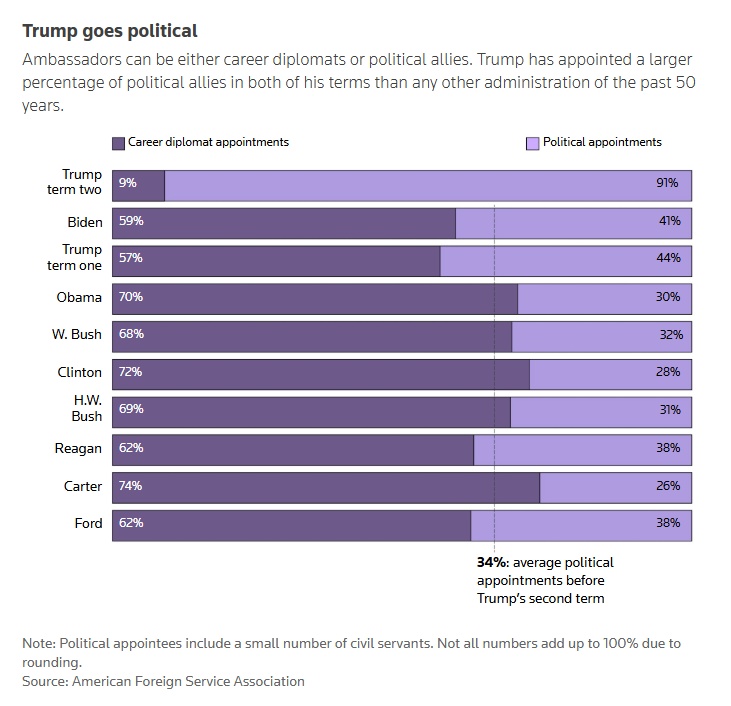
New: A Washington Post analysis found Trump's use of vulgar language, personal insults and self-aggrandizing rhetoric in social media posts and speeches has increased significantly since his first term.
The numbers: 93% of his speeches this term contain a vulgar term, up from about 40% last term.
And: Trump's vulgar or insulting social media posts have tripled compared with a similar period in his first term.
Yesterday: A federal judge ruled the Trump administration could not choose to ignore the Presidential Records Act, which Trump officials recently argued was unconstitutional.
Background: Several advocacy groups sued to stop the administration from implementing a new records policy that experts said weakened safeguards.
HHS is again ordering changes to the CDC website that are at odds with the recommendations of the public health agency's scientists. Earlier this week, the CDC was told to take down a webpage that explained how people who have multiple sexual partners can reduce their risk of contracting mpox.
( The archived page can be viewed here. ) Asked why, an HHS spokesperson said it "was not medically accurate" and didn't "align with Administration priorities."
Demetre Daskalakis, a former top CDC scientist who served as deputy coordinator of the Biden administration's mpox response, disputed the assertion that the information on the webpage was inaccurate. "Providing advice to people that is actionable is what public health should do and we did that," he said. "The document went through CDC scientific clearance."
Last fall, HHS told the CDC to stop using the term mpox and revert to calling the disease monkeypox, a term the WHO has advised against using. And HHS secretary Robert F. Kennedy Jr., a longtime vaccines critic, instructed the agency to change a webpage on vaccines and autism to state that claims the two are not linked aren't evidence based. - Helen Branswell
Tax experts say this grant of immunity is shocking in the breadth of protection it offers the president and could undermine confidence in the fairness of the tax system.
"This is an unprecedented remedy," said former IRS Commissioner Daniel Werfel, noting that Trump should be treated like every other American. "People expect the same tax rules and enforcement framework to apply to everybody."
The IRS probe revolved around whether Trump doubled-dipped in cutting his taxes, according to a 2024 report by The New York Times and ProPublica - specifically whether he used the same losses from his Chicago skyscraper to cut them twice in future filings, a big no-no. The report said Trump could owe more than $100 million, including penalties, if he were to lose the audit battle.
"The president and his affiliates might not pay the taxes they should," said DeBot, policy director at New York University's Tax Law Center. "This is giving the president and his affiliates completely different set of rules than everyday taxpayers." The immunity is especially useful to Trump. His company includes hundreds of separate businesses, making his tax returns complicated. He also has a reputation for aggressively cutting his taxes, which some experts find suspicious - and at least in one case deemed now illegal.
After his Atlantic City casinos collapsed under heavy debt in the mid-1990s, for instance, Trump claimed about $1 billion in losses to cut his tax bill, even though lenders had forgiven hundreds of millions of dollars he owed. Trump argued the debt was never technically forgiven because he had exchanged equity in the bankrupt casino business for it - a tax maneuver Congress later barred as an abusive tax loophole. Through that technique and other tax shelters and deductions, Trump was able pay just $750 in federal taxes in 2016 and 2017, and zero in 2020, according to a congressional investigation after his first term.
Trump's settlement with the IRS refers only to existing audits, not future examinations, so the president and his family are not off the hook for any alleged abuses in future tax returns. Parts of the settlement are being challenged in court. The compensation fund is being attacked by police officers who helped defend the U.S. Capitol from Trump's supporters on Jan. 6, 2021. They have sued to block anyone - including the rioters - from receiving payouts.
Some law experts expect the tax immunity will be challenged in court, too. "This is the president trying to play every role in the system, acting as plaintiff, defendant, and his own judge and jury to extract extraordinary windfalls," said New York University’s DeBot, adding that giving broad immunity "stretches beyond what DOJ actually has authority to do."
https://bsky.app/profile/thetnholler.bsky.social/post/3mmij2tbvjk2o
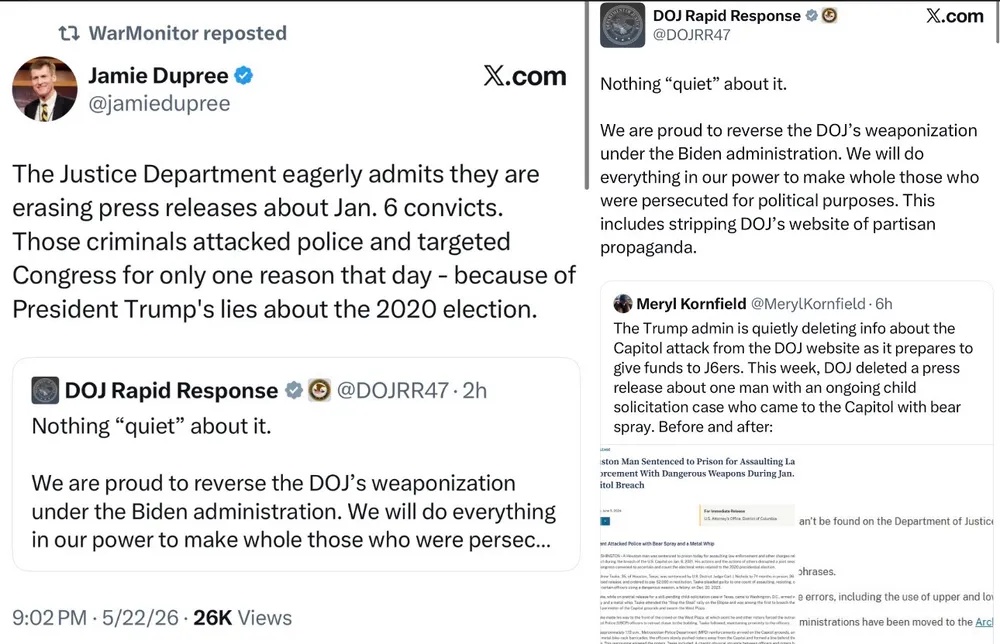
The Department of Justice is acknowledging it has removed from its website news releases about criminal cases related to the Jan. 6, 2021, riot, calling the information about the prosecutions "partisan propaganda."
On Monday, the Justice Department announced the creation of a $1.776 billion fund meant to compensate Trump allies who feel they were unjustly investigated and prosecuted. Acting Attorney General Todd Blanche has not ruled out that rioters convicted of violence will be eligible for payouts, prompting bipartisan anger in Congress.
After a journalist on Friday observed on the social media platform X that the Justice Department was "quietly" removing news releases on its website that were related to the Jan. 6 attack, including about a Texas man who pleaded guilty to assault and also faced separate state charges of soliciting a minor, the department responded through its "rapid response" account that there was "nothing 'quiet' about it."
"We are proud to reverse the DOJ's weaponization under the Biden administration. We will do everything in our power to make whole those who were persecuted for political purposes," the post said. "This includes stripping DOJ's website of partisan propaganda."
Among the releases removed from the site were those concerning seditious conspiracy cases against members of the Proud Boys and Oath Keepers, far-right extremist groups. The Justice Department, in an unopposed motion last month, asked a federal appeals court to vacate those seditious conspiracy convictions, a request that was granted Thursday. The department on Friday moved to dismiss the cases against the group members.
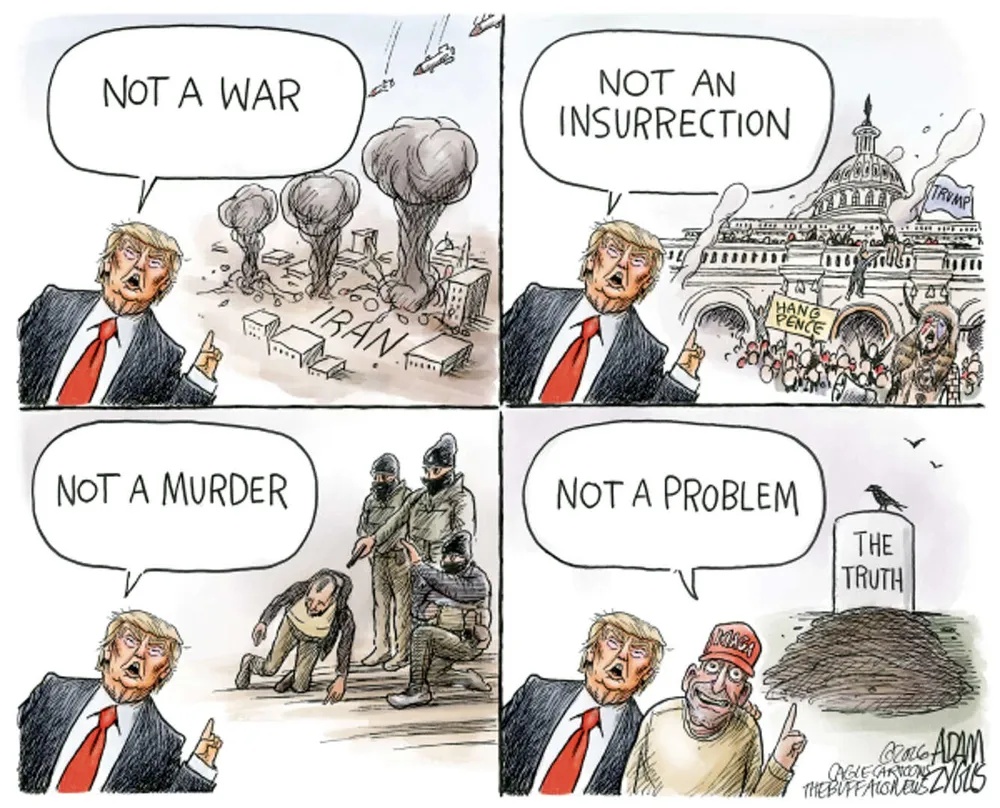
The Department of Justice acknowledged that it has removed webpages that detail charges, convictions, and other information related to the myriad defendants involved in the Jan. 6, 2021, riot at the Capitol.
After Washington Post staff writer Meryl Kornfield posted to X on May 22 that the DOJ was "quietly deleting info about the Capitol attack" from its website, the official DOJ Rapid Response X account fired back, saying there was "nothing 'quiet' about it." The account posted that it was "proud to reverse" the agency's "weaponization" under former President Joe Biden.
"We will do everything in our power to make whole those who were persecuted for political purposes," DOJ Rapid Response wrote on its X account. "This includes stripping DOJ's website of partisan propaganda."
What's left of Jan. 6 history? According to Kornfield, among the documents purged was a news release about a man who went to the Capitol with bear spray and is still facing an ongoing child solicitation case. She also attached links to two other news releases, which were preserved using the Internet Archive's Wayback Machine.
A May 24 search of the DOJ's archives performed by USA TODAY showed that some news releases related to Jan. 6 were still available, including when members of the Oath Keepers and Proud Boys pleaded guilty to seditious conspiracy charges, an announcement that 13 people were charged in federal court two days after the incident, and then-Acting Attorney General Jeffrey Rosen's official statement about the riot published Jan. 7, 2021.
More generally, an archival search for the term "Capitol breach" returned just 11 results. A search for the same term in press releases published after Jan. 20, 2025 - the first day of Trump's second term - returned zero results.
Reframing the events of Jan. 6. While DOJ Rapid Response characterized the news releases as partisan propaganda, critics argue that the Trump administration is systematically working to rewrite the events of Jan. 6. As one of Trump's first acts in his second term, more than 1,500 people involved in the riot were granted full, complete, and unconditional pardons.
USA TODAY reported in April that the DOJ asked a federal appeals court to throw out seditious conspiracy convictions given to leaders of the Proud Boys and Oath Keepers for their involvement in the Capitol riot, going a step further than the commuted sentences Trump granted in January 2025.
The Trump administration has also overseen sweeping cuts targeting prosecutors, FBI agents, and others who worked on cases related to the riot launched by his supporters that rocked the country in the aftermath of the 2020 presidential election, according to previous reporting by USA TODAY.
Jan. 6 payouts? More recently, the Jan. 6 defendants have been thrust back into the spotlight, following Trump's announcement of a $1.776 billion "anti-weaponization fund," which could be used to pay those involved in the riot payouts. The money is part of a settlement of a $10 billion lawsuit filed by Trump and his family against the IRS.
The DOJ has said the money will be available for "victims of lawfare and weaponization" under the Biden administration - a descriptor Trump has repeatedly used for his supporters who faced charges or convictions after storming the Capitol on Jan. 6.
"These were people that were weaponized and really treated brutally by a system that was so corrupt with corrupt people running it," Trump said earlier this month. "They're getting reimbursed for their legal fees and the other things that they had to suffer."
The Trump administration has mass-deleted information about prosecutions tied to the Jan. 6, 2021, attack on the U.S. Capitol, including cases of defendants who assaulted police officers. The removals mark the latest phase of President Trump's effort to rewrite the history of the violent riot.
Justice Department news releases that detailed guilty pleas, jury verdicts and prison sentences abruptly disappeared from government websites last week. A review by NPR found that the deleted material included information about some of the most serious assaults on law enforcement that occurred that day. NPR maintains the most complete database and visual archive of the Jan. 6 prosecutions.
The previously accessible news releases now lead to a "Page not found" message. The mass deletion of government information about the riot, in which a mob of Trump supporters injured 140 police officers and threatened the lives of members of Congress and then-Vice President Mike Pence, follows a broader effort by the Trump administration to whitewash the attack.
Trump granted clemency to every Jan. 6 defendant, including full pardons for all the most violent rioters and the erasure of seditious conspiracy convictions for members of extremist groups. The Justice Department fired dozens of prosecutors who worked on Jan. 6 cases and hired a former riot defendant who was seen on video urging the mob to "kill" police. The administration settled a wrongful death lawsuit brought by the estate of rioter Ashli Babbitt, who was shot and killed while storming the Capitol, for nearly $5 million. On the fifth anniversary of the riot, the White House created a website that distorts that day's events, describing the rioters as "patriots" and blaming police for causing "chaos." And just last week, the administration announced a $1.8 billion "Anti-Weaponization Fund," indicating that even rioters who assaulted police may be eligible for payouts. When speaking about the attack, Trump consistently describes his supporters as victims rather than perpetrators of violence.
Brendan Ballou, a former federal prosecutor who worked on Jan. 6 cases, told NPR in a recent interview that the administration's effort to flip the story of the riot is part of a broader effort to attack democratic institutions. "It's clear there is an ongoing fight to rewrite the history of Jan. 6, because these people know if they can successfully get people to forget about Jan. 6 - or worse yet, condone it - then they will be able to convince people to accept any attack on democracy," said Ballou.
While the government continues to remove information on the attack, NPR's database and visual archive of the attack remains accessible. NPR's work has been used by prosecutors, defendants, academic researchers and the general public. The searchable database covers all the nearly 1,600 criminal cases, including charges, convictions and sentencing outcomes. The archive also includes a timeline of the day's events and makes accessible hundreds of videos from police body cameras, Capitol surveillance footage and other sources. NPR is currently taking legal action to obtain additional video evidence held by the government, which has not been previously disclosed.
Breaking: House Democrats today announced a bill that would block Trump's proposed 250-foot triumphal arch near Arlington National Cemetery.
Details: The bill would block new construction in the area Trump wants the arch to be built and prevent any arch or similar structure from being built on D.C. parkland without congressional approval.
US Senate Report does not support pediatric deaths from COVID-19 vaccines
U.S. Citizenship and Immigration Services announced Friday that foreigners in the U.S. who want a green card will need to leave and apply in their home country, barring some unspecified exceptions.
The announcement, which potentially affects hundreds of thousands of green card applicants a year, was the latest immigration policy unveiled by Trump’s Republican administration to stun and confound lawyers, advocates and immigrants. It’s also part of a pivot by the administration to target legal pathways to immigration, after focusing since last year mostly on migrants in the U.S. illegally.
"This is simply an attempt to try to limit and scare people away from the legal immigration process," immigration attorney Charles Kuck said, adding that he expected legal action against the change. "This is a scare tactic."
For more than half a century, foreign nationals with legal status have been able to apply for and complete the process for permanent residence in the United States — including people married to U.S. citizens, holders of work and student visas, and refugees and political asylum-seekers, among others.
That appeared to change suddenly on Friday, when USCIS announced the shift on its website. "From now on, an alien who is in the U.S. temporarily and wants a Green Card must return to their home country to apply, except in extraordinary circumstances," the agency said. "It seems like maybe who they’re targeting is potentially those whose period of stay lapsed while they were here," she said.
Trump's administration has slashed the number of refugees admitted into the U.S. this year and limited them to white South Africans. She said she thinks the policy will deter some companies from pursuing green cards for their clients.
Exam results withheld: The White House has not released the summary of Trump's recent physical, despite past precedent of timely disclosures.
Medical concerns escalate: Thirty-six physicians have urged invoking the 25th Amendment, citing observed behavior and public statements as evidence of decline. Political stakes rise: The delay fuels opposition attacks and public doubt, while allies reaffirm his fitness and reject claims of impairment.
Renewed calls for 25th Amendment action. A group of 36 physicians from major U.S. institutions has formally urged Congress to invoke Section 4 of the 25th Amendment, citing patterns they interpret as cognitive decline, impaired judgment, and erratic conduct. Filed in the Congressional Record, their statement warns of risks tied to Trump's sole nuclear launch authority. While avoiding a formal diagnosis, the doctors argue that observed public behavior warrants urgent constitutional action. The Amazing Times + 1
Experts and political figures question official narrative. Medical analyst Dr. Vin Gupta has challenged the White House's stated cause for Trump's hand bruising, arguing the explanation is atypical for high-dose aspirin and calling for clearer disclosure of diagnoses and treatments. Former Republican strategist Rick Wilson suggested the administration’s withholding of exam details raises concerns, while White House officials continue to assert that the president is in excellent health. Raw Story + 1
A pattern of health scrutiny. Trump, approaching 80, has faced repeated scrutiny over his stamina following episodes where he appeared to close his eyes for extended periods during public events, as well as frequent Walter Reed visits described as routine. Shifting explanations for past scans and visible symptoms have added to skepticism. Recent polls show a majority of Americans doubt his mental sharpness and physical health for the presidency. OK! Magazine + 2
The numbers: A CBS News poll this month found 54% of White voters without a college degree disapprove of Trump's job performance, up from 32 % in February 2025.
Why it matters: White working class voters have been key to Trump's electoral victories, with overwhelming majorities of the demographic supporting him in 2016, 2020 and 2024.
Exclusive: Two political appointees at the Treasury Department pushed the Bureau of Engraving and Printing to design a $250 bill with Trump's face on it.
More: An 1866 law mandates that only deceased individuals may be depicted on U.S. currency. The BEP director was reassigned after refusing to move forward with the bill.
Yesterday: A bipartisan group of 35 former federal judges asked a district court judge to reopen Trump's lawsuit against the IRS over leaked tax records.
Why: The judges asked the court to investigate whether the U.S. government committed fraud by settling the case with a deal that created a $1.8 billion "anti-weaponization" fund.
The fund: The $1.8 billion is to be used to pay those who claim to have been targeted by the DOJ for their political beliefs. It operates outside normal procedures, limiting the fund’s oversight.
The National Park Service is using at least $67 million worth of park entrance fees to help fund President Trump's beautification projects in Washington, according to a Times analysis of federal records.
Some conservationists have criticized the Trump administration for steering so much money to projects in Washington, like repairs to ornamental fountains, rather than to urgent upgrades needed for national parks.
The deal is one of many actions by the Trump administration that have helped companies in which the Trump family holds stakes. Government contracts and other benefits have gone to various Trump-linked companies, prompting allegations of self-dealing by Democratic lawmakers and good government experts. But ProPublica's reporting on the Vulcan loan represents the first time the awarding of a contract from a federal agency has been directly linked to White House intervention.
Richard Painter, the chief White House ethics lawyer during the George W. Bush administration, said aides to the president should not be intervening in contracting and lending decisions by agencies, particularly in matters that financially benefit the president's family. "This is our money they're spending," Painter said. "This is corruption we pay for."
Among the companies under review was Unusual Machines, a Florida drone parts maker, a Defense official said. Trump Jr. sits on the company's advisory board and holds millions of dollars worth of shares. The Pentagon was accused of cronyism last year when it awarded the company a contract to make drone engines for the Army.
New: A federal judge today ordered the Kennedy Center to remove Trump’s name within two weeks and granted a preliminary injunction to stop the center from closing for two years.
Background: The Trump-led Kennedy Center board voted to rename the center after the president and to shut down the center for renovations from July until 2028.
What to know: More than half of the performers have dropped out of a fair planned by the Trump administration to celebrate the 250th anniversary of the United States’ founding.
Why: Some of the performers cited the event’s political associations, saying they had initially not realized it was being hosted by the Trump administration.
And: Others, including Poison vocalist Bret Michaels, said they had concerns about safety after receiving threats.
Furthermore, the U.S. government owes an ethical duty of care to citizens who have been exposed to ebolavirus. Many exposed individuals will be those who have volunteered to provide clinical care and humanitarian relief in a conflict zone -- like Peter Stafford, MD, the medical missionary in the DRC who was the first (and so far, the only known) American to contract Ebola during this outbreak. By telling these individuals they will be barred from returning home if they are exposed, the government is placing them at undue risk. No administration -- Republican or Democratic -- has funneled citizens to facilities abroad instead of safely evacuating them to America.
Public health experts have warned that this strategy is entirely self-defeating. When you tell people they will be forcibly marooned in an offshore facility, you create a powerful disincentive for transparent reporting. Exposed individuals may hide their symptoms and delay seeing diagnoses and care. High-risk individuals might attempt to bypass formal screening channels entirely to sneak home. This could drive the virus underground, accelerating the exact domestic threat the administration claims it is trying to prevent. These measures will also discourage health and humanitarian workers from traveling to the region to assist with the response, exacerbating the risk of continuing spread.
The Laikipia quarantine facility is a symptom of a broader, isolationist approach to global health security. Pandemics cannot be stopped by harsh and restrictive measures. Epidemic preparedness requires robust domestic containment, transparent reporting, health equity, and a commitment to clinical and scientific excellence.
>A federal judge this morning temporarily barred the Trump administration from taking steps to establish the fund that the president said would be used to pay victims of "weaponization and lawfare" under Democratic administrations. And this evening, a different judge reopened Trump's $10 billion case against the I.R.S., saying she wanted to investigate "grievous allegations" that the hasty deal to resolve it - which included the creation of the fund - was "premised on deception."
Many of Trump’s allies have announced plans to apply for, and are likely to benefit from, the fund’s disbursements. A number of lawmakers, including prominent Republicans, have publicly objected to its aims.
Blanche's latest target is the 82-year-old writer who accused Trump of sexual assault and won $88 million in defamation judgments against him. The department now is investigating donations by a nonprofit founded by the liberal billionaire Reid Hoffman to pay Carroll’s legal bills, according to people with knowledge of the matter. Bringing charges may be difficult: The office of the prosecutor overseeing the investigation has been marred by failures and resignations.
A federal judge in Washington ordered the Kennedy Center to remove Trump’s name from its facade and from all official branding, ruling that it had been added unlawfully.
"Congress gave the Kennedy Center its name, and only Congress can change it," the judge wrote, adding that a law passed by Congress in 1964 made "crystal clear" that the institution was to be named for President John F. Kennedy. The judge also temporarily blocked it from shutting down for renovations this summer, as Trump had planned. Trump later wrote on social media that the judge should be "ashamed of himself."
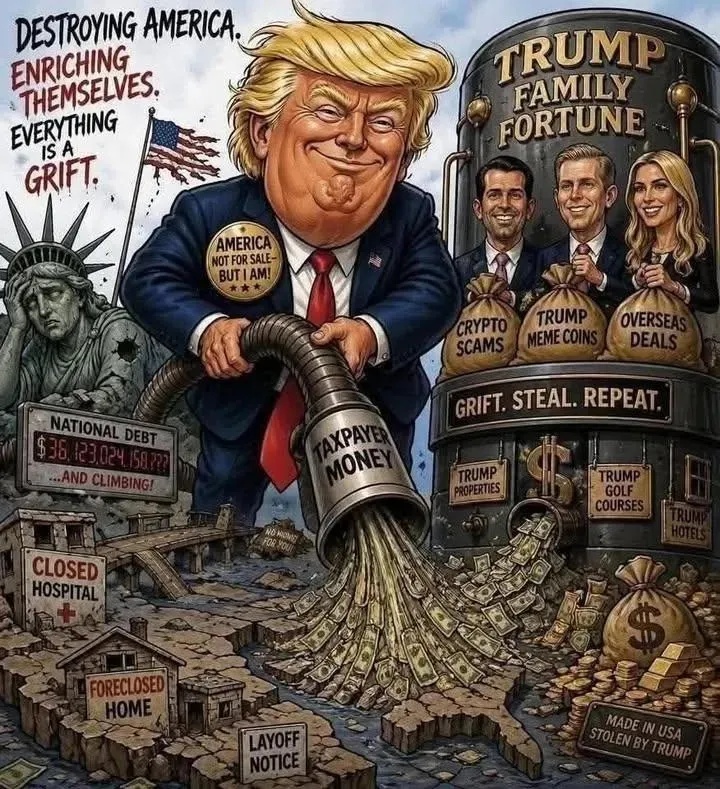
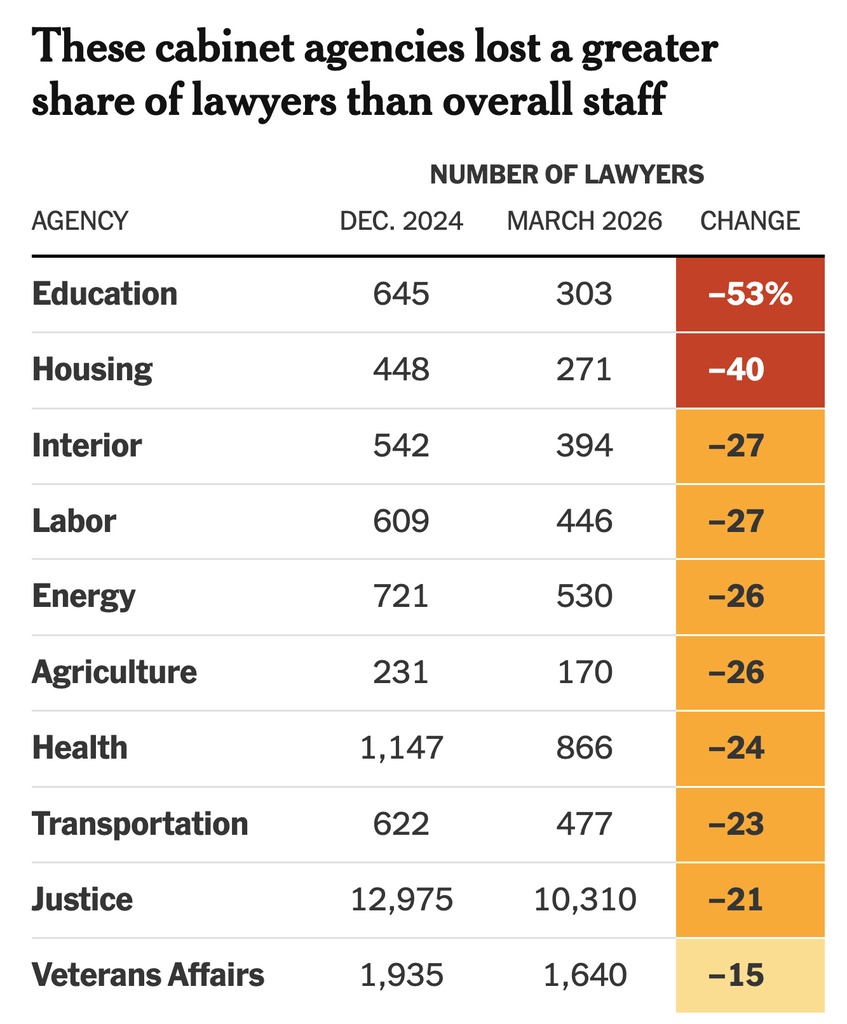
Roughly one in five lawyers who worked in the government at the end of 2024 were gone by this past March. Some left over policy disagreements. Others lost their jobs in staffing cuts. The lack of lawyers is creating a backlog of cases across government agencies.
"There are a lot of things that just can't get done without lawyers - appearances in court, reviewing of regulations," one former government attorney said. The government recently started a recruiting network for legal talent. So far, that outreach has drawn the interest of just 300 people.
President Trump is backing away from his plan to establish a $1.8 billion fund to pay people who say they have been politically persecuted, according to people familiar with the president's thinking. A sign of Trump's retreat came today when the Justice Department announced that it would abide by a judge's order not to move toward activating the fund until at least June 12, when a hearing on it is scheduled. Privately, some administration officials expressed relief that the judge's ruling offered a way out of the situation. Trump could change his mind. But he has been leaning for days toward scrapping the fund, which has prompted widespread backlash from both Republicans and Democrats. Critics characterized the fund as a scheme to reward the president's political allies with taxpayer money.
US taxpayers have invested more than a billion dollars to build a network of biocontainment units in major hospitals across the country. These are intensive care units that are engineered to provide maximum biocontainment coupled with the highest standard of care.
Legally, US citizens have an unqualified constitutional right to enter the United States. Ethically, by designating foreign soil as a quarantine zone our government abdicates its responsibility to protect its own citizens. Doing so is not necessary for a disease like Ebola, for which we have well-established, effective methods for mitigating transmission risk. It sets a dangerous precedent that the human rights of US citizens are contingent upon geography and political expediency. This strategy also places the US Public Health Service personnel deployed to staff the facility in Kenya at undue risk. For the first responders who answer the call to serve their country, we have an obligation to do everything in our power to keep them safe and ensure they have access to the best medical care available. We must implement plans that maximize success and impact while actively mitigating risks to those willing to put their lives on the line—a goal best achieved by monitoring US citizens returning from Ebola-affected countries within the United States.
Exclusive: The Pentagon recently banned journalists from its press office, designating the office, to which journalists have had free access for years, as a classified space.
Background: The Defense Department has been in a months-long legal battle over restrictions the Trump administration has placed on journalists at the Pentagon.
Friday: A judge opened a probe into whether Trump's "anti-weaponization fund," created as part of a settlement in a suit Trump brought against the IRS, constitutes fraud.
Background: The fund is intended to pay people who claim to have been targeted by the government because of their politics.
What to know: Democratic state lawmakers have said they're looking into taxing payouts to citizens of their states from the "anti-weaponization fund" at 100%.
Examples: Lawmakers in California, New York and Wisconsin have said they're exploring enacting such a tax, saying taxpayer money should not go to Jan. 6 insurrectionists.
Saturday: After more than half the performers pulled out of a fair celebrating America’s 250th anniversary, an event organizer said Trump will kick off the fair.
Context: Many of the performers who pulled out said they did so because they were not aware of the organizing group’s connections to Trump.
The Trump administration has released a sweeping proposal to overhaul the bedrock regulation for all federal grants, and in doing so is seeking to codify tighter political control of federally funded research. Proposed changes, which would deemphasize the role of peer review in determining what work to fund, limit the ability of scientists to use federal funds to publish their research or travel to conferences, and offer political appointees more latitude to terminate grants at will.
Administration officials have said the changes are necessary to make government-funded science more transparent and to cut back on waste, fraud, and abuse. Many in the scientific research community disagree, characterizing the changes as the White House attempting to usurp autonomy from scientists and career civil servants.
When President Biden left office in January 2025, his administration left behind an extensive plan for how the federal bureaucracy should address and work to prevent future disease outbreaks, including Ebola. The Trump administration, though, has disregarded the plan in favor of its own game plan, which officials said has led to a faster, more comprehensive response than any other country.
The shift in federal planning probably slowed the response to the ongoing Ebola outbreak, former officials said, at a time when speed is critical to saving lives and containing the disease.
Here's an example: Three senior Biden officials — Maj. Gen. Paul Friedrichs, Raj Panjabi, and Stephanie Psaki — pointed to Trump's intention to quarantine and treat American citizens in Kenya as a key deviation from the earlier plans, which focused on how to bring Americans home for treatment, as happened in the past.
Exclusive: The Pentagon hired a man convicted of a misdemeanor charge related to his participation in the Jan. 6 Capitol riot to work in a highly classified counterterrorism position.
Background: The man, Elias Irizarry, was 19 and a freshman at The Citadel, a public military college, when he participated in the 2021 storming of the U.S. Capitol.
The administration is planning to remove a $368 million deep-ocean observation system that was put in place a decade ago to monitor coastal environments, marine ecosystems, warming waters and powerful currents.
After a swell of criticism from both sides of the aisle, President Trump's acting attorney general said this afternoon that the administration was permanently halting its plans to create a $1.8 billion fund to compensate people who claim to be victims of political persecution.
"We're not moving forward with the fund, period," said Todd Blanche, the president's former personal lawyer who now leads the Justice Department. "Not moving forward ever?" a House Democrat asked him. "Correct," Blanche said. Still, Blanche said that a separate plan, to give Trump and his family protection from I.R.S. audits, remained in effect.
Four House Republicans sided with Democrats this afternoon to direct President Trump to halt U.S. engagement in Iran and require permission from Congress to continue operations in the Middle East. The vote was a remarkable rebuke of Trump and his handling of the war.
The adopted resolution, which now heads to the Senate, was the latest sign of divisions between the White House and Republicans on Capitol Hill. In a vote last month to move forward with a similar measure, a handful of G.O.P. senators also broke ranks. But even if the measure were to pass the upper chamber, the ability of Congress to force a president to withdraw troops remains a contested legal question.
The Trump administration is resisting an order requiring that the government refund the full $166 billion collected from tariffs that were found to be illegal. Now, it’s unclear when or if many businesses will get back the full sum they paid to the government.
Trump's aides have also settled on a new rationale to justify his broad tariffs. Last night, they proposed a tariff of 10 percent to 12.5 percent on 59 countries and the E.U.
Exclusive: Trump is diverting $90 million in national park entry fees to pay for a $1.6 million Independence Day fireworks display in D.C. and fountain repairs in the capital city.
Response: Advocacy groups say the funding diversion means repairs elsewhere in the nation's park system, which needs a cumulative $24 billion in fixes, won't happen.
Exclusive: The Trump library said in response to a FOIA request that it could not find any Twitter direct messages sent by Trump during his first term.
Why it matters: The library is responsible for preserving White House records from Trump's time in office. Failing to preserve DMs that Trump may have sent would be a violation of records law.
What happened: Homeland Security Secretary Markwayne Mullin yesterday at a congressional hearing dodged questions about whether he'd abide by court rulings.
More: Mullin said that he would not violate the Constitution but that he couldn't say whether DHS would obey court orders because "the courts were politicized."
Thousands of comments submitted through National Park Service feedback signs criticized the Trump administration, opposed historical revisions, and called for more funding and staffing at national parks.
Last year, the Department of the Interior (DOI), the federal agency that manages the nation’s national parks, installed what critics dubbed "snitch signs" at national parks, asking visitors to report any negative portrayals of American history. But instead of reporting signage, visitors left thousands of comments criticizing the Trump administration.
Recently, the National Park Service (NPS) released public comments received between June 4, 2025, and Jan. 14, 2026. The file contains roughly 35,000 comments, many of them repeated. But the exercise may have been futile because much of the feedback strongly disapproves of the president and his administration, with commenters demanding that national parks not erase or rewrite history. Others pointed to a lack of information about climate change, transgender rights, and slavery.
Most notably, many comments directly criticized President Trump and DOI Secretary Doug Burgum. One commenter wrote, "You asked us to report anti-American behavior. I would like to report the Fascist in Chief, Donald J. Trump, for being a stain on this country, its people and its land. Thank you for your attention to this matter."
Others described the administration's actions as un-American and accused it of attempting to erase history. One comment stated: "Trump administration: Hands off our history. The rangers at this National Park are doing a great job. They are providing an essential service, protecting our history and beautiful natural landscapes for future generations. Instead of undermining them, you should support them."
In 2025, President Trump signed a directive recognizing only two genders, and the administration subsequently removed references to transgender people from federal websites. Visitors noted the lack of acknowledgment of transgender activists and urged the NPS to restore signage recognizing their role in advancing LGBTQ+ rights.
Many commenters also called on the NPS to hire more rangers and increase funding, arguing that the parks need additional support. In 2025, President Trump launched DOGE, the Department of Government Efficiency initiative, which significantly reduced the National Park Service workforce. Approximately 1,000 park employees, about 5% of the workforce, were laid off, leaving many parks understaffed. The administration's 2027 budget proposal would further reduce NPS funding by $736 million, roughly 20% of its $3.2 billion annual budget, potentially putting additional jobs at risk.
Many comments criticized the feedback initiative itself. One commenter wrote, "Climate change is real and so is racism. Snitch signs are fascist." Another said the signs soliciting feedback were ridiculous and that history should not be revised simply because it makes people uncomfortable.
Not all comments were political. Some focused on park services, others praised the natural beauty of the parks, and some made jokes, including remarks about not being able to spot Bigfoot.
Erasure of History
The controversy began in May 2025, when President Trump signed Secretarial Order 3431, Restoring Truth and Sanity to American History. The order directed federal sites to "remind Americans of our extraordinary heritage, consistent progress toward becoming a more perfect Union."
In practice, critics say the policy led national parks to remove signs and exhibits of historical significance in an effort to reshape historical narratives. A removal tracker maintained by Save Our Signs documents signs that have been removed or modified, including those related to slavery, Indigenous history, climate change, and LGBTQ+ history. The National Parks Conservation Association has also documented exhibit changes, including alterations to a slavery-related exhibit at Independence National Historical Park in Philadelphia.
A QR code posted at national parks now asks visitors to report "any signs or other information that are negative about either past or living Americans or that fail to emphasize the beauty, grandeur and abundance of landscapes and other natural features."
The policy has generated backlash from advocacy groups, activists, park rangers, and members of the public. Multiple lawsuits have been filed alleging violations of free speech protections. Meanwhile, a coalition of roughly 1,000 off-duty, former, and retired park rangers has organized in opposition to what they describe as censorship and unlawful terminations. The group, known as Resistance Rangers, encourages visitors to contact their elected representatives and send postcards to Secretary Burgum.
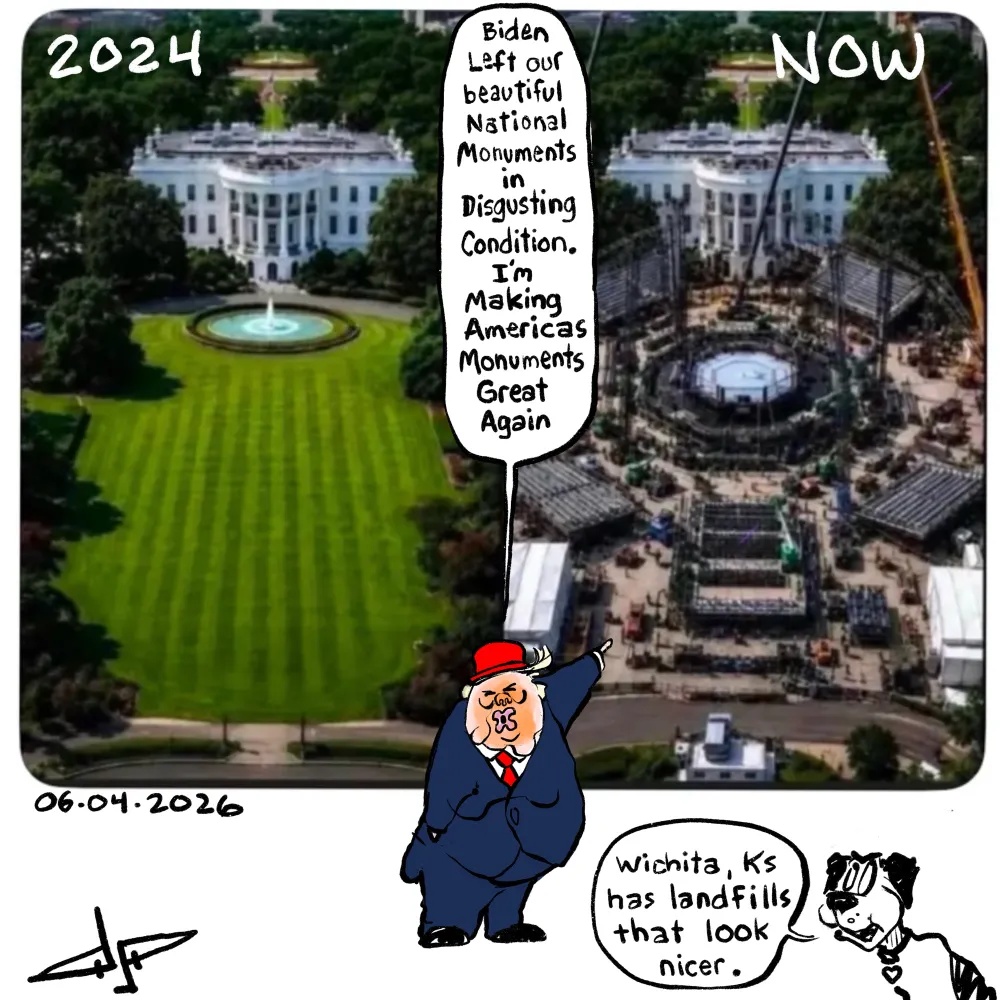
What happened: Trump's latest medical report did not include a hair-loss-prevention drug that his physicians said he used during his first term.
Why it matters: The White House has been criticized for a lack of transparency about Trump's health. Critics say the hair loss drug’s absence raises questions about what else is not being disclosed.
President Trump issued an executive order yesterday redefining the positions within the civil service sector, a change that would make it easier to terminate federal workers by classifying them as political appointees. It would affect many high-level officials who oversee the review and disbursements of grants at the National Institutes of Health. Biomedical researchers and policy experts decried the change when it was proposed this spring.
A federal judge in Rhode Island ordered the Trump administration to restart its processing of asylum claims. The judge also ordered an end to the indefinite hold on applications for green cards and other immigration benefits for people from the 39 countries subject to President Trump's travel ban.
The judge, John McConnell, an Obama appointee, wrote that the policies had violated the law and left immigrants living in the U.S. in "indeterminate legal limbo" because of "anti-immigrant sentiments." He said that the burden had fallen hardest on immigrants who had followed all the procedures.
The policies McConnell struck down have been in place since November, shortly after the authorities said an Afghan national shot two National Guard members in Washington, D.C.
Exclusive: At one point, the Trump administration planned to classify 2.7 million living people as dead, a former senior Social Security official alleged.
Why: The plan was reportedly part of an immigration enforcement effort — though some of the 2.7 million are U.S. citizens or lawful permanent residents — to cut off undocumented immigrants from the financial system.
Nearly two dozen Epstein accusers told Reuters that speaking out sparked threats and relentless harassment, in some cases after Justice Department files exposed their identities. Some now carry weapons and live in fear as online attacks and intimidation transform their lives.
Reuters identified 23 Epstein accusers who've faced threats, harassment and intimidation by trolls, haters and other foes - some after speaking publicly about their abuse, others after their identities were exposed in the Justice Department's Epstein files.
A federally-commissioned study on the health effects of alcohol was published today in an independent journal. The research, which ultimately found that even low levels of drinking may increase disease risk, started as part of an update to U.S. dietary guidelines. But the work sparked controversy when some lawmakers — along with alcohol industry trade groups — claimed the scientists were biased against alcohol and would reach a conclusion with draconian implications.
The Trump administration never released the final report. As STAT's Isabella Cueto writes, the suppression of research that was commissioned by Congress and paid for by taxpayers raises more questions about the independence of scientists under a second Trump administration.
A study that found even low levels of drinking alcohol can increase health risks was published in full on Tuesday in an independent journal after a draft version was sidelined by the Trump Administration, which opted not to consider the federally-commissioned research to inform new U.S. drinking guidelines set out earlier this year.
The study, originally commissioned under the Biden Administration, found that the lifetime risk of dying from an alcohol-related cause, including injuries and road accidents, stood at at least 1 in 1,000 for Americans having one drink per day, but that this rose to 1 in 100 for those consuming two drinks per day. For American men, consuming two drinks per day - a rate widely seen to constitute moderate drinking - the risk was 1 in 25, the study found. The alcohol industry, which lobbied against the study, says its methodology was flawed and it was led by scientists biased against alcohol.
On Tuesday, the Distilled Spirits Council of the United States said a congressional investigation concluded the study was "irretrievably flawed" and should not be considered for the dietary guidelines. The investigation was led by Republican James Comer of Kentucky, the home of America's bourbon whisky.
The Trump Administration opted to use a separate study from the non-profit National Academies of Sciences, Engineering and Medicine to inform the alcohol update. That study found that moderate drinking is associated with a lower risk of dying from any cause.
A HHS official said that the final version published on Tuesday had not been reviewed by the government and had key differences to the federally-commissioned work, including that it downplayed certain protective effects given equal footing in the draft version, excluded other analysis and made policy recommendations.
A group of six U.S. health officials had in early 2025 been drafting a proposal to tighten alcohol advice for Americans to one drink per day for all genders, versus two drinks per day for men and one for women in the 2020-2025 Dietary Guidelines. The Trump Administration ultimately published new advice that guided Americans to drink less for better health, but without advice on servings.
The Alcohol Intake and Health Study was commissioned by the U.S. Department of Health and Human Services to update the alcohol advice in the 2025-2030 Dietary Guidelines for Americans, laid out in January. A draft version of the study was published in January 2025. But the Trump Administration did not consider the findings in its update of the alcohol advice or release the final version of the study, which was published instead in the Journal of Studies on Alcohol and Drugs on Tuesday.
"Putting him in this job, even temporarily, is a mistake, not only because he is unqualified, but because it reveals a contempt for the very idea of nonpartisan intelligence." - John Sipher, who worked for the Central Intelligence Agency for 28 years.
Five days ago, security officers escorted five diabetes experts out of the American Diabetes Association meeting for handing out copies of an editorial criticizing federal research cuts. Criticism of that move from members of the organization continues to pile in, STAT’s Elizabeth Cooney reports. And for many people, the way ADA leadership has defended itself is only making matters worse.
"To me, it was inconceivable," said John Buse, a former ADA president and co-author of the editorial in question. He wasn't necessarily surprised by the idea that leadership might approach the members and ask them to stop handing out materials. But getting officers involved was "shocking," he said.
As the conflict in the Middle East drags on, U.S. goods and services are becoming more and more expensive. A new government report released today showed that consumer prices were up 4.2 percent in May from a year earlier, a significant jump from the 2.4 percent rate before the war.
The increase has been driven largely by spiking energy prices, which have been inflated in part by the near closure of the Strait of Hormuz. Those costs have spilled into other categories that require significant energy, like travel and food.
Polls show that many Americans are frustrated with the rising prices, which are now outpacing wage growth. But President Trump shrugged off the concerns today as a blip and proof his agenda was working. "The numbers were great," he said. "I love the inflation."
Dr. Ashish Jha, a senior fellow at Harvard University who served as President Biden's COVID-19 Response Coordinator. "And yet, in response to the hantavirus and Ebola, this administration has chosen to impose very draconian and extreme public health measures."
The administration, and some outside experts, defend the steps as necessary to protect the American public. Critics say the aggressive measures are uncalled for and counterproductive, and worry that similar tactics would be imposed more widely if any kind of outbreak actually occurs in the U.S.
"It's very concerning about what overreaction we may see," says James Hodge, a public health law professor at Arizona State University. "How far will this government go to contain an outbreak?" But the administration then took a very rare step: imposing mandatory federal quarantine orders on two of the passengers who wanted to quarantine at home like some other passengers. "That's heavy-handed. And really quite unnecessary," Hodge says. "They're taking a lot of steps that many would view as very authoritarian, very over-the-top," Hodge says.
But even more surprising to many public health and infectious disease experts, federal officials also barred U.S. citizens helping fight Ebola from coming home to get treated if necessary. Instead, the administration has been sending Americans to Europe for treatment and wants to open a facility for exposed people in Kenya.
"It's completely stunning that we would not allow Americans to return to the United States," says Jennifer Nuzzo, who runs Brown University's Pandemic Center. "We have specialized, taxpayer-built units that exist solely for this purpose: to provide life-saving care to people who may be exposed to deadly diseases while they are doing important public health work."
In some ways, the tactics mirror the administration's immigration crackdown, says Lawrence Gostin, a public health law professor at Georgetown. "The administration is conflating its immigration policy with public health guidance and expertise," Gostin says. "We're seeing a real overkill that's trampling the civil liberties of American citizens."
Similarly, the Trump administration invoked a public health regulation during the pandemic to quickly expel migrants and asylum-seekers at the U.S.-Mexico border to prevent the spread of the virus. Gostin calls the administration's actions "political theater."
"The administration is trying to look tough," Gostin says. "And that's just no way to deal with an infectious disease that really doesn't know borders. We need to use science and public health rather than political theater and overkill."
The tactics could backfire by discouraging other countries from reporting outbreaks early, undermining public trust, and driving exposed and infected people into hiding instead of cooperating with public health authorities, Gostin and others say. That increases the chances people will bring dangerous infections into the country and spread the pathogens, experts say. The best way to protect Americans is to stop outbreaks at the source, according to Gostin and other public health experts.
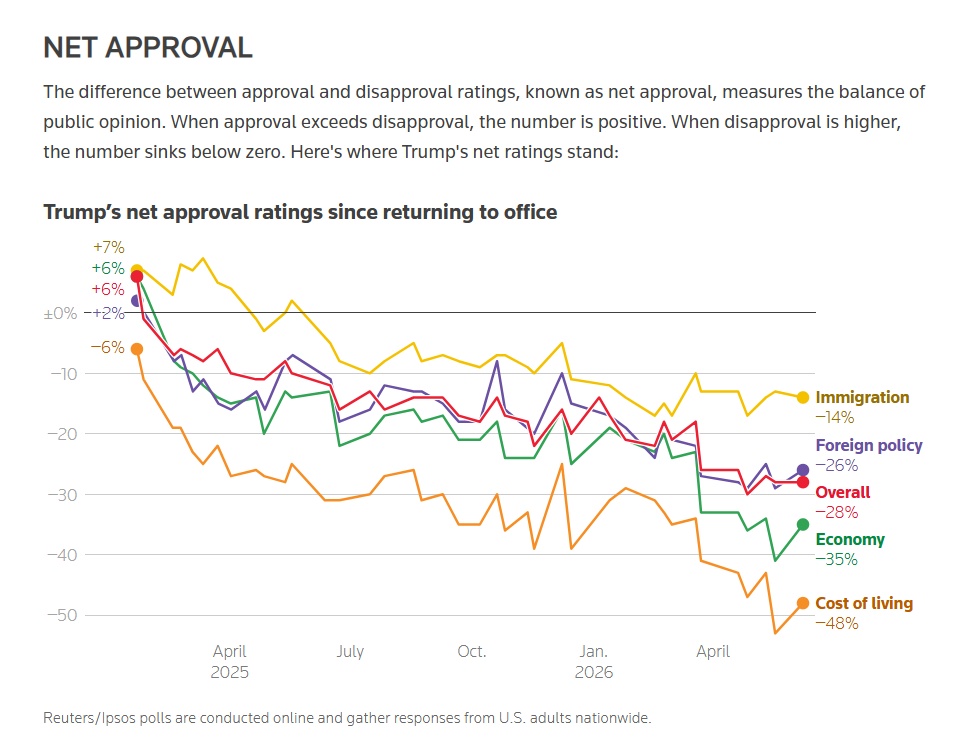
A federal judge in Virginia extended her block on the Trump administration's "anti-weaponization" fund and questioned why the DOJ has not formally rescinded the memo establishing it.
Judge Leonie Brinkema said she's concerned it might come back in a different form. She gave the government a week to come up with a declaration from acting Attorney General Todd Blanche and Treasury Secretary Scott Bessent stating under penalty of perjury the fund is really dead.
The US Food and Drug Administration (FDA) directly cautions parents that if they are being offered stem cell treatments outside an approved clinical trial, "you are likely being deceived and offered a product illegally". Though the Duke trial found minimal safety concerns with properly administered stem cell infusions, authorities continue to highlight the potential risks of under-regulated therapies. The FDA warned in 2021 that it had received reports of complications following applications of umbilical cord stem cells and other related unapproved products leading to "blindness, tumor formation, infections and more".
In his 16 months as the secretary of the Department of Health and Human Services within the Trump administration, Kennedy has undercut established scientific endeavors. He has fired thousands of federal health officials, dismissed longstanding scientific advisers, defunded $31m in autism-related research and attempted to shrink the recommended list of childhood vaccinations.At the same time, largely unnoticed, he has given his backing to alternative health providers moving to fill the gap. Kennedy appeared by video link at the first two annual summits held in San Diego by Autism Health, a leading advocate of stem cell infusions for autistic kids.At the summit last year, he told the audience that "your issue is no longer on the fringe". At this year's gathering in April, he promised to "create opportunities that extend across a lifetime" and to work with the stem cell providers "to drive solutions together".
Kennedy has said that he does not want to see a "wild west" of alternative therapies developing in the US. Yet in the same breath, he conceded that opening up the country to such providers will lead to "charlatans and people who have bad results, but ultimately you can't prevent that". The Guardian has contacted the US health department and the FDA but did not receive a reply.
In fact, the Right to Try Act is specifically limited to patients who are terminally ill and have been diagnosed with a "life-threatening disease or condition". Autism does not fall under that definition. "Technically speaking, the federal Right to Try Act covers terminal diseases and is not applicable to non life-threatening conditions even if they have no cure," said Jeff Cohen, an expert in health law at the Florida Healthcare Law Firm.
A wonky policy change by the Trump administration may spell the end of a wide swath of data from the Census Bureau, including key statistics used for redistricting, policymaking and research. Federal law requires the bureau to keep people anonymous in the data it produces from surveys and government records.
But this month, the administration put out an order that many data experts say makes it harder, if not impossible, for the agency to balance protecting the confidentiality of people's information with releasing useful data about local areas and small populations. The order by the Commerce Department, which oversees the bureau, bans "noise infusion." It's one of the main privacy protection techniques the bureau has used for decades to make certain data fuzzy - to ensure that individual people, including members of minority communities, can't be identified.
Instead, the Trump administration's new policy, which also applies to the Bureau of Economic Analysis, leaves both statistical agencies with two options going forward: releasing "coarsened" statistics with fewer details or not releasing some statistics at all. Data experts worry it could be the latter at the Census Bureau.
"Neighborhood-level data is at risk. Rural communities' data may be not publishable," says Beth Jarosz, a senior fellow at Georgetown University's Massive Data Institute and vice president of the Association of Public Data Users. "There are some counties that are only a couple hundred people, and you might not be able to publish data for those counties anymore." John Abowd, a former chief scientist at the Census Bureau who served during the first Trump and Biden administrations, says the order upends privacy protection systems for multiple ongoing surveys and other datasets.
For the once-a-decade head count the bureau is best known for, the agency did not add any statistical noise to the state-level 2020 census results used to redistribute congressional seats and Electoral College votes. But the bureau has applied privacy protection methods involving noise to the detailed demographic data that's used for redrawing maps of individual voting districts. Abowd says under the Trump administration's ban on statistical noise, plans for 2030 census redistricting data "will have to be completely redesigned, and not just the confidentiality protections." "The only confidentiality protection available is coarsening. It is guaranteed to reduce the level of detail drastically," Abowd adds.Asked if some political mapmakers may find that kind of redistricting data unusable, Abowd replied: "I'm pretty sure most would."
The department's order could be revoked before the 2030 census, under a new presidential administration. But census watchers are concerned about lasting repercussions from a policy change coming in the middle of key preparations for the upcoming national tally and shortly after a thinning of the bureau's expertise amid the Trump administration's slashing of the federal workforce. And some current staffers are expressing alarm about the order.
"It would not be a major overreaction to say that this is cataclysmic," says a bureau employee who asked NPR not to name them because they are not authorized to speak to the press. "From our perspective right now, if this policy stays in effect, it's the end of a lot of our data production."
Jarosz at Georgetown University is concerned that the Trump administration's new ban on statistical noise was released with little explanation. "The way that it should work is that scientists, experts do their best job to come up with a plan. They present that to the public. There are opportunities for feedback. There are opportunities for criticism from other experts that aren't in the federal government. And we end up with a system where it's had really good transparency, lots of checks and balances," Jarosz says. "This new order upends all of that. It takes the public out of the process. It takes the experts out of the process. This feels very much like a political choice."
Until the bureau starts publicly explaining how the order is affecting its data releases, Jarosz adds, it's an open question whether participants in the bureau's surveys should be concerned about the confidentiality of the personal information they have shared with the government.
"The Census Bureau and all of the statistical agencies are bound by laws to protect the privacy of our information. And so they had put together the best tools that they could find to do that," Jarosz says. "If they keep publishing the same amount of data and they don't have those tools, then yes, privacy could potentially be at risk."
The removal comes after U.S. District Judge Christopher Cooper ruled in late May that Trump's rebranding of the performing arts center in his own name was illegal, contravening federal law that the center could only honor Kennedy and usurping authority from Congress.
In the weeks since, officials have removed references to Trump on the Kennedy Center's website, issued new identification cards, edited employee email signatures and rescinded any trademark applications adding Trump to the institution's name, Floca wrote in his filing. The restoration of the building's original name followed denials Friday by both Cooper and an appeals court of last-ditch attempts by the administration and Department of Justice to stay Cooper's May ruling.
"Judge Cooper should be ashamed of himself!" he wrote. “Unless I am free to do what I do better than anyone else, bring this Institution back, physically, financially, and artistically, I have no interest in continuing what could only be a hopeless journey into "NEVER NEVER LAND."
A Kennedy Center official told a federal judge that all references to President Donald Trump inside, outside and online have been removed from the Kennedy Center, in compliance with the court's extended order requiring their removal by noon today. Construction workers began removing Trump's name from the fascade of the Kennedy Center building early Saturday morning, six months after a board handpicked by the president voted to rebrand the iconic performing arts venue by adding his name to it. Crews removed lettering on the building, added in December, that inserted Trump’s name before "The John F. Kennedy Center for the Performing Arts."
In her order closing the case, U.S. District Judge Kathleen Williams, a Barack Obama appointee, expressed a number of doubts about the finality of the process but seemed inclined to let things go - at least for a while. Meanwhile, at least four other lawsuits and/or claims were filed aiming to pump the brakes on what critics call a "slush fund."
California Gov. Gavin Newsom said he and his wife Jennifer Siebel Newsom are being investigated by the Justice Department and accused President Donald Trump of targeting him for political reasons. Agents have "knocked on the doors on family friends and former employees. Not because they've found a crime, but because they're trying to find one," Newsom said in a video. He said the investigators have demanded records and "random documents." Newsom, a Democrat who has repeatedly clashed with the president, said the probe is politically motivated because of his criticisms of Trump and because he is also considering a run for the Oval Office.
The rule changes that the White House Office of Management and Budget (OMB) recently proposed to the Health and Human Services (HHS) grant process would drastically change this process. There are too many objectionable aspects of these proposals to discuss here. But three are particularly striking. Political appointees would be able to make funding decisions and could ignore the advice of independent scientists. They could also stop funding midway through the promised grant period. And they would institute new rules, including rules severely limiting foreign interactions. These changes raise fundamental concerns about the research endeavor, about ethical obligations to participants in clinical studies, about the ability to train the next generation of leaders in biomedical innovation, and about society’s ability to address disease threats early, before broader consequences occur.
A nonscientific, political process for determining what is scientifically sound has not worked in the past and will not work now. Lysenkoism demonstrated that allowing politics to control the scientific process can halt or even reverse a nation’s progress. Erratic funding would fundamentally undermine innovation and dramatically impair America’s ability to address today’s health challenges. The OMB proposal is currently open for public comment, and we urge our readers to express their concerns. When science becomes politicized, everyone loses.
Today: Newsom revealed he and his wife are under federal investigation and accused President Donald Trump of weaponizing the Justice Department.
More: Newsom said the probe is because he is considering running for president in 2028. He did not detail the nature of the investigation.
What happened: A group of preservation and cultural heritage groups today sued to stop Trump's plans to turn national parkland in D.C. into a "National Garden of American Heroes."
Why: The groups accused Trump of "disregard for legal requirements" in pursuing the project. Any new memorial project on federal land would likely require congressional approval.
Friday: U.S. District Judge Leonie M. Brinkema issued a preliminary injunction blocking Trump's proposed $1.8 billion "anti-weaponization" fund.
Background: Trump officials have said the fund is not happening, but have remained ambiguous about whether it may be proposed again in the future.
Summary: 38% of poll respondents did not think the US would exist as a single country in 250 years
64% said American democracy was in danger of failing, up from 57% in August
A majority said 250th anniversary celebrations had grown too political
Trump has put himself at the center of many of the events to mark the anniversary, including staging a White House cage match on his birthday on Sunday. On Monday he said he would be the main attraction at a July 4 celebration in Washington that will also serve as a political rally for the Republican as his party looks to keep control of Congress in November's midterm elections.
Trump has framed his presidency as a bid to save America from being destroyed by Democrats. Democratic leaders contend it is Trump who is the danger to democracy and allege he is using federal law enforcement to target political critics.
Exclusive: A contractor project summary prepared for the White House showed President Donald Trump's planned ballroom would likely cost $600 million, half of which would come from public money.
More: The estimate exceeds Trump’s by $200 million. A White House spokesperson said in a statement that the project will cost $400 million and be privately funded.
Over the weekend: Trump's name was taken off the Kennedy Center at 3 a.m. Saturday, with the spot that used to bear his name now covered by tarps.
Next: The area will remain covered until the underlying marble is repaired. A center spokeswoman did not give an estimate as to when that will occur.
As part of the Trump administration's continued efforts to close the Department of Education, the oversight of special education will now be the purview of HHS, officials announced yesterday.
Project 2025, a policy blueprint for the administration created by the Heritage Foundation, called for the elimination of the Education Department and for HHS to take over responsibilities for administering grants related to disability education.
People with disabilities have fearfully anticipated this decision, as it hands stewardship of disability education over to Health Secretary Robert F. Kennedy Jr., who has called autism an "epidemic" and historically purported a false link between the condition and vaccines.
President Trump blindsided his allies on Capitol Hill today with an early morning social media post. In it, he pulled back his own nominee to be the nation's top intelligence official and demanded that Congress pass a voter ID law, adding to the rising tension with senators in his party.
By delaying the nomination of Jay Clayton hours before his confirmation hearing, Trump cleared the way for Bill Pulte - a close ally of the president with no national security experience - to assume oversight of the nation's spy agencies later this week. Trump's selection of Pulte as the acting director of national intelligence had been condemned by senators in both parties.
Trump's move also makes it more likely that a powerful spy program will remain expired for weeks or months. To "add a slight bit of intrigue," the president said, he plans to block the extension of the program unless it was paired with new requirements on voter identification and registration, which do not have enough Republican support to advance.
Last month, the National Science Foundation (NSF) abruptly decided to dismantle much of the Ocean Observatories Initiative (OOI) - a network of underwater and floating infrastructure, and a fixed subsea observatory in the Pacific Northwest. Marine scientists have long debated the correct balance between spending on costly infrastructure like these, and funding research grants. But the sudden break-up of OOI has triggered widespread condemnation. The NSF has not shared its reasoning for the decision, so researchers are left wondering to what extent the move reflects scientific priorities, policy changes or the predilections of the Trump administration.
The first removals of instrumented moorings were scheduled to begin today. There has been a bipartisan effort by some lawmakers to stop the process, and Democrats from the US Senate have called the move "expensive, destructive, and - crucially - illegal".
The deal: Experts say the agreement requires early concessions from the U.S., including the lifting of sanctions, while making vague promises of working toward an agreement on Iran's nuclear program.
More: World leaders have publicly praised the deal as a move toward peace, but many officials say the deal leaves many terms undefined.
What to know: The White House today retired a jet that has served as Air Force One for 35 years in preparation of a jet donated by Qatar becoming the new presidential plane.
Controversy: The $400 million jet was given to the Trump administration by Qatar and is expected to be gifted to Trump's presidential library at the end of his term, leading critics to suggest it amounts to a bribe.
Senate Democrats are opening an inquiry into the Trump administration's remaking of federal vaccine policy, demanding officials produce records by next week. STAT's Daniel Payne viewed a letter that senators sent to Kennedy, denouncing his changes to the Advisory Committee on Immunization Practices in particular.
Democrats in Congress have regularly complained that HHS leaders aren't compliant with their requests for information, and it's hard to see how this inquiry would be different. Still, the letter offers clues about the direction of future oversight efforts by Democratic senators, especially if they’ve got a majority after the midterms.
Two diversity-oriented programs supported by the National Institutes of Health doubled the odds that an undergraduate student would earn a Ph.D., a new study found. Over the past year, both programs were terminated by the Trump administration — as was the funding for the study analyzing them.
“The word that comes to mind is heartbreaking,” Anna Woodcock, an author on the study, said about the termination of the research. It's "just absolutely crushing to spend 20 years of a career doing this work to find it cut so abruptly."
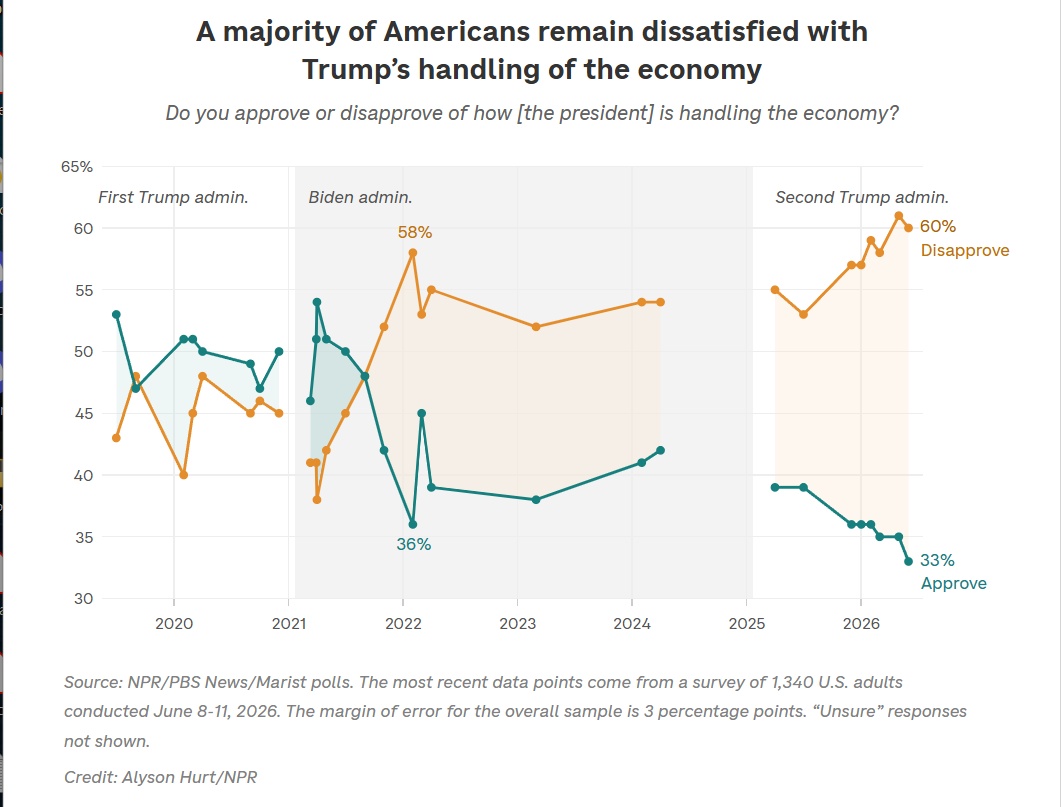


Last week we learned that the Department of Commerce quietly issued a policy directive that the Census Bureau and the Bureau of Economic Analysis (BEA) that limits the type of privacy protections the agencies can use. The policy limits the agencies to two of the oldest methods of privacy protection, thus making it more difficult for agencies to safeguard data.
The agencies strive to protect data while also publishing meaningful public data. However, taking away a privacy tool will not necessarily result in 'better data' but will likely result in less data, less useful data, or both.
Without proper data privacy tools agencies will have to:
Aggregate data at higher levels - meaning less granularity;
Suppress data; or
Withhold data products
Data products have already been removed from the Census Bureau’s website. Data for Democracy means transparency and accountability to the public. This is the opposite.
Boycott Trump's Fourth of July party. "Thanks to the incompetence and dishonesty of Mr. Trump's planning team, there won't even be any good bands playing. Talk about a lame party. Better that states stay home and invest in less divisive local festivities."
The Iran deal is a U.S. failure in writing. "This is the biggest geopolitical power shift in the Gulf since the start of the Iran-Iraq war. There is a new sheriff in town. Dial 1-800-Ayatollah."
Former President Barack Obama said it seems like the United States has either returned to the status quo or is "worse off" now than before President Donald Trump launched the war on Iran.
In an interview with "TODAY" co-host Craig Melvin, Obama said: "We've now fought a war, spent billions and billions of dollars, you know, put enormous strain on our military. A lot of people have died. And it feels like we're back where we were before we started the war, except maybe a little bit worse off." The former president noted that under the 2015 deal negotiated during his administration, "Iran had agreed not to develop nuclear weapons."
Why would an administration want to hide any historical information about the past (and be so willing to go to battle to keep these stories hidden)? Why undo the work of communities and researchers who have worked together to invite visitors into a conversation about the past, how we talk about the past, and how the past shapes our future? Who benefits from unilaterally deciding which stories and questions get to stay in a historic site? And how will this chapter of history be told in 20, 50, 100 years, at Independence National Historic Park and beyond?
Most Americans continue to disapprove of how President Donald Trump is handling Iran, according to a new AP-NORC poll that was conducted as Trump suggested a deal with Iran had been reached.
What to know: Trump's overall job approval stands at 37%, unchanged from an AP-NORC poll conducted in May. Americans' views on how the president is handling Iran are roughly in line with that. About one-third of U.S. adults approve of Trump's approach to the economy. That's in line with last month, and continues a challenging stretch for Trump on the issue.
A new report from the Center for Western Priorities found that less than one percent of 35,700 comments submitted to the National Park Service in response to signage asking the public to report negative depictions of American history in parks actually used the comment form as intended. The comments were received via a QR code sign that Interior Secretary Doug Burgum ordered to be posted at national park sites. The sign asked park visitors to report "any signs or other information that are negative about either past or living Americans or that fail to emphasize the beauty, grandeur, and abundance of landscapes and other natural features."
The Center for Western Priorities analyzed 35,700 comments submitted across 475 national park units between June 2025 and January 2026, organizing the comments into categories based on content and sentiment. The vast majority of comments expressed opposition to the order, support for national parks, the importance of telling a complete history, criticism of the Trump administration generally, as well as a number of jokes and off-topic responses. However, a negligible number of comments actually flagged signage or supported removal, with only 47 comments, or 0.1 percent of the total comments submitted.
"These comments pass the vibe check with flying colors. Americans support our parks and the stories they tell, and they aren't happy about the Trump administration's efforts to rewrite history," said Lilly Bock-Brownstein, Center for Western Priorities Creative Content and Policy Manager. "Instead of helping Trump censor our national parks, visitors used the comment form to tell the Trump administration to respect our parks or get lost."
The Trump administration's budget office redirected $352 million that was intended in part for Secret Service training and recruitment to what it described as security measures at the White House, a government database shows.

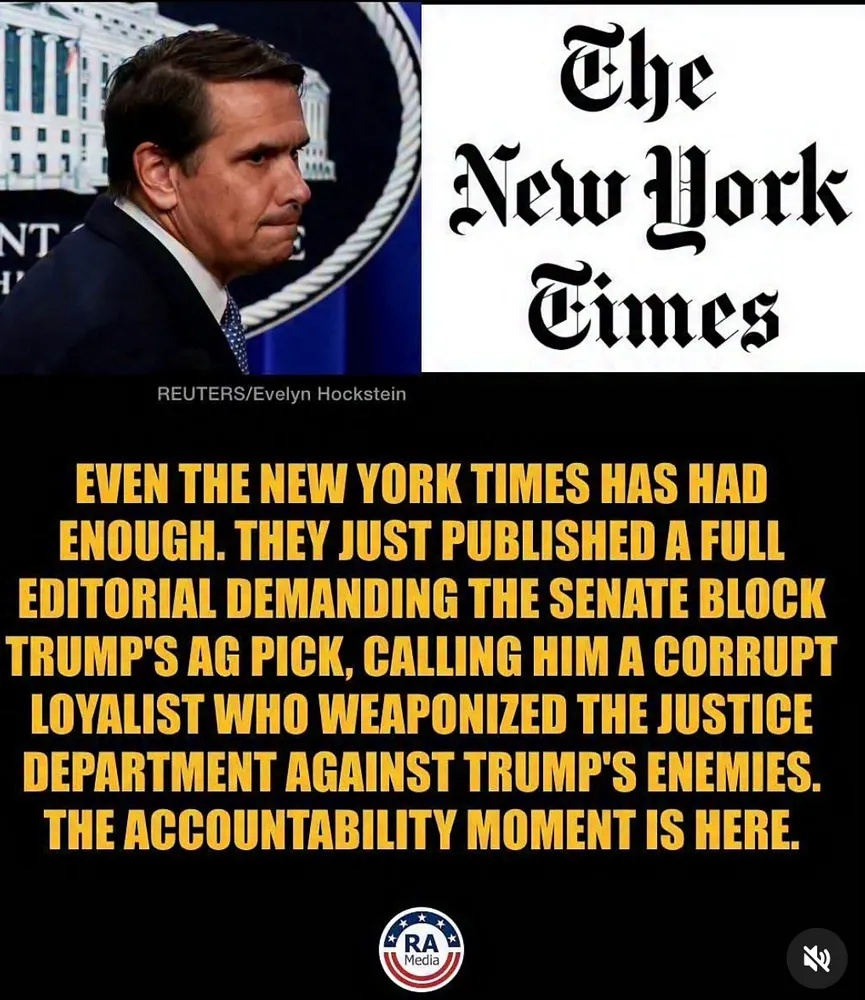
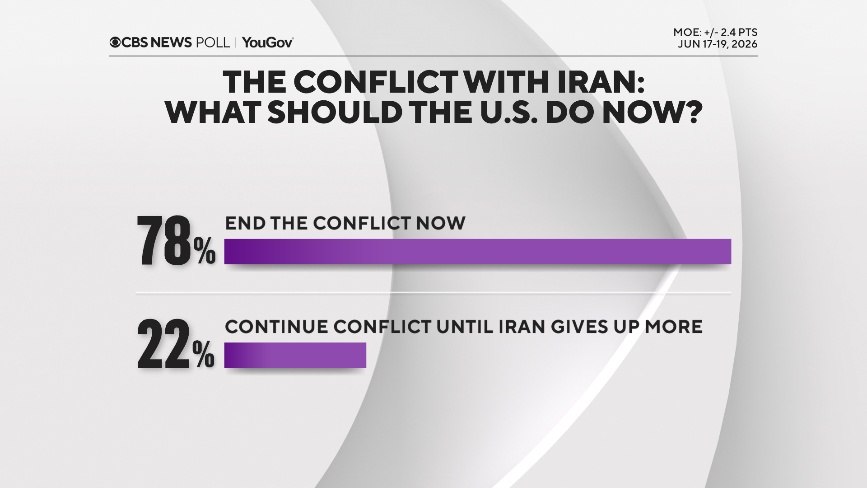
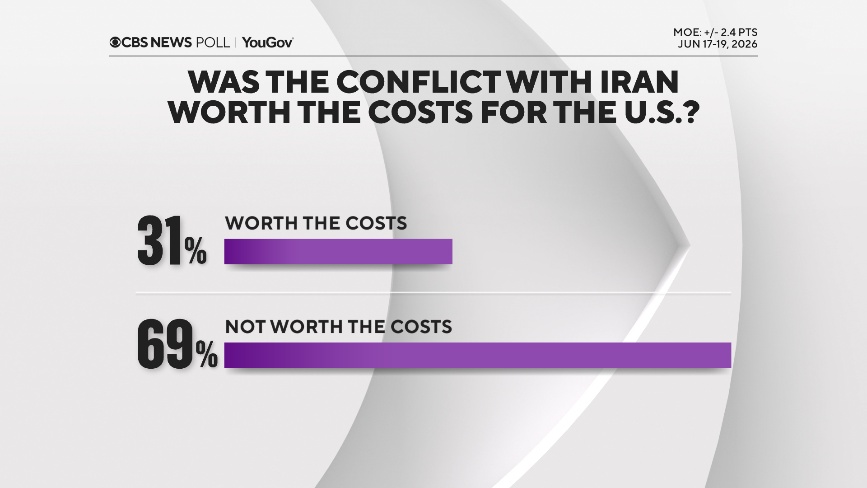
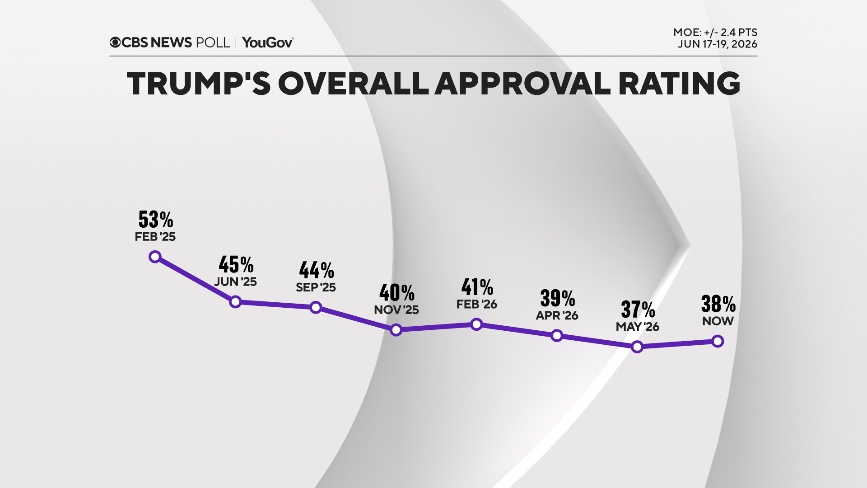
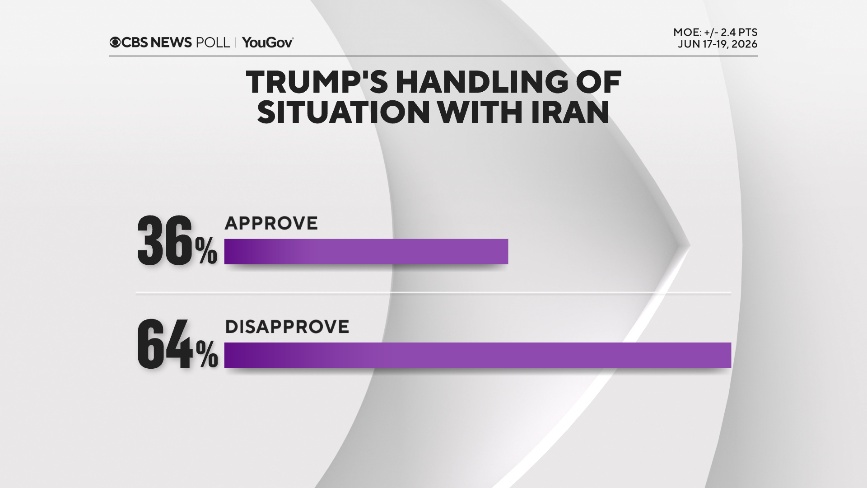

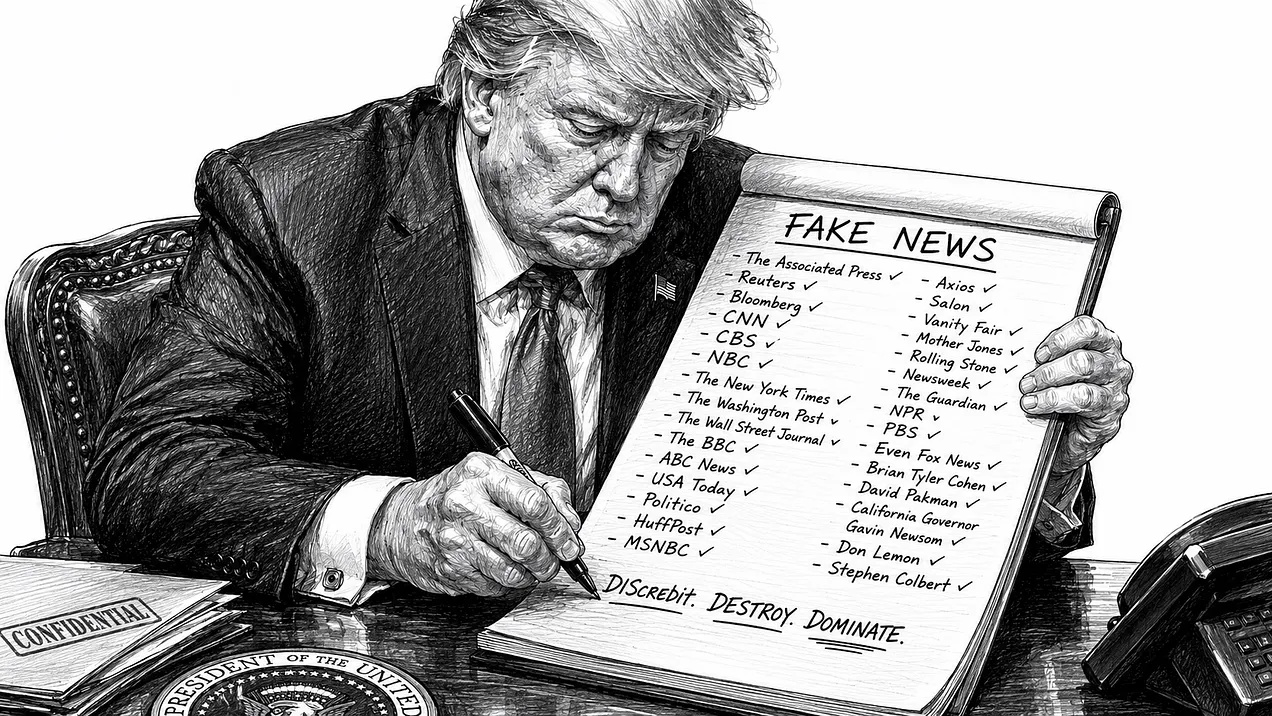
Right now, on an official United States government website funded by taxpayers, there is a page that names specific American news agencies and journalists, and brands them as media offenders. Not a campaign site. Not a political action committee. The White House. Whitehouse.gov. The building your taxes pay for. Most Americans have no idea this page exists. That changes today, because once you see it, you will not unsee it. Go look. The address is "Media Offenders." The tagline reads "Misleading. Biased. Exposed."
The page went live the weekend after Thanksgiving 2025. Its first weekly entry is dated November 28. It works like a wanted board for the press.At the top sits a rotating "Media Offender of the Week." The government picks an outlet and a reporter, prints their names, prints the claim it dislikes, and stamps its own version of “The Truth” beneath a heading that reads "The Offense."
Below that runs an "Offender Hall of Shame," a searchable database of stories the administration has flagged. Each entry tags the outlet, the reporter, and a category of wrongdoing. The labels include bias, lie, malpractice, omission of context, mischaracterization, clickbait, and one the government literally calls "Left-Wing Lunacy." There is a Leaderboard that ranks news organizations by volume of alleged offenses, like a sports standings table for shaming the press. The administration’s own description calls it "a race to the bottom."
There is a "Repeat Offenders" chart for outlets the government says keep getting it wrong. The list of named publications reads like a directory of American journalism. The Associated Press. Reuters. Bloomberg. CNN. CBS. NBC. The New York Times. The Washington Post. The Wall Street Journal. The BBC. Even Fox News and the conservative Daily Signal show up when a story displeases the White House.
In June 2026 the page expanded past newsrooms into a category called "Leftist Influencers." It started naming individual online commentators such as Brian Tyler Cohen and David Pakman, accusing private citizens of spreading false claims about the President. California Governor Gavin Newsom's office flagged that the targets also swept in figures like Don Lemon and Stephen Colbert. Then there is the part that should chill you most. The page hosts a "Report Bias" tipline.
The government asks the public to submit articles for the list. A federal administration is recruiting ordinary Americans to inform on reporters, by name, on government property. Read the language the page uses about the people it targets. It calls a physician a "charlatan." It calls a medical opinion "moronic." It nicknames CNN's Jake Tapper "Fake Tapper." This is the official voice of the United States government, written in the cadence of an anonymous troll account.
The Society of Professional Journalists, the oldest broad-based press association in the country, sent a formal letter to the White House press secretary demanding the page come down. Its national president and its ethics chair signed it. They pointed to one entry as the tell. CNN’s Jake Tapper had misidentified the race of a suspect on air, then corrected it. Correcting a mistake in the open is what the SPJ Code of Ethics tells journalists to do. The White House put the correction on the offender page anyway.
Sit with that. The government took a reporter who followed the rules, who owned an error in public, and held him up as a villain for it. When a government punishes honesty, it teaches every reporter watching to bury the next mistake instead of fixing it. A page that claims to defend truth ends up rewarding the cover-up.
Leadership is measured by how power treats the people who criticize it. Anyone can protect speech they like. The entire point of the First Amendment is to protect the speech that those in power cannot stand. A confident government answers criticism with facts and lets the public decide. A frightened one builds a list. In its letter to the White House, the SPJ noted that this page mirrors a 2017 Kremlin initiative that lists independent journalism carrying unfavorable coverage of the Russian government as "fake news," and warned that the United States should not follow that example. When the oldest press association in America compares your government's website to a Putin program, that is not partisan noise. That is the alarm.
In China, the Cyberspace Administration runs a state platform to "refute rumors," an official government site that publishes the government's version of truth and labels disfavored claims as false. Researchers have criticized it for hiding its methods and tracking the Communist Party's line. The structure is the same one now sitting on whitehouse.gov.
In Russia, the Kremlin brands journalists and outlets as "foreign agents," and the media regulator Roskomnadzor went after independent newsrooms like Novaya Gazeta and TV Rain for how they covered the war in Ukraine, then drove them off the air. Russia names the enemy in public first. The shutdown comes later.
In Hungary, Viktor Orban's allies launched pro-government outlets dressed up as fact-checkers that push the state's narrative and discredit the press that questions it. In Turkey, a site called "Fact Checking Turkey" treats statements by government officials as the measure of truth and aims its fire at foreign coverage the government dislikes.
In North Korea, the end state of all of this, the government simply owns the truth outright, and no competing account is permitted to exist. Every one of these regimes begins from the same premise the Media Offenders page begins from: the state decides which journalism is legitimate, and the state keeps a list. We have spent generations telling ourselves that this is what makes us different from them. The page on our own government’s website erases that line.
Today: Minnesota's chief federal judge ruled today that there was no merit to subpoenas issued to Gov. Tim Walz (D) and other state and local officials.
More: The judge said in his order that the subpoenas were meant to coerce Minnesota officials to take specific actions Trump wanted on immigration enforcement.
Yesterday: Trump said in a post on social media that Prime Minister Keir Starmer would resign, and that he had "failed badly" on immigration and energy policy.
Awkward timing: Trump's post came before Starmer's announcement of his resignation today, leading to heavy British criticism of the president's foray into the nation's domestic politics.
Since the Trump administration announced its plan to overhaul the federal grantmaking process to give more power to political appointees, researchers have expressed alarm at the potential impact such a change could have on American science. And within the 412-page proposal, there's one particular section that health disparities researchers say could disqualify their work from federal funding - a change that poses perhaps the biggest threat yet to the future of their field.
That section would prohibit the use of federal funds to "Promote or Support Theories of Disparate-Impact Liability." Disparate-impact liability, essentially, refers to the idea that even a seemingly neutral policy or action, without explicit discrimination, could cause disproportionate harm to a specific group of people. Researchers worry that this language, which goes beyond banning "DEI," could further promote a colorblind view of the world that ignores race. (Hint: The statement includes the phrases "unaccountable deep state bureaucrats" and "woke and wasteful projects.")
More funding anxiety news: A federal institute focused on disability research has currently allocated $37 million for federal grants, but nearly all of it - totaling more than $34 million - has yet to be made available. If the money is not distributed before Sept. 30, the end of the fiscal year, it could eliminate scores of jobs and devastate essential programs that support individuals with disabilities and research about the disability community.
The National Institute on Disability, Independent Living, and Rehabilitation Research is small, but as the only federal body focused on disability research, its impact is real. "It feels like the research infrastructure of our country is crumbling," Kansas-based researcher Kelsey Goddard said. "If I don't have NIDILRR funding, I am effectively out of a job."
A federal judge on Monday ruled that a recently revamped version of a federal tool central to the Trump administration's efforts to nationalize elections can no longer be used. U.S. District Court Judge Sparkle L. Sooknanan sided with advocacy groups that argued the recent upgrades to the program, called Systematic Alien Verification for Entitlements, or SAVE, aggregated Americans’ sensitive personal data in a way that could result in voters being wrongly purged from voter rolls.
"All in all, the federal government has knowingly trampled on the privacy rights of American citizens in a manner that threatens the sacred right to vote," Sooknanan said in an order explaining the decision. "This Court cannot stand idly by while that happens." She said Congress had expressly prohibited the government from centralizing Americans' personal identifying information and that the federal agencies that created the SAVE program "knew that the database violates those statutory protections."
The decision is a major legal setback for President Donald Trump in his efforts to use federal agencies to encourage a nationwide crackdown on having noncitizens illegally on state voter rolls. The modified SAVE system, which critics had referred to as an unlawful centralized federal database of voter information, had been a key pillar of the second election executive order the Republican president signed earlier this year. The ruling leaves its future uncertain.
The executive order seeking to create a national voter list is among numerous steps Trump has taken during his second term to try to overhaul the way elections are run. He also has tried to force voters to provide documentary proof of citizenship to register to vote, ban mail ballots from counting if they are received after Election Day and prohibit the Postal Service from mailing ballots to people not on an approved list of voters. Most of those steps have been blocked by various courts, in part because the Constitution gives states and Congress the authority to set election rules, but provides no such power to the president.
Voting by noncitizens is already illegal and punishable as a potential felony that could lead to deportation. It also is rare, accounting for just a tiny fraction of those on state voter rolls, The SAVE program was created under an immigration law mandating that DHS help federal, state and local agencies prevent government benefits from going to noncitizens. At least 25 states used it to check their voter rolls since April 2025, after the Trump administration significantly expanded its search abilities. Since then, at least 67 million registrations have been scanned through the program, but critics worry it could end up purging valid voters from the rolls.
Anthony Nel was one of those whose registrations were wrongly flagged. The South Africa native became a U.S. citizen more than a decade ago but had his voter registration in Denton, Texas, north of Dallas, canceled temporarily last year after Texas ran its voter file through SAVE. The check wrongly identified him as a potential noncitizen. "I hope others can see this fight and not take their right to vote for granted," he said in a text message.
The judge wrote. "So they haphazardly combined and repurposed the private information of millions of Americans, including citizenship data that they knew to be unreliable." Mark Johnson, who teaches at the University of Kansas law school and regularly pursues lawsuits over election laws, said "it couldn't be more clear" that the SAVE program violates federal privacy laws. He said an executive order from Trump cannot override a federal law."
"It's an illegal idea. Plus it's a bad idea," he said. In her ruling, Judge Sooknanan said the plaintiffs had shown that the updated system had indeed been identifying some lawful voters as noncitizens and that states using it "are actively removing United States citizens from voter rolls based on inaccurate information."
The US National Science Foundation (NSF) announced last week that it will no longer proceed with Trump administration plans to dismantle much of the Ocean Observatories Initiative - a network of hundreds of instruments used to monitor ocean science and climate change. Some devices had already been removed, and the NSF said that it is "developing plans to redeploy the equipment after servicing". The change came after a bipartisan effort by some lawmakers to stop the system from being taken apart.
Breaking: The Senate passed a war powers resolution to stop President Donald Trump from resuming strikes on Iran, with four Republicans joining all but one Democrat to support it.
What next: The House passed the same measure earlier this month. War powers resolutions cannot be vetoed, but there are disagreements as to whether they can be legally enforced.
New: A top medical journal today published a study that found covid vaccines cut emergency department visits and hospitalizations among healthy adults by half last winter.
Background: The study was originally supposed to appear in the CDC's Morbidity and Mortality Weekly Report in March, but was pulled from publication by Jay Bhattacharya, CDC’s interim director.
This spring: The Justice Department issued subpoenas to Post reporter Ellen Nakashima and three Wall Street Journal journalists about their national security reporting.
But: The news organizations challenged the subpoenas for the journalists to appear before a grand jury. The subpoenas were withdrawn earlier this month.
Yesterday: Trump claimed in a social media post that vandals "took some form of knife or blade, and put a 250 foot long gash" into the new paint job on the Lincoln Memorial's Reflecting Pool.
More: The Trump administration has not provided evidence of the claim, despite Trump saying it would release photos of the damage.
Last week: Scotts Miracle-Gro committed $1 million to resod the White House South Lawn after it was damaged by the UFC fight held there on Trump's birthday.
Concerns: CREW, a nonprofit government watchdog, said the arrangement raises ethics questions. CREW’s vice president said White House social media posts about the donation read like an ad.
Today, 101 former judges filed a complaint, asking the New York State Bar Attorney Grievance Commission to "initiate an investigation into Acting Attorney General Todd Blanche (Registration No. 4192456) for violation of the New York Rules of Professional Conduct." The judges are joined by Democracy Defenders Fund and Lawyers Defending American Democracy.
There are three grounds for the request:
The role Blanche played in the settlement of Trump v. I.R.S., which the referral calls "fundamentally incompatible with his ethical obligations under the New York Rules of Professional Responsibility." They cite multiple ethics rules that prohibit lawyers from engaging in "Conduct that tends to reflect adversely on the legal profession as a whole and to undermine public confidence in it warrants disciplinary action," before concluding, "Never could that be clearer than here."
Blanche's abuse of his authority at DOJ against personal and political enemies of his former client, Donald Trump. The complaint points out that this violates ethics rules against bringing frivolous cases, defined as "the lawyer knowingly advances a claim or defense that is unwarranted under existing law." It also refers to a rule that prohibits lawyers from "engage[ing] in conduct that is prejudicial to the administration of justice" and in harassing conduct.
Blanche's "personal involvement in overseeing the Department of Justice's botched and incomplete release of documents related to Jeffrey Epstein and Ghislaine Maxwell under the Epstein Files Transparency Act (EFTA)." The complaint references "serious concerns" about Blanche's interview of Ghislaine Maxwell. The complaint argues he failed to meet "expectations of competent and diligent representation of the United States," that his work "was burdened by his own conflicts of interest," and that overall, the circumstances "reflected adversely on his fitness as an attorney." The complaint concludes that "The American public deserves an Attorney General who serves the interests of the Nation, and not those of a single man."
All of this is happening as Blanche continues to be embroiled in the growing scandal over the slush fund case. He has refused to submit written guarantees to the court in the Eastern District of Virginia that the government has abandoned the plan to give Trump access to $1.776 billion in taxpayer money to use as handouts for January 6 defendants and others of his supporters who claim they were mistreated by a weaponized justice system—by which they mean, of course, that they pled guilty or were convicted by juries in cases brought against them.
There's a new controversy in the works involving Blanche, with CNN reporting that "Trump personally pushed acting Attorney General Todd Blanche to issue" subpoenas to journalists at The Washington Post and the Wall Street Journal in connection with investigations into alleged national security leaks. The papers fought back and DOJ withdrew the subpoenas, but the reporting about Blanche's involvement may raise additional ethics questions that he will have to face. CNN wrote that Trump "delivered the message" to Blanche that he wanted an investigation "with the word 'Treason' written in Sharpie - on a stack of printed articles he handed to Blanche."
Trump and Blanche are putting all the reasons that independence is a necessity on full display.It's important that the people with the power to investigate others are subjected to strict standards of accountability themselves. This Justice Department has dismantled those procedures.
Or as former Deputy Attorney General Laurence Silberman more succinctly put it, "the most heinous act in which a democratic government can engage is to use its law enforcement machinery for political ends." Blanche has been accused of doing just that. Accountability could come, in his case, in the form of a Senate confirmation hearing, which he must survive to become the Attorney General. But judgment by a bipartisan group of his peers in New York would be a far more fitting place for judgment on the claims that have been made against him to be rendered. The institutions that are supposed to keep power in check only work if people pay attention when they're tested. That's what we're doing: following the facts, insisting on accountability, and refusing to look away when the rules are bent for the benefit of the powerful.
The latest: A judge today asked the center's board of trustees why the building is still obscured by scaffolding and tarps 11 days after a construction crew removed Trump's name from the building.
More: The judge ordered the board to file an update on the matter, as well as the center's plans for the coming months after it was ordered to remain open past Trump's planned July 5 closure.
The Post tested ChatGPT, Gemini and other chatbots with political questions, and the results show that the AI tools have different political leanings.

U.S. District Court Judge Indira Talwani, who was nominated by Democratic President Barack Obama, sided with a coalition of nearly two dozen states that challenged the Republican president’s order in granting a summary judgment. Her ruling applies to this year’s midterm election cycle.
Plaintiffs argued in two lawsuits, both filed in federal court in Boston, that Trump's order should be found unconstitutional because the states and Congress, not the president, have the power to set election rules. The judge agreed, saying in her ruling that the provisions of Trump's order seeking to create a federal list of eligible voters and using the U.S. Postal Service to determine who can receive a mail ballot are "legally void" because they "unconstitutionally violate the separation of powers."
It was the second ruling in as many days against executive orders Trump has signed seeking oversight of the nation's elections. A separate ruling Wednesday prohibited an executive order he had signed last year that would have required people to show documents proving their citizenship when registering to vote.
"Donald Trump's executive order targeted all of these voters," she said. "But today, the courts affirmed what the Constitution makes clear: States run their elections, not the President."
Maine Secretary of State Shenna Bellows, a Democrat whose state was among the plaintiffs, said the executive order illustrated how Trump was attempting to "abuse power in previously unthinkable ways" to interfere in elections.She said it “strains credulity” to think the U.S. Postal Service could set up a workable system for pre-screening individual voters to determine whether they would be allowed to vote by mail, adding that it would be "a shocking violation of American constitutional rights."
Since his 2020 presidential election loss to Democrat Joe Biden, Trump has groundlessly claimed mail voting is rife with fraud and has launched a federal investigation into that year's vote, even though repeated audits and investigations, including ones run by Republicans, found it was free of widespread fraud. Trump also has said he wants to "take over" election administration in Democratic areas.
Thursday's decision to end temporary legal protections to about 350,000 Haitians and 6,000 Syrians may be a sign of what’s in store for nearly 1.3 million people from 17 countries on Temporary Protected Status. Read more.
What to know: The decision exposes TPS holders from Haiti and Syria to potential detention and deportation. It could also pave the way for hundreds of thousands of other beneficiaries with pending asylum claims or other immigration relief to be forced to leave the country. Many have lived and worked in the United States for decades and have American children.
Fired government scientists just launched a new site to keep climate data public.The site is called " Climate.us & it was created by former staffers behind Climate.gov, the NOAA-run website long used by many for trusted climate information."
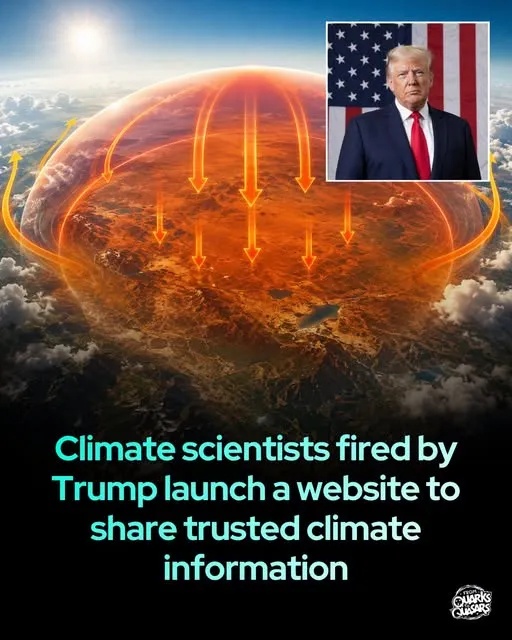
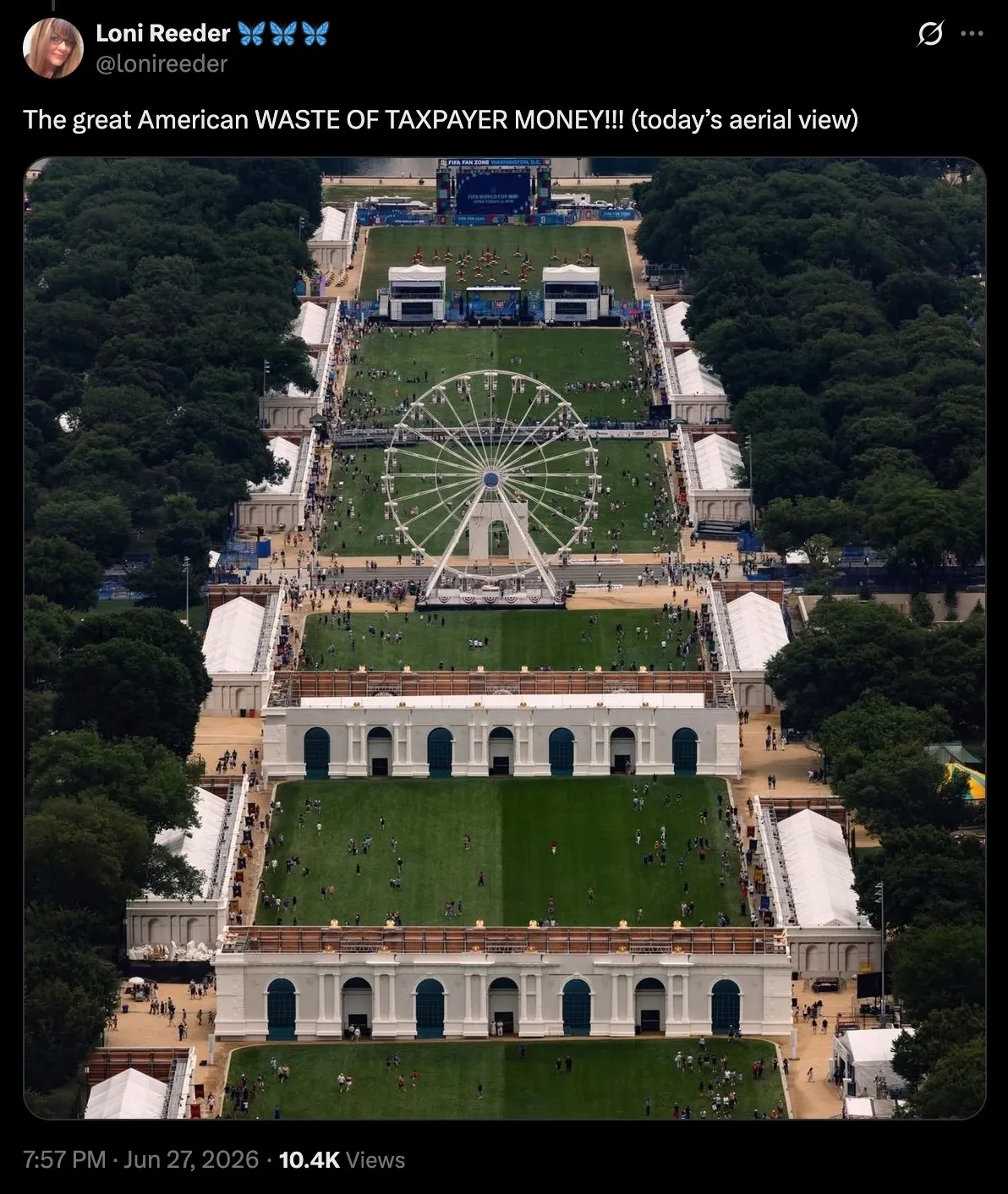
Today: The Supreme Court ruled that President Donald Trump can fire the heads of independent agencies without cause but that he cannot fire a Democratic appointee to the Federal Reserve Board.
Also: The court also decided not to take up Trump's challenge of a $5 million civil judgment against him after he was found liable for allegedly sexually abusing and defaming journalist E. Jean Carroll.
Last week, a federal judge in D.C. temporarily blocked new regulations restricting the amount of federal loans that students pursuing nonprofessional degrees can take out, while also drastically redefining what counts as a professional degree. Importantly, U.S. District Judge Beryl Howell did not rule on the legality of differentiated loan caps overall, but focused specifically on the Trump administration’s definition of a professional degree. That definition is likely inconsistent with the way Congress defined it when creating the loan caps last summer, she wrote in the decision.
The rule, set to take effect Wednesday, will be paused as judicial review continues. In the meantime, health care workers continue to push back. On Thursday, more than 500 nurses arrived at Capitol Hill for a day of advocacy. One of their talking points: the Nursing is a Professional Degree Act, which aims to change the field’s position within the policy via legislation.
Last summer, after Trump shuttered climate.gov-the National Oceanic and Atmospheric Administration's portal on climate science-the site's former program manager called it a "deliberate, targeted attack." Another former NOAA official, once its acting chief scientist, accused the administration of trying to keep inconvenient climate data "buried." Thousands of NOAA staffers (north of 20%) had been either fired, laid off, or forced into early retirement by that point last June—including all ten tasked with producing climate.gov.
But it looks like America's vaunted private sector really is still a place where entrepreneurial visionaries can identify gaps in the market and meet the public's needs: A team of roughly 80 volunteer scientists and former NOAA staffers has resurrected climate.gov as the nonprofit climate.us.
Funded with over $321,000 in crowdsourced donations (and more from one major anonymous backer), climate.us restores the site's climate "dashboard," which graphs everything from arctic sea ice to greenhouse gas emissions to fluctuations in radiation from the Sun. It's also reassembled the old government resource's entire 15-year history of climate news, as well as blogs by subject matter experts unpacking complex meteorological phenomena like El Niño, maps, status reports, and classroom materials designed to aid climate literacy.
"Trusted climate information should not disappear when politics change," said Rebecca Lindsey, former managing director of climate.gov and current director of climate.us—in a statement.
"Climate.us is building an independent, durable platform so people can continue to find the data and information they need to understand and talk about climate, and to teach, report, plan, prepare, and make informed decisions," she explained.
Lindsey's team found powerful allies among the pool of dedicated (and now grievously underemployed) scientists forced out of public service last year under Trump-aligned billionaire Elon Musk's perversely wasteful government efficiency initiative, DOGE.
Even without all of that previously accessible, up-to-the-minute climate data, many researchers and educators are grateful to have this version of NOAA’s site back on the web.According to the fledgling nonprofit, about one third of its funding has come from over 2,500 small donations, offering a freedom from influence that it might not have enjoyed under any presidential administration in the past.
Lindsey said the new site will uphold climate.gov's original commitment to unbiased dissemination of scientific information without advocating for any specific actions on climate change. As Lindsey told the New York Times, "The best solutions to our climate challenges are going to come from a climate literate public."
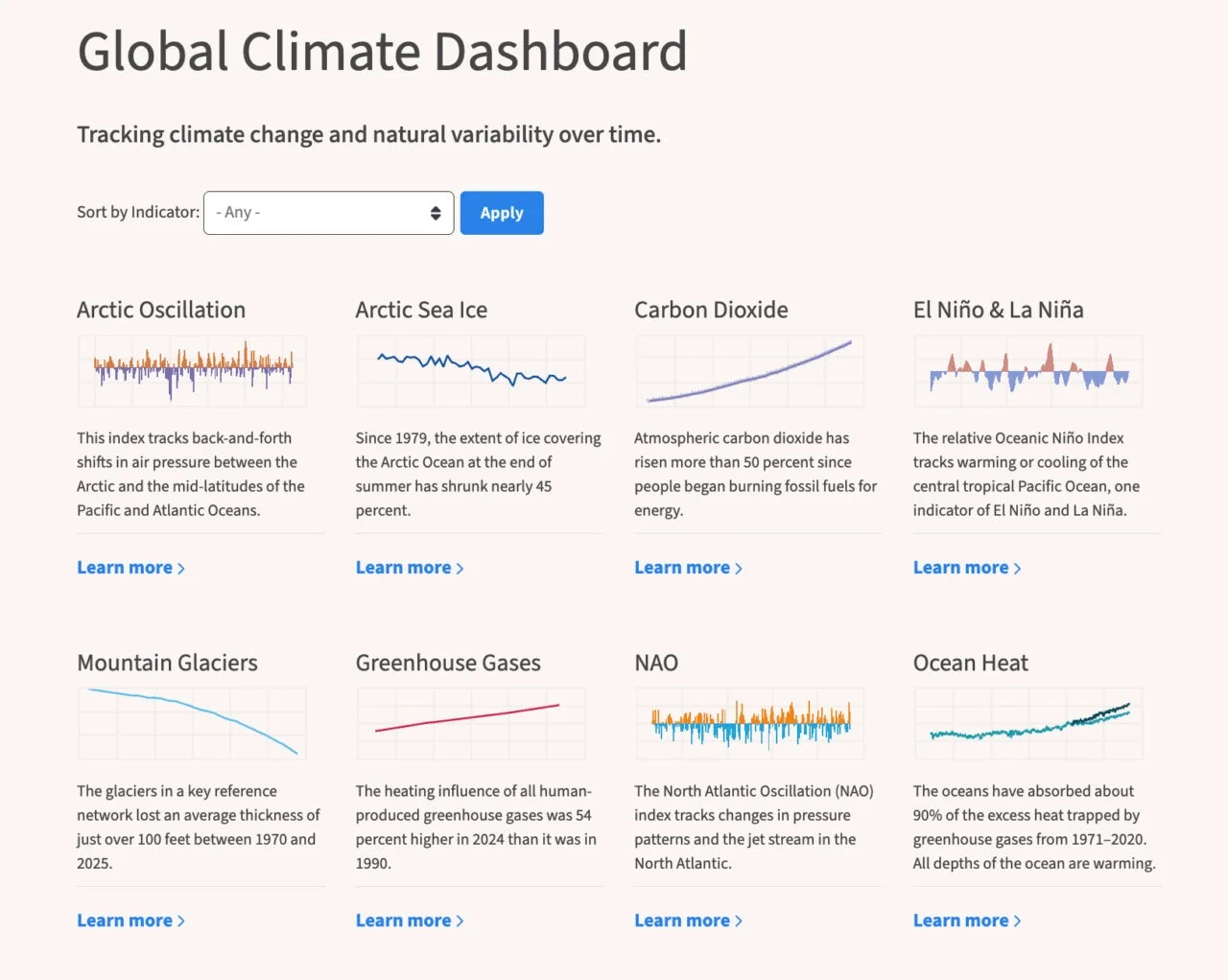
The White House routed a $500 million no-bid contract through a White House office that typically handles repairs and furnishings and is exempt from competitive bidding requirements.
The justices struck down President Trump's executive order limiting birthright citizenship, reaffirming the long-held principle that the Constitution guarantees that nearly all children born on U.S. soil are citizens.
The Supreme Court significantly expanded presidential power yesterday, holding that Trump can fire most independent government regulators. That's a big deal. Critics say a president who can fire regulators at will is a president less constrained by constitutional checks and balances. He or she can issue loyalty tests. The court framed only one exception: governors of the Federal Reserve.
The first concerned Trump's efforts to fire Rebecca Kelly Slaughter, a Democratic member of the Federal Trade Commission, because her policy views are, in his mind, inconsistent with the priorities of his administration. (As in, she's a Democrat.) The 6-to-3 decision in that case determined that the president could indeed fire her at will.
That's a substantial shift in political power, one that gives the president more direct control over independent government agencies. The ruling has implications for more than two dozen of those agencies — including, but not limited to, the Securities and Exchange Commission, the National Labor Relations Board, the Nuclear Regulatory Commission and the Postal Service. As my colleagues note, the president has already changed the leadership of at least 13 agencies.
The Supreme Court said today that President Trump's executive order limiting birthright citizenship had violated the 14th Amendment of the Constitution. The justices, in a 6-to-3 decision, reaffirmed the long-held principle that children born on U.S. soil are American citizens.
The ruling blocked Trump's effort to prevent babies born to undocumented immigrants and temporary foreign residents from automatically becoming Americans. Chief Justice John Roberts - who was joined in the majority by all three liberals, as well as conservative justices Amy Coney Barrett and Brett Kavanaugh - cited the views of the lawmakers who approved the 14th Amendment: "Citizenship, then and now, was the right to have rights - to freely participate in our political community," he wrote.
In dissent, Justice Samuel Alito called the ruling a "serious mistake" that opened the door to those he called "birth tourists." On social media, the president called the Supreme Court's decision "too bad for our Country," and urged Congress to take up the issue with legislation.
A White House task force has been gathering thousands of pages of documents from intelligence agencies, with plans to declassify some of them, so President Donald Trump can amplify new accusations about past elections, three people familiar with the effort said.
The group has been charged with gathering information related to the 2020 presidential election, signs of ballot irregularities, potential voting machine issues and possibly beyond, according to the three people and two other people familiar with the task force's mandate.
President Donald Trump earned more than $635 million from a licensing agreement with a cryptocurrency group specializing in meme coins bearing his name, an amount that pushed his crypto holdings past $1 billion, according to a newly released financial disclosure form. Unlike past presidents, Trump did not divest his assets or place them in a blind trust before taking office.
Today: The Supreme Court struck down an executive order from President Donald Trump that would have refused to grant citizenship to children born to undocumented immigrants in the United States.
More: The ruling affirmed the long-standing interpretation of a provision of the 14th Amendment to mean any child born in the U.S. is automatically a U.S. citizen, with some exceptions.
Exclusive: White House officials sidestepped typical contracting procedures to award a no-bid contract for the construction of the new East Wing ballroom to Clark Construction.
Context: Most federal agencies are required to open project contracts to a bidding process to keep costs low, but experts say the Executive Residence is exempt from those rules.
Yesterday, the FDA published the names of eight new panelists who will serve on a committee advising the agency on the possibility of allowing compounding pharmacies to manufacture certain peptides. But STAT's Lizzy Lawrence and Sarah Todd report that the majority of those new members are involved with businesses that promote and prescribe peptides - meaning they’ll be weighing in on rules changes that could directly benefit them.
"The key question seems to be whether this arguably 'stacked' [committee] will essentially overrule FDA staff who might continue to have concerns on a switch to listing of these peptides as permissible for compounding," said Paul Knoepfler, a biologist and STAT contributor who wrote an essay this spring predicting a peptide committee overhaul.
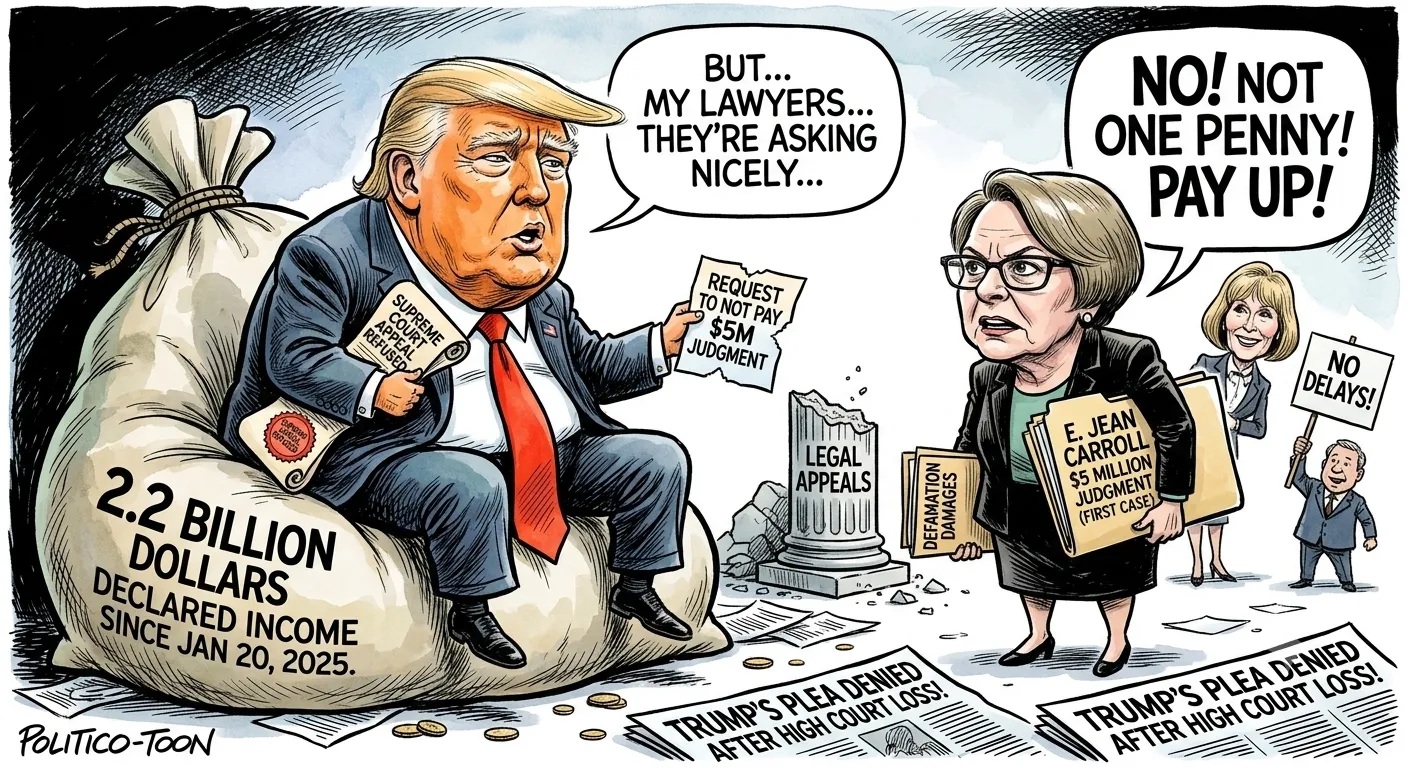
US President Donald Trump reported more than $1.4 billion in income from his family's crypto ventures last year, showing how Trump now derives most of his income from digital assets that have benefited from his policies, according to a review of his latest financial disclosures.
The poll: An Economist/YouGov poll released yesterday found 54 percent of Americans strongly or somewhat approve of reversing the addition of Trump's name to the Kennedy Center.
Background: Trump's name was briefly added to the building after the Trump-appointed Kennedy Center board voted to rename the center after him. A court order struck down the change and the name has since been removed.
Former CIA Director John Brennan sued the Trump administration Wednesday, demanding a court order that would require officials to preserve records from investigations that he says are targeting him for "what amounts to phantom criminal conduct."
The lawsuit says the records would shed light on the motivations of government officials who are investigating Brennan and would form the basis of defense efforts to dismiss any eventual indictment on grounds that the case constitutes a vindictive prosecution.
Such an argument, his lawyers said, would be supported by the more than 100 verbal or written statements that President Donald Trump has made since 2017 lambasting Brennan and by the Republican president's directives to his Justice Department to initiate investigations of Brennan "without regard to factual or legal justification."
"To fully consider those motions, the reviewing judge would need to scrutinize the motivations of the Justice Department officials who directed, oversaw, or undertook those actions to determine whether they violated Director Brennan's rights, and specifically whether they were motivated by a desire to vindictively prosecute him as an act of retribution," Brennan's lawyers wrote in the lawsuit filed in federal court in Washington.
Without an order, the lawsuit contends, the records are at risk of being lost or intentionally deleted. The lawsuit amounts to a preemptive strike of sorts on months-long investigations into Brennan and other perceived adversaries of the president, and represents another effort by Brennan's legal team to sound the alarm on inquiries they believe are part of a pattern of politically motivated probes driven by the White House. It asserts that Brennan is being targeted in a vindictive and selective manner arising from Trump's "obsession with punishing him for his lawful conduct as CIA Director and for his constitutionally protected criticism of the President and the President’s policies."
President Trump has taken at least 14 actions to nationalize elections. He has taken at least 21 actions to tighten voting restrictions. He has cut security, pushed for mid-decade redistricting, questioned previous results and punished those who didn’t question previous results. It all amounts to an extraordinary effort to reshape election rules.

What happened: A group of House Democrats sent a letter today to acting director of national intelligence Bill Pulte demanding to review any intelligence Pulte plans to declassify on Trump's pet issues.
Context: Trump critics are concerned that Pulte, who used his position as head of a federal mortgage regulator to target Trump’s perceived foes, will politicize the intelligence community.
Today: Democrats released a report alleging some donors were convinced under false pretenses to give money to Freedom 250, the White House-backed celebration of the nation's 250th anniversary.
Details: The report says the donors intended to give to a congressionally chartered initiative, but received routing and account numbers that directed the money to Freedom 250.
The latest: Washington, D.C.'s historic preservation officer told the Trump administration that the president's plan for a triumphal arch near Arlington National Cemetery should be built elsewhere.
Why: The officer, David Maloney, said the arch would "severely damage an exceptional cultural landscape." He proposed building it near Nationals Park and Audi Field in Southwest Washington.
Donald Trump staged a hostile takeover of the US’s 250th anniversary celebration to enrich political allies, harvest voter data and promote Christian nationalist ideology, according to a congressional investigation released on Thursday.
The interim report, "From Vanity to Insanity: How the White House Cheated the American People Out of Their 250th Birthday", outlines a web of alleged corruption, wire fraud and pay-to-play schemes orchestrated through a shadow corporation embedded within the National Park Foundation (NPF).
The document was produced by Democratic staff of the House of Representatives' natural resources committee’s oversight and investigations subcommittee. It has not been officially adopted by the committee.
"Under President Donald Trump, this anniversary has been hijacked and perverted into a hotbed of corruption and self-enrichment," it states, contending that the machinery built for a national commemoration was converted "into an apparatus for raising and spending money in service of the President's ego, political ideology, and pet projects".
The interim report finds that, by taking control of the NPF board and installing key campaign operatives such as Meredith O’Rourke and Chris LaCivita, the White House secured an opaque vehicle that enjoyed the NPF's non-partisan credibility and tax-exempt status while operating outside standard government transparency laws.
The interim report alleges that Freedom 250 surreptitiously diverted resources intended for America250 for its own benefit, leaving America250 scrambling for funds.
Sources interviewed by Democrats on the committee said fundraisers including O’Rourke misled prospective America250 donors by providing them with Freedom 250’s banking and routing numbers instead. The report finds this could constitute wire fraud and charitable solicitation fraud under federal and District of Columbia law.
This deceit extended to the entertainment industry. Artists recruited for the kickoff of the Great American State Fair – including Martina McBride and Young MC - were assured the event was non-partisan, only to face social media backlash when the event was revealed to be a Trump-backed rally. In the words of Young MC, the booking was a "bait and switch".
The investigation also outlines how Freedom 250 effectively put a price tag on presidential access, circulating sponsorship packages starting at $500,000 and climbing above $10m for tiered recognition, culminating in a "historic photo opportunity" with Trump.
The report also points to perhaps the most clear example on 14 June when the White House hosted a huge Ultimate Fighting Championship (UFC) event on the South Lawn to celebrate the president's 80th birthday. The event was heavily sponsored by corporations facing impending federal regulation and used vast government resources for "Super Bowl-level security" marshalled by the Department of Homeland Security (DHS).
Fighters received bonuses in "USD1", a cryptocurrency issued by World Liberty Financial, a trust run by the president's children, and Trump personally bought up to $50,000 in stock in the UFC's parent company weeks before the event.
Freedom 250 has also functioned as a conduit for steering federal funds to Trump campaign loyalists. Event Strategies - the same firm that planned the January 6 rally that preceded the US Capitol attack - was awarded 18 federal contracts totalling roughly $40m, along with an indefinite delivery master contract worth up to $100m.
Beyond lucrative contracts, the administration is accused of building a partisan political database disguised as a government domain. Freedom 250's website, initially managed by former "Department of Government Efficiency" (Doge) employees known for past data leaks, extensively logs user data.
Event registration is powered by Campaign Nucleus, a firm founded by Brad Parscale, a veteran of Trump election campaigns. Campaign Nucleus openly boasts about using artificial intelligence to analyse personal data and target "persuadable" voters. Unsuspecting visitors, such as attenders of a free Fifa World Cup Fan Zone on the National Mall, unwittingly fed their personal information directly into this Republican campaign apparatus.
The report also focuses on the ideological overhaul of the semiquincentennial. Freedom 250 replaced America250's civic engagement focus with overt Christian nationalist programming, operating in tandem with the Religious Liberty Commission, which recently recommended repealing the Johnson amendment to allow churches to engage in partisan politics.
A central feature of this effort was "reedom Trucks"-a federally funded fleet of mobile museums dispatched to schoolchildren across the nation. Supplied with content from the conservative PragerU [the Prager University Foundation] and Hillsdale College, these exhibits recast the founding of the US as an exclusively Christian project, embracing demonstrable falsehoods.
Exhibits include an AI-generated George Washington claiming that "our rights are a gift from God", a statement the first president is not documented as having made, alongside antisemitic tropes suggesting that Jewish merchants financed the revolutionary cause while omitting they also fought and died for it.
Concurrently, the administration aggressively moved to erase historical realities, removing national park signage detailing slavery, forced removal of Indigenous peoples and climate change. Huffman said it amounted to an attempt to reshape American identity to fit a narrow rightwing agenda.
"It's a fantasy that airbrushes out the more complicated parts of our history - slavery, the Native American genocide, the actual secular ideals on which our government was founded. It wasn't the opening of the clouds and some revealed covenant with God as they would have you believe."
As Washington barrels towards Fourth of July, with another Trump speech and a big fireworks display planned for the national mall, Huffman acknowledges that Freedom 250 is unstoppable. But his goal now is exposure.
"The one thing we can do is make sure the American people know what they're doing in our name and with our tax dollars," the congressman said. "We should do that because what they have pulled off here is a potential template for other betrayals of public trust that they and maybe future generations will attempt if we don't challenge them."
Surveys conducted in recent months among Americans around the U.S. reveal that many feel less pride for their country than in the past; believe that the U.S. is headed in the wrong direction; feel that the Americans dream is unattainable; and worry that American liberties are under threat.
Democrats-whose party is shut out of control across all three branches of the federal government-and young people appear to be feeling particularly gloomy about how things are going in the U.S. and where they might be headed. But many concerns also seem to cut across age groups and party affiliations.
Most Americans feel the U.S. is off track. The majority of Americans think the U.S.'s peak is already in the rearview mirror. Nearly 6 in 10 in December Pew Research Center said they believe the country's best days are "behind us." Breater share of Democrats agreed with it—at 64%—than Republicans—at 53%. NBC News May 29 and June 7 poll showed 58% said the U.S.'s best years were in the past. And many opine that worse is yet to come for the country.
April Associated Press and National Opinion Research Center (NORC) poll, found 72% said things in the U.S. were generally headed in the "wrong direction." A June Reuters/Ipsos poll showed 77% believe political violence-which is already on the rise-will likely increase further in the next five years. On the economic front, only 22% in an April Pew poll were "very confident" that they would have enough savings for retirement, while 55% said the economy would be weaker in 2050.
April Pew polling showed majorities of Americans think the U.S. will be worse off in 2050 than it is now in a number of other ways: more politically divided (66%), less important in the world (58%), more dangerous (56%), and with a less sophisticated government (54%).
Though Republicans and Democrats were split in how satisfied they were with how things in the U.S. are currently going, some of these concerns cut across the aisle, with similar shares of respondents from each party believing that political divides will worsen and the government will work less effectively.
December Pew survey showed 44% are “pessimistic” about what the U.S. will be like in 50 years, vs just 28% who said they are "optimistic." On this broad view, Democrats were less hopeful than Republicans: 50% of Democrats–and 63% of liberal Democrats—said they were pessimistic, while 39% of Republicans said the same. But that was still greater than the share of Republicans who expressed optimism, at just 33%.
These negative views aren't new. AP-NORC pollsters have been asking Americans whether they believe the country is headed in the right or wrong direction for years, and since 2017 a majority have answered that it was going in the right direction in only one of dozens of polling periods—in the spring of 2021.
American pride is at a record low, and fractured. Americans' pride has fallen to a 25-year low as the country's Semiquincentennial anniversary nears, according to Gallup polling. Just 33% of U.S. adults say they are "extremely proud" to be American, the lowest share since Gallup first posed the question in 2001. An additional 20% say they are "very proud," while 22% say they are "moderately proud," 15% "only a little proud," and 9% "not at all proud."
That marks a notable drop, in both 2024 and 2025, 41% of U.S. adults expressed extreme pride in being American. In earlier years that figure was as high as 70%-in 2003-after pride surged after the 9/11 terrorist attacks in 2001. NBC poll found 33% said they were "extremely proud" to be an American, with 10% saying they were "not at all proud."
April AP-NORC survey showed Americans are feeling less pride for the country in specific areas than they were when surveyed in a 2017 poll, during Trump's first term. Since that time, Americans' pride in the country’s armed forces dropped from 78% to 59%; in its history from 58% to 44%; in its democracy from 42% to 28%; and in its political influence around the world from 34% to 24%.
The polls found that the sense of pride Americans felt in the country was divided across age groups and political affiliations, however. While the share of adults aged 18-34 by Gallup said they were extremely proud was just 14%, 48% for those 55 years or older said the same. Meanwhile, 70% of Republicans expressed extreme pride, compared to only 14% of Democrats.
Notably larger shares of Republicans than Democrats also expressed pride in various aspects of the U.S.-from its scientific and technological- achievements to its armed forces to its "treatment of groups in society"-in the recent AP-NORC survey, while slightly more Democrats than Republicans said they were proud of the country’s popular culture.
Partisan differences also contributed to the declines AP-NORC found since 2017; for example, Democrats’pride in the military fell from 74% in 2017 to 42% this year.
Many Americans believe democracy and constitutional rights are threatened
A number of Americans have expressed a belief in polls this year that democracy and certain constitutional freedoms are at risk. The Reuters-Ipsos poll showed 64% of Americans believe democracy is in danger of failing, with 85% of Democrats and 50% of Republicans saying so. Notably, just 37% of Republicans asked the same question in a Reuters-Ipsos survey in 2025 expressed that belief––making this year's figure a major 74% increase.
The value that Americans place in democracy has also dropped somewhat, according to the AP-NORC poll, though not as significantly: 66% of respondents in the April survey agreed that "a democratically elected government" is "extremely important"––down from 76% in 2024 and 80% in 2021.
The AP-NORC poll additionally showed nearly half of Americans believe that freedom the of speech is under "major threat," while 35% believe the same of the right to vote and 28% of the freedom of religion.
Most feel the “American Dream” is out of reach.bWhen asked if they believed the American dream-"that if you work hard you'll get ahead"-currently holds true, 66% of respondents in the AP-NORC poll disagreed. That figure is consistent with the findings from 2024 and 2025.
Responses were significantly split across party lines, however: 17% of Democrats surveyed this year believed the American dream holds true today, versus 57% of Republicans. Men were also more likely to believe in the truth of the American dream, at 39%, compared to women, at 29%, and older adults—those 60 years and older—were more likely to believe it than those aged 18-29, at 46% versus 22%, respectively.
Still larger differences in beliefs were seen across racial groups, with just 19% of Black adults believing that the American dream currently holds true and 30% saying it has never been true, compared to 40% and 12% of white adults.
Overall, 15% of respondents said the American dream has never been true, while half said it once held true but doesn’t anymore. In the NBC poll, meanwhile, 78% of respondents said the American dream is harder to attain than it was a generation ago—a 10-point increase from 10 years ago.
Often heralded as "America's best idea", national parks are the closest thing the country has to sacred lands. What many may not realize, however, is that US history - not just nature - is at the heart of the visitor experience at most of the 433 parks, historic sites and monuments in the NPS system.
But over the past year and a half, this history has been under attack, as the Trump administration has raced to reconstruct a version of US history they prefer - one in which the Bransfords didn't exist, the genocide of Native Americans didn't happen, George Washington didn't own slaves and the glaciers aren't melting because of the ongoing climate crisis.
Last May, the Trump administration gave park employees three months to review all content in the parks, a monumental task that quickly overwhelmed staff whose ranks had been cut by more than 25% since the start of the administration.
One park regional leader told staff in a meeting to just "guess what the offending language was". Another manager said: "If there's any doubt at all … whether you think it's appropriate or not, put it on there, report it." All park employees the Guardian spoke to requested anonymity because they were not authorized to talk to the media and feared professional reprisal. With little to no guidance, many park staff were left to fill in the blanks themselves. One employee said the way they flagged materials was to "put on [their] white supremacist hat"; another asked themselves: "What would my bigoted neighbor not want to read about?"
In March of this year, the database of staff submissions was leaked by an anonymous group that calls themselBves the "civil servants on the front lines". The Guardian verified the contents of the database with multiple NPS staff.
The leaked database - which includes nearly 2,000 images and files of flagged park material - provides a rare and detailed look into how Trump's executive order was implemented and the broad swathe of park history and science that was at risk of censorship. Several entries show staff were unsure about what to do or guessing at what they should submit. A sign at the National Mall in Washington DC, describing a now defunct waterfront wharf, was flagged for a brief reference to enslaved dock-workers. "You might hear the shouts of hundreds of dockworkers, many of them enslaved people until the end of the Civil War in 1865," the sign read. The submitter wrote: "is the word 'enslaved' ok here?"
At Cape Hatteras National Seashore, a part of the country where homes are being swept away into the ocean, signs about sea level rise and climate change were flagged because they "reduce the focus on the grandeur, beauty and abundance". And at Little Bighorn battlefield national monument, park staff used ChatGPT to determine if some signs that said the US "implemented harsher policies and broke more promises" and was "hungry for land and gold" were in violation of Trump's executive order.
An official list of removed signs was revealed only after a judge ordered the interior department to provide an inventory as part of an ongoing lawsuit. It showed at least 60 signs across 38 parks, from Alaska to the Virgin Islands. Advocates say the list is incomplete, but it's the most comprehensive view of the extent of the Trump administration's censorship campaign to date. The interior department noted in a subsequent court filing that there were more removed signs they didn’t account for.
"It's pretty tragic what's transpired," said Bill Hayden, a former interpretive specialist who worked on exhibits and signage at Glacier national park for 31 years. Developing park signage was typically a deliberative, months-long process that involved consultations with scientists, archaeologists and historians, Hayden said.
"The national parks were all about researching science and researching history and telling the truth. I was never in a situation where I felt an administration was dictating what could or could not be shared with the public." Based on the Guardian's review of flagged and removed material, stories about slavery, racism and discrimination against Black Americans and Native Americans, and the climate crisis were the ones most at risk of censorship. These are also stories the NPS has historically omitted or struggled to tell.
When the country's first national park, Yellowstone, was created in 1872, the Shoshone, Bannock, Crow, Blackfeet and other Native peoples who had called the area home for centuries were forcibly relocated to reservations and banned from entering the park. The Manzanar national historic site in California, which memorializes the incarceration of 120,000 Japanese Americans during the second world war, for example, was established in 1992.
The Stonewall national monument in New York, the first national park site dedicated to LGBTQ+ history, was created in 2016. And in 2023, three sites that are part of the Emmett Till and Mamie Till-Mobley national monument were established in Mississippi and Illinois, to recognize the life and legacy of the 14-year-old Till, who was lynched in Mississippi in 1955. In just one year, the Trump administration has turned back the clock on much of that progress, said James. "The goal now is just to sell a whitewashed and sanitized view of that history."
The Guardian also identified dozens of instances in which parks staff turned Trump's executive order on its head, using it as an opportunity to report existing signage that was disparaging to Native Americans and other marginalized groups. In part because of these efforts, Trump's censorship effort is now caught in legal limbo. In June, a federal judge blocked any further removals and ordered all signs that had been taken down to be restored.
"This Administration seeks to share a limited history by ordering the removal of all signs, displays, and interpretive exhibits at National Parks that do not align with its preferred narrative, thereby telling half-truths," US district judge Angel Kelley wrote in a 63-page injunction. "Not only does this undermine the integrity of the National Parks; it sets a dangerous precedent of censorship and sanitization."
"What more do you want to take away from them?" he said. "The system has taken everything from them. So why would Mr Trump and his administration want to at least take away their story? Haven't they given enough?"
The Guardian's Deleted data series explores how critical US government information is being deleted and what the consequences will be, and will preserve or recreate lost datasets. If you know about any datasets, webpages or government materials that have been deleted or altered in the past year, or are willing to share how those changes affect you, we’d love to hear from you. Please reach out at deleted-data@theguardian.com.

A trip to the nation's capital is a summer vacation staple. We walk you through the changes President Donald Trump has made to the city since he returned to office. He has put his image and name on buildings, torn down storied structures, altered others, started massive construction projects and deployed armed military personnel.
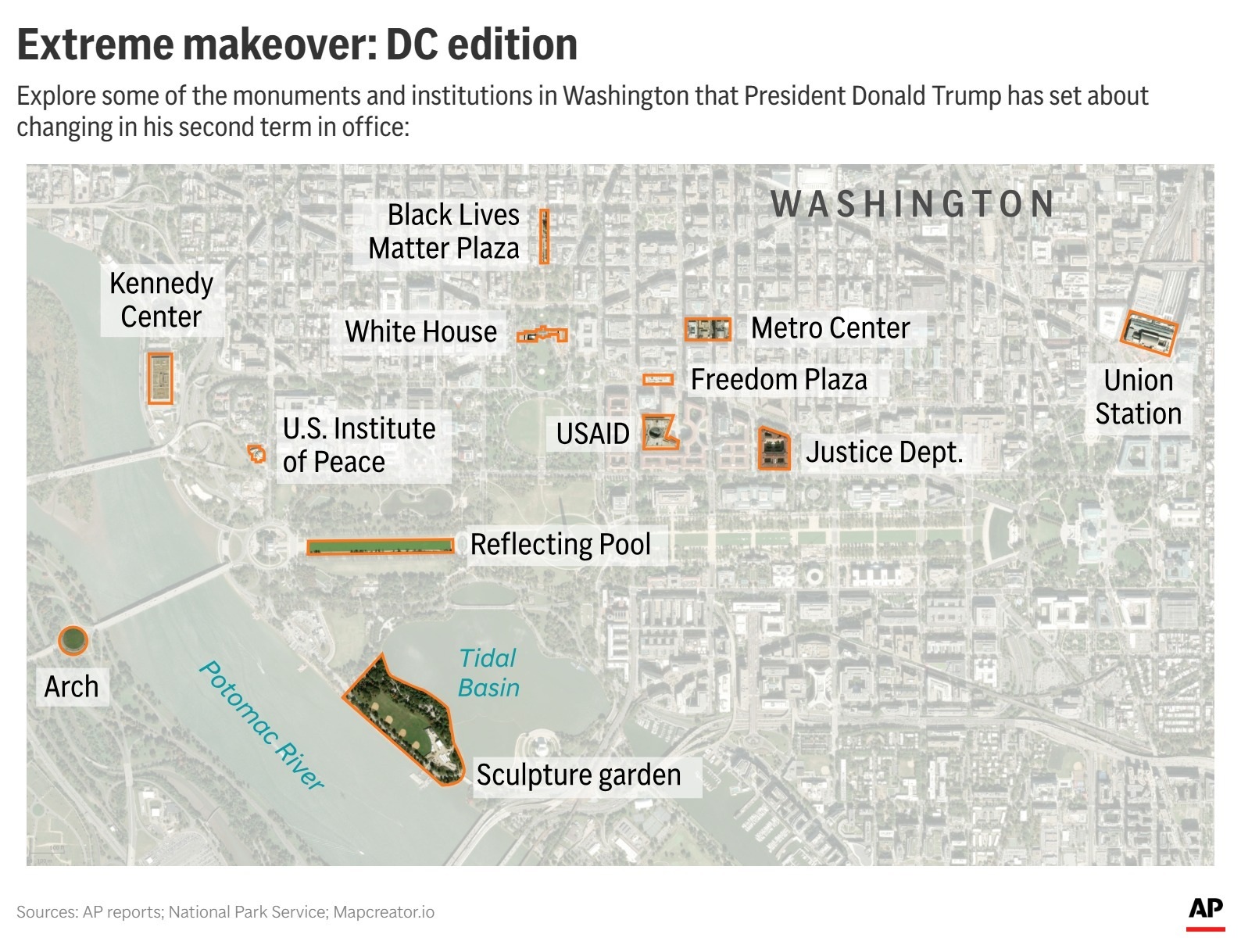
This weekend: In a report published Saturday, the White House accused the Smithsonian's National Museum of American History of "extreme political activism."
Details: The report accused museum leaders of adopting "an ideological framework" that does not celebrate the American story but treats it "as a political instrument to divide."
The Supreme Court recently rejected President Trump's appeal after a jury found he sexually abused and defamed the writer.
The latest: President Donald Trump said today that the ceasefire between the United States and Iran is "over" and that the U.S. would likely strike Iran again Wednesday.
Last night: The U.S. launched more than 80 strikes against Iran in response to Iranian attacks on ships in the Strait of Hormuz.
Yesterday: A federal judge blocked a DOJ subpoena for the names, addresses and contact information for Fulton County election workers and volunteers who worked the 2020 election.
Why: U.S. District Judge William M. Ray II, a Trump appointee, wrote he was concerned about the Justice Department's ability "to appropriate your private information without a legitimate purpose."
New: The court today ordered Trump's name to stay off the Kennedy Center branding and building pending the outcome of a case challenging the renaming of the center.
Background: The order came in response to a DOJ appeal of a district judge ordering Trump's name to be removed from the center.
A federal judge ruled that E. Jean Carroll can receive the $5.8 million awarded to her after a 2023 jury found that President Donald Trump sexually abused her in 1996 and later defamed her when he denied her allegations.
U.S. District Judge Lewis Kaplan directed the release of the money from a court escrow account, along with the interest that has accrued since the verdict, after the Supreme Court refused last week to hear the president's appeal of the award.

The Trump administration itself has admitted that the war has cost far more than $30 billion. On June 24 - a week before Vought's testimony - the White House formally requested $88 billion in supplemental funding from Congress, including $72 billion for the Iran War. No doubt Vought was aware of this funding request; after all, he wrote it - his signature appears on the second page.
Throughout the conflict, the cost of the Iran War has been habitually understated. Establishment media have parroted Hegseth's defactualized cost estimates and similarly low estimates from establishment think tanks. The estimate that came closest to the Trump administration's requested $72 billion for the war came from Popular Information. In May, we estimated the Iran War had cost $71.8 billion.
On the 250th anniversary of the signing of the Declaration of Independence, the Trump Administration attempted to declare independence from history with the release of "Saving America's Story." Assigned an Orwellian title that obscures the effort to rewrite America's story, the 162-page Domestic Policy Council report, published on the White House's website on July 4, attacks the archivists, curators, educators, historians, and museum professionals who work at the Smithsonian National Museum of American History. That the administration has chosen to do this at precisely the moment when it is gutting the National Archives and censoring historical exhibits at national parks demonstrates that the new report is just one part of a broader effort that threatens to reduce American history to conservative ideology.
The report follows President Donald Trump's March 27 "Restoring Truth and Sanity to American History" executive order. And like so many Trump administration reports and statements, it can be seen as a classic example of projection, whereby the administration accuses others of doing exactly what it is doing. The report states, for example, that "museum leadership has explicitly adopted an ideological framework that no longer treats the American story as a shared national inheritance to be taught or celebrated, but as a political instrument to divide, dispirit, and discourage our citizens." That is not an accurate assessment of the Smithsonian, but it is a pretty good description of the new report.
What's more, the report includes multiple false claims about American history and the Smithsonian. To take one example, it is simply not true that the museum has "not created any exhibit dedicated to presenting a general narrative of American history" or telling the story of the Founding Fathers, the Declaration of Independence, the Revolutionary War, or the U.S. Constitution. Nor is it true that the museum fails "to provide America's young people access to what is genuinely inspiring and unifying in our history, as well as to the lessons imparted by the American experience of overcoming great national challenges." It is entirely false to assert that the museum disregards "the progress America has made and the ideals that continue to inspire millions."
The Domestic Policy Council also mischaracterizes and misrepresents the words of the museum's director, Anthea Hartig, who has consistently worked to educate and inform visitors through innovative exhibits and inspirational programs. Indeed, the report itself quotes Hartig's 2026 welcome to the museum's special semiquincentennial exhibit.
Instead of accurately describing the work of thousands of museum professionals, the report demands that the Smithsonian favor one form of U.S. patriotism over all others. In the process, it minimizes discussions of the political struggles and social movements that have attempted to move the United States toward "a more perfect union."
More generally, the report constitutes an attack on American historians, museum professionals, and intellectual expertise, asserting at one point that "much of the museum profession" engages in "discriminatory and likely illegal behaviors and practices" and accusing "the largest funder of the humanities" (the Mellon Foundation) of advocating for "discriminatory practices." Once again, these would do well as descriptions of the administration's new report, but they fail to capture the democratic aspirations of most museum professionals and many humanities foundations today.
Make no mistake about it: the report represents an attempt to turn back the clock to a time when U.S. history was taught as the history of white Christian men who conquered a continent, U.S. military leaders who never lost a battle, and U.S. presidents who were single-handedly responsible for national greatness. My advice to Americans: go see the Smithsonian for yourselves.
The E.P.A. announced today that it would loosen limits on smog-causing pollution from heavy-duty vehicles, regulations that the agency's leader has criticized as burdensome for the trucking industry. The changes mark the latest move by the Trump administration to reverse efforts by Joe Biden to speed the transition to electric vehicles.
Yesterday: Trump called the Supreme Court's ruling upholding birthright citizenship "absolutely insane" in a social media post.
Background: Last month, the court struck down a Trump order denying citizenship to those born in the United States to undocumented immigrants or immigrants in the country temporarily.
More: Trump said he will ask for "a Rehearing by the United States Supreme Court, IMMEDIATELY."
Donald Trump has terminated the remaining members of the independent, federal commission that assists election administration officials nationwide just a few months before the midterm elections, multiple outlets reported on Thursday. The remaining three commissioners of the four-member bipartisan commission were forced out on Thursday in different ways. The one Republican appointee resigned and the other two, Democratic, appointees were notified of their terminations via email from the White House presidential personnel office.
The Election Assistance Commission serves as a "national clearinghouse of information on election administration", accredits testing laboratories and certifies voting systems, and maintains the national mail-voter registration form developed by the National Voter Registration Act of 1993, according to the commission's website. The terminations follow Trump and top administration officials' advocacy to change vote-by-mail requirements and investigations into the 2020 election outcome, which Trump lost to Democrat Joe Biden.
"It is irresponsible and dangerous that this Administration remains dead set on causing chaos for our election officials across this country," Arizona's secretary of state, Adrian Fontes, said in a Thursday statement. "This move undermines the integrity of nonpartisan election administration."
Matthew Wielicki has criticized the scientific consensus on global warming as alarmist. Now he'll oversee the federal government's flagship report on how climate change affects the United States.
The Trump administration moved to allow farming, drilling and mining in the habitats of endangered animals. Environmentalists called it the most severe cut to wildlife protections in 50 years.
The E.P.A. fired an official who wrote a memo requiring a fish farm to track microplastics, accusing him of trying to embarrass the agency.
The Trump administration picked a climate science critic with no training in climate science to lead an official report on how climate change affects the U.S.
The new Air Force One donated by Qatar, which President Trump flew on to Turkey this week, was not retrofitted with the same defensive features as the old model, officials said. On Friday, the Trump administration issued subpoenas to Times reporters who wrote about the plane.
What to know: Donald Trump Jr. and Eric Trump have invested heavily in defense technology start-ups, many of which have government contracts worth billions.
Timing: The Trump brothers made most of these investments after Trump was elected president for a second time.
The ruling: The judge said today that Trump's lawsuit against the IRS was an attempt "to provide some legitimacy" to the now-dropped $1.8 billion "anti-weaponization fund" created in a settlement.
More: The judge referred two of Trump's lawyers for potential disciplinary proceedings and had her order sent to oversight groups already investigating key government lawyers in the deal.
This morning: A satirical art group called the Secret Handshake installed a 10-foot-tall gold-colored "Iran War Participation Trophy" dedicated to Trump on the National Mall.
White House response: A spokeswoman for Trump called the art group untalented and said they should "stick to their ugly 'art' and refrain from weighing in on foreign policy."
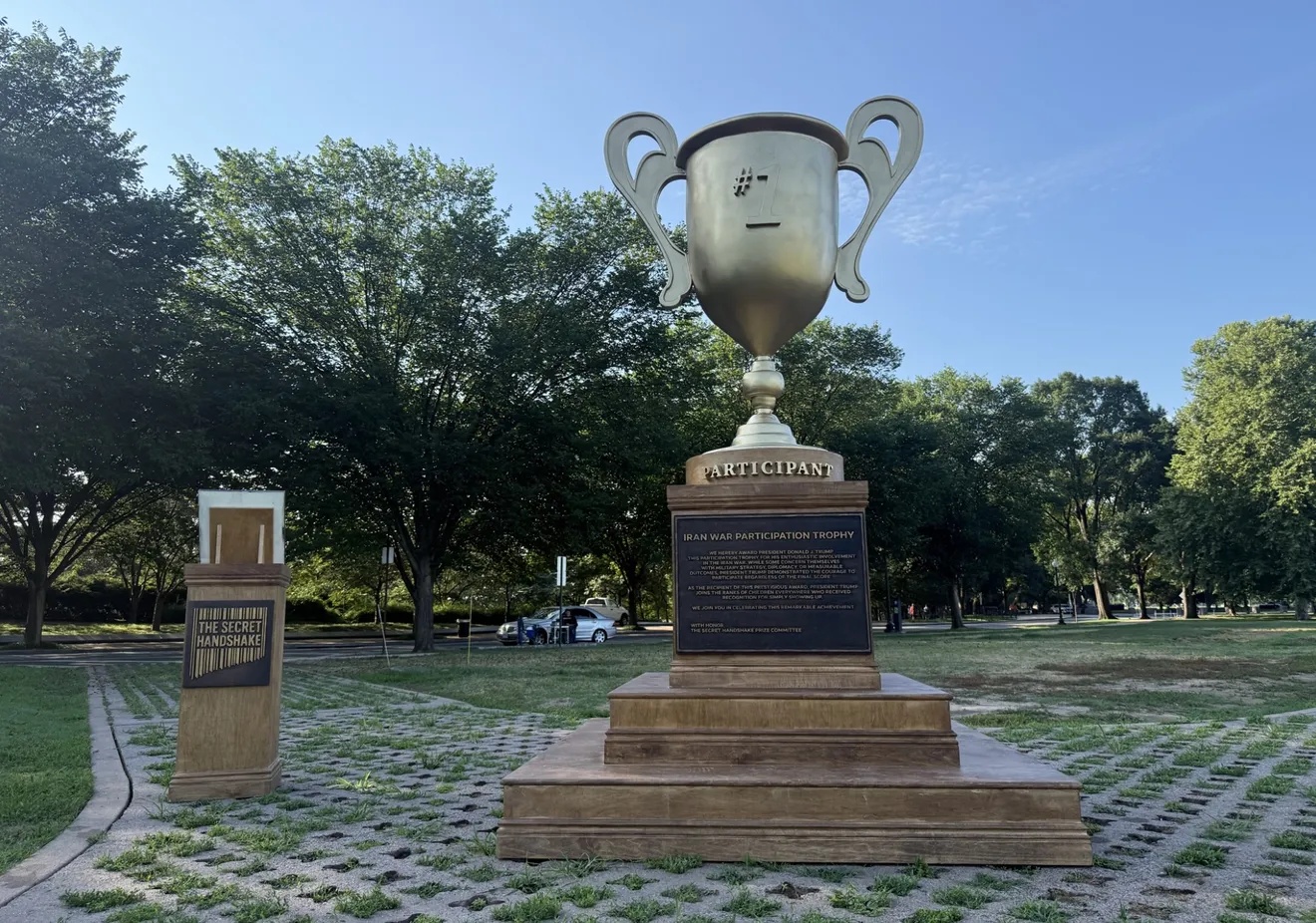
Graphic source: https://www.usatoday.com/story/news/politics/2026/07/13/trump-participation-trophy-statue-dc-iran/90903020007/
President Donald Trump's lawsuit against the IRS was brought in "bad faith" for an "improper purpose," a federal judge in Florida found as she slapped sanctions on some of those involved.
U.S. District Judge Kathleen Williams said that the lawsuit "was not brought to vindicate rights," but to "manipulate the judicial process."
The Trump administration has instructed Immigration and Customs Enforcement officers to largely halt their practice of stopping vehicles while conducting immigration operations nationwide, according to people familiar with the matter.
The agency has come under renewed scrutiny over the past week after federal immigration officers killed two people. Both were shot after agents tried to stop their vehicles. In Houston last week, an ICE agent killed Lorenzo Salgado Araujo, a 52 year-old Mexican man; witnesses say he was shot through the passenger-side window. In Biddeford, Maine, yesterday, agents shot and killed Joan Sebastian Guerrero, a 26-year-old Colombian man.
In total, federal agents carrying out Trump's deportation crackdown have killed six people, nearly all of which involved officers firing at people in vehicles. The pause could make it more difficult for ICE to keep up with pressure from the president to arrest and deport an increasing number of immigrants.
The Times reported last week that while President Trump flew to Turkey on July 7 for a NATO summit aboard his new Air Force One, he flew back the following day aboard the old Air Force One. The Times reported that the new Air Force One, a Qatari-donated Boeing 747-8, lacked some of the advanced security features of the older aircraft, including antimissile capabilities. The Times cited sources who spoke on the condition of anonymity to discuss sensitive security issues. For a U.S. president, it's risky to fly internationally in a plane not hardened against attacks.
The Trump administration, angered by the story and eager to flush out those who spoke to The Times, issued subpoenas on Friday night for journalists who reported it, seeking their testimony before a federal grand jury “in regard to an alleged violation of federal criminal law.” Those reporters are colleagues whose names you have seen often in this space: Julian Barnes, Adam Goldman, Eric Lipton, Tyler Pager and Eric Schmitt.
The subpoenas were an escalation of Trump's attempts to threaten and intimidate independent news organizations. "The appearance of federal law enforcement agents on the doorstep of news reporters should shock the conscience of any American who believes in the Constitution and the press freedom it protects," David McCraw, our top newsroom lawyer, wrote in a statement that night.
In a statement on Saturday, a Justice Department spokeswoman said that "reporters are not the targets, those leaking classified information are." She continued, "We value and appreciate the important role that the press plays in this country, but D.O.J. also plays an important role to make sure that the people entrusted with our nation's secrets do what they’re supposed to do with that information."
And Dick Stevenson was straightforward about where he and his team are right now. "Facing an administration and a president willing to go to great lengths to seek to impede what we do," he told me, "only hardens our resolve to stick with our mission."
Todd Blanche, the acting attorney general, very likely needs the support of every Republican on the Senate Judiciary Committee to be confirmed to lead the Justice Department. But after a rocky confirmation hearing today, it was not clear whether he will get it.
The main hurdle for Blanche is Senator John Cornyn, a Texas Republican, who raised questions about Blanche's role in a deal granting President Trump protection from I.R.S. audits and creating a $1.8 billion fund aimed at paying some of Trump's allies. Afterward, Cornyn said he had not yet made up his mind. "It's a very difficult position to be in," he said, "to be the president's personal lawyer and then to end up being a member of the cabinet."
Blanche's confirmation, however, is partly symbolic. Under law and precedent, he can probably remain in charge of the Justice Department until a new leader is confirmed or Trump leaves office.
In a separate hearing room on Capitol Hill today, Democratic senators pressed Jay Clayton, Trump's pick to be the next director of national intelligence, on the 2020 election. And in her confirmation hearing, Dr. Erica Schwartz, the president's pick to lead the C.D.C., said she did not think Trump or Robert F. Kennedy Jr., the health secretary, would ask her to do anything to hurt public health.
Today: Trump's nominee to be director of national intelligence, Jay Clayton, repeatedly refused to acknowledge Joe Biden won the 2020 presidential election during a Senate Intelligence Committee hearing.
More: Clayton said he is not an "election denier," and said he believed U.S. elections needed "substantial work" to be more secure.
Context: Trump officials have continued to pursue baseless claims that the 2020 presidential election was stolen from Trump, who is preparing to give a major speech on the matter tomorrow.
A federal judge's ruling against President Donald Trump was particularly scathing in her comments about Acting Attorney General Todd Blanche, which takes on greater relevance Wednesday as he sits for a confirmation hearing Wednesday.
Key Facts: In a scathing ruling Monday, U.S. District Judge Kathleen M. Williams took aim at Blanche and recommended disciplinary action against him and other attorneys representing Trump in his lawsuit against the IRS.
Williams questioned Blanche's ethics, noting his previous service as Trump's personal lawyer before his tenure at the Department of Justice.
She ordered the court to mail a copy of her ruling to the State Bar of New York, of which Blanche is a member and where he has already been slapped with an ethics complaint backed by more than 101 former federal and state judges.
"The Court is extremely troubled by the testimony given by Acting Attorney General Blanche on May 19, 2026. In response to why the 'settlement agreement' had not been submitted to this Court for review, he stated that 'there is no judge' because the case had been dismissed and, therefore, there was 'no mechanism' for reviewing the agreement.
While temporally accurate, this answer is, at best, misleading and, at worst, disingenuous. The Court was available to review any pleading by any Party at any time during this lawsuit. And if Acting Attorney General Blanche had thought the dismissal was improvidently granted or thought Plaintiffs misspoke when they said, 'no judicial analysis is appropriate,' he only had to file an appearance and ask for relief."
key background: Williams voided Trump's IRS settlement earlier this week, accusing him of "improperly" using the court to "provide some legitimacy to an agreement to confer immunity to people and entities affiliated with the president."
Trump had sued the IRS for $10 billion in January, alleging it failed to keep his tax returns private after details leaked to the press. Trump dropped the suit in May to settle with the IRS in a deal that gave him a $1.8 billion fund meant to pay those who claimed they were unfairly targeted by the Biden administration, including Jan. 6 rioters. Blanche later said the government was not moving forward with the fund, though Trump defended it as a "great idea."


As millions of Americans prepare for another brutal heatwave, it's now harder to find information about ways to stay cool while saving energy and keeping utility costs down.
At least 1,662 Department of Energy webpages offering guidance on protecting the electrical grid during heatwaves have gone dark as of 3 July, according to a Guardian analysis of a list of deleted URLs provided by researchers at the Internet Archive, a non-profit that hosts a repository of more than a trillion archived webpages.
These removals are just the latest example of a broader pattern: information that conflicts with the administration's priorities - from data on queer and trans youth to online resources from the Consumer Financial Protection Bureau - is being removed from federal websites and surveys.
The energy department deletions coincide with the Trump administration's latest push to undermine federal climate regulations. At least 18 webpages were removed within days of the proposed rollback to energy efficiency regulations for home appliances like air conditioners and heaters.
If enacted, the proposed rollback would effectively undo decades of policies that have been proven to lower household utility bills and make it much harder for the energy department to update efficiency standards for new appliances under future administrations, advocates say.
"Having a functioning air conditioner is a health and safety issue for the elderly, for folks with health conditions, and for the very young," said Andrew deLaski, executive director at the Appliance Standards Awareness Project, a coalition of environmental, consumer and utility industry groups that advocate for cost-effective efficiency standards. "Ensuring that the standards are up to date helps to keep their energy consumption under control so that people can afford to operate these products," deLaski said.
For Itai Vardi, research manager at the Energy and Policy Institute, a non-profit fossil fuel and utility watchdog, the proposed rule and website deletions are "just absurd". "It's ironic that the Trump administration and Republicans love to talk about consumer choice as a tenet of American freedom, but they're actually taking that away," Vardi said. "What they're doing here is rolling back the rules on energy efficiency, but also trying to hide helpful tips and information for the public, and it's going to cost people more money."
The deleted webpages were filed under the department's "energy saver" section and included a wide range of advice for energy and cost-saving measures, from ways to keep your home cool during the summer when energy bills and usage can spike to tips on how to "weatherstrip", or seal air leaks, around the home.
More than 300 of the webpages had more than 160,000 page views in the last 30 days, according to a Guardian analysis of government web traffic data from the US General Services Administration.
Critics say the webpage removals are one way the Trump administration is making the case for a broader campaign, outlined in Project 2025, to push through a slew of measures deregulating the fossil fuel industry and gutting the federal bureaucracy. "It's a senseless dedication to an anti-regulatory agenda driven by what I would say are anti-regulatory zealots," deLaski said.
The poll: A Washington Post-Ipsos poll taken last week found 37% of Americans approve of Trump, the same as in April.
Breakdown: Only 15% of Americans "approve strongly" of Trump, down from 19% in February. During his first term, Trump regularly had about 30% of Americans strongly supporting him.
Yesterday: The Times filed a motion to invalidate subpoenas for several of its reporters to testify before a grand jury about their reporting on Trump's new Qatari-donated Air Force One.
Background: The reporters were subpoenaed by the Justice Department as part of an investigation into leaking in the Trump administration.
Defense Secretary Pete Hegseth announced Wednesday that he is rolling out a new screening program for “testosterone deficiency” among troops, calling it necessary to allow them to operate at their “absolute best.” Read more.
Why this matters: The move comes as other Trump administration officials have begun to advocate for men to have easier access to testosterone replacement therapies, but the messaging from Hegseth and others blends known science on the hormone with broader, and less substantiated, claims. The Pentagon did not respond to questions about what research or academic studies underpinned the move.
Over the past several years, special operations troops — and specifically Navy SEALs — have come under scrutiny for their use of testosterone and similar substances to enhance performance. The death of a SEAL recruit during training in 2022 led to the discovery of substances including testosterone in his possession, and revealed far more rampant drug use among the elite program than was previously acknowledged. Rep. Chrissy Houlahan, a Pennsylvania Democrat and Air Force veteran, said it "proves that Secretary Hegseth takes direction from the far corners of the manosphere."
But under Trump, the Justice Department has sought to leave unconfirmed prosecutors in their positions indefinitely, often through novel personnel maneuvers.
In May, a U.S. appeals court panel expressed skepticism that the maneuver was legal. The federal judges in the city decided to take applications for the position, and it appointed a bipartisan panel to review the applications.
On Wednesday morning the court - comprising 17 active and senior judges appointed by five presidents - issued its unanimous order naming Rogoff the U.S. attorney for western Washington. "This administration doesn't want to deal with advice and consent-they just want to install cronies to carry out a corrupt political agenda."
@jerasikehorn.bsky.social Remember this confession Trump. Is. Pure. Projection.
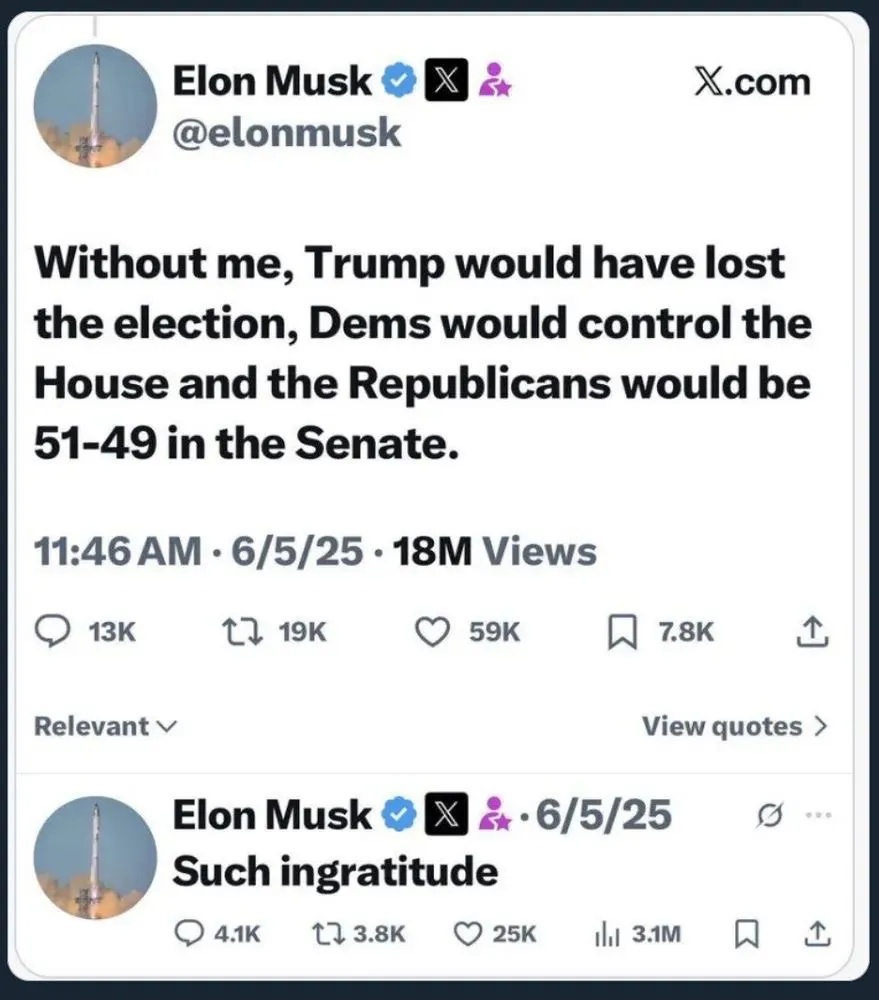
Source: https://bsky.app/profile/jerasikehorn.bsky.social/post/3mqtrs2vbwc2t
@muellershewrote.com Whoopsie daisy. July 16, 2026
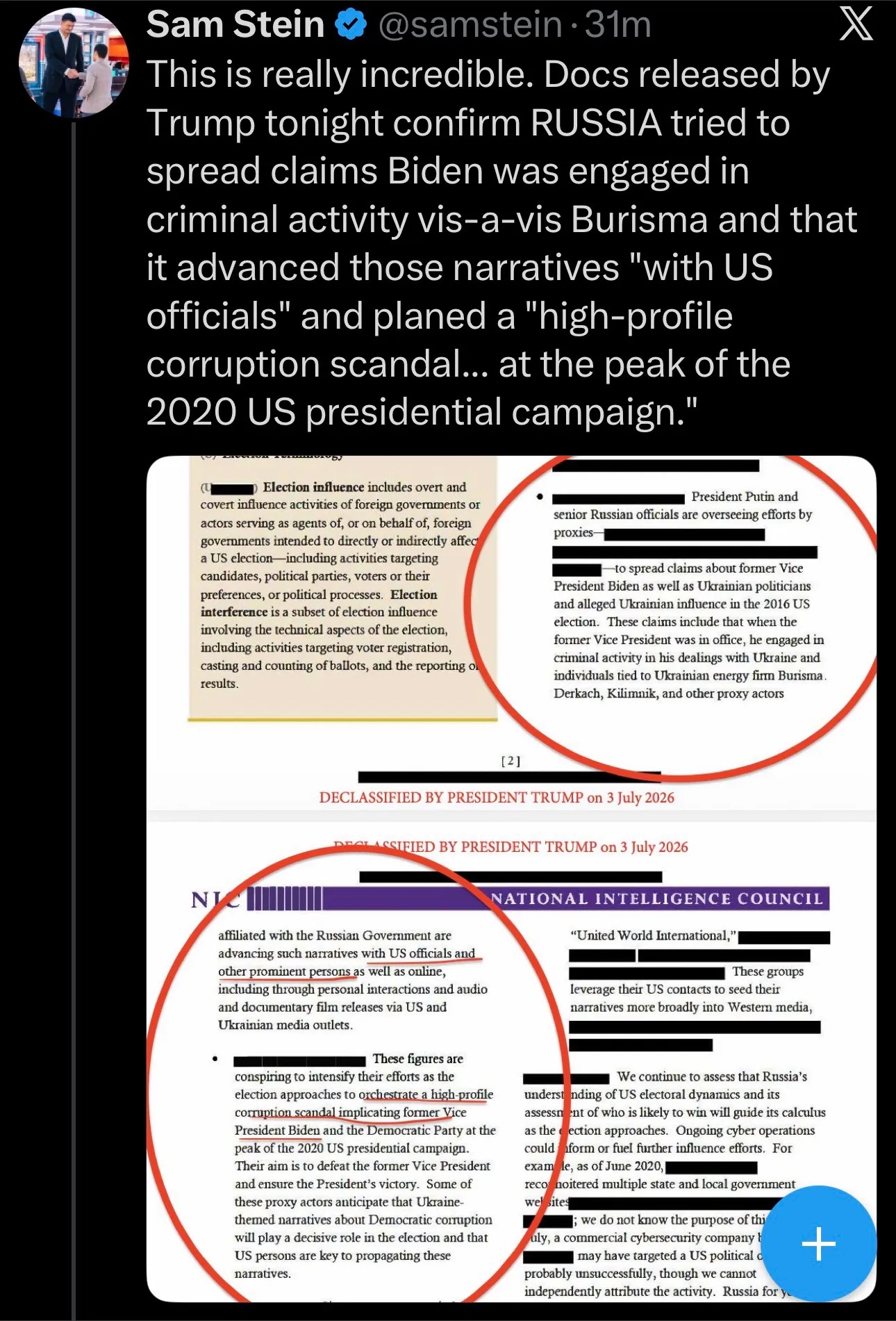
Source: https://bsky.app/profile/muellershewrote.com/post/3mqspe3ohnk2r
MeidasTouch. July 16, 2026. @meidastouch.com We watched Trump's dangerous and deranged speech so you don't have to. Here are the moments you need to know about:
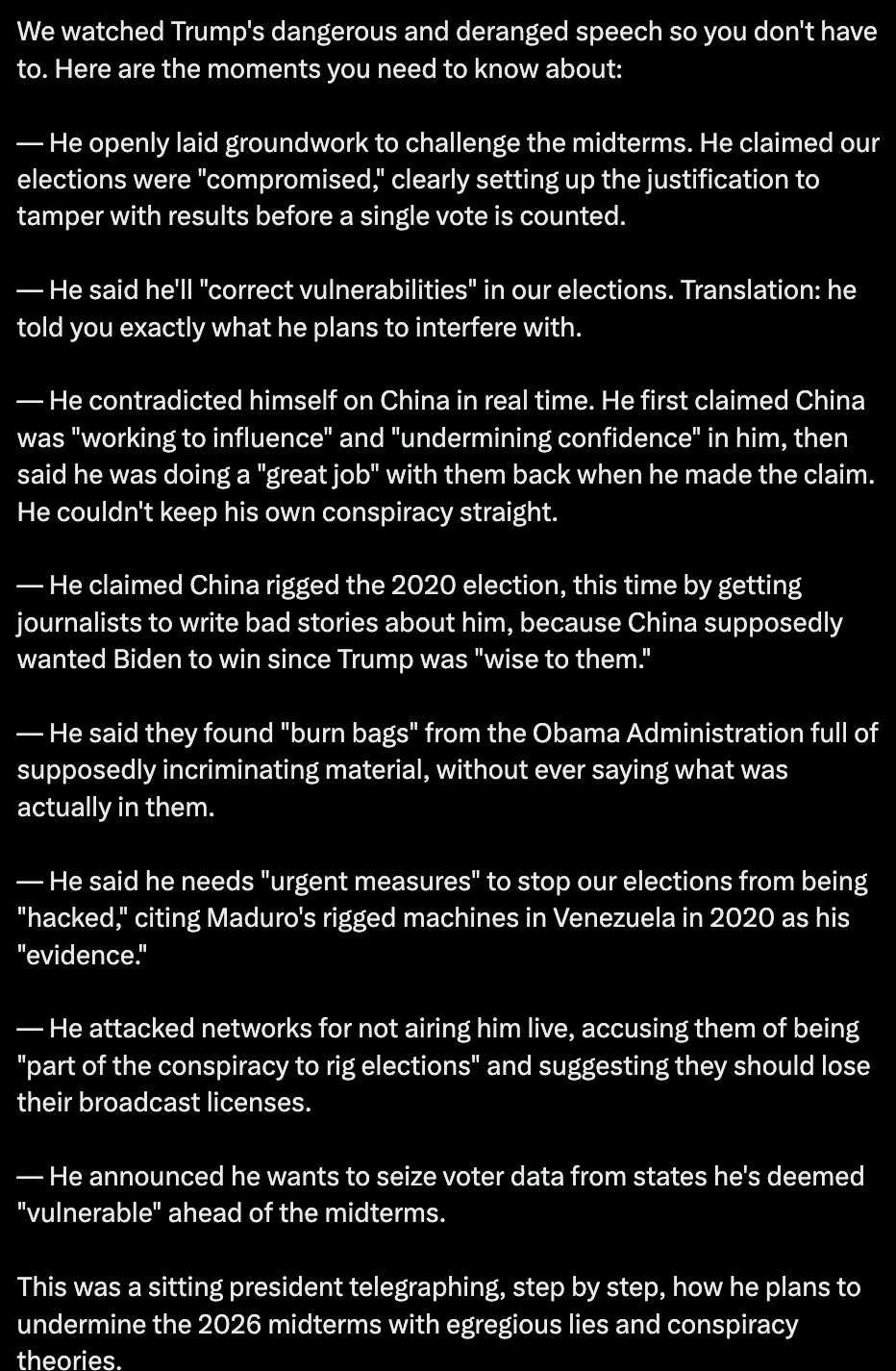
Source: https://bsky.app/profile/muellershewrote.com/post/3mqspe3ohnk2r
Doctors specializing in men’s health are divided as to whether people who don't have symptoms of low testosterone should be tested for the condition. Many doctors also urge men to be cautious about taking TRT, which can stall sperm production and cause infertility.
"There's no free lunch. There are side effects," says Dr. Jeff Morrison, a urologist at the University of Colorado. "If you are interested in further fertility, then TRT is probably not a good option."
Morrison says he ensures that his patients—particularly younger men in their 30s and 40s—are counseled about TRT’s potential adverse effects, which also include an increased risk of blood clots, acne, breast tenderness, and irritability. TRT is also generally considered a long-term or lifelong treatment.
Morrison says he always recommends lifestyle changes to his patients with low testosterone before turning to TRT. Improving sleep, losing weight, and reducing stress are among the interventions that can boost testosterone levels, Morrison says.
But some symptomatic people do need TRT to raise their testosterone to normal levels, and for them, the treatment can “truly be life-changing," Morrison says. "Men don’t deserve to suffer from low testosterone. But they have to be properly counseled on the risks and benefits of therapy."
Testosterone is an essential hormone which, in men, is produced primarily in the testicles and helps regulate sex drive, sperm production, bone density, and muscle mass. Most men experience a gradual decline in testosterone starting in their late 30s or early 40s.
But medical guidelines don't recommend testing testosterone levels unless a man has signs or symptoms that suggest a deficiency, such as low libido, erectile dysfunction, and anemia, or has a high-risk medical condition that can cause low testosterone such as HIV.
"It's not recommended by the American Urological Association or the Endocrine Society to routinely screen people," says Dr. Ajay Nangia, professor of urology at the University of Kansas Health System. Primary care doctors do not routinely test men's testosterone levels. "The recommendation by Mr. Hegseth goes against these guidelines."
But while Khera supports screening, he said he worries about inappropriate use of TRT. "I wouldn't treat someone with TRT if they weren't symptomatic" or had normal testosterone levels, says Khera, who helped publish seminal research on TRT and in 2025 led a U.S. Food and Drug Administration expert panel on the treatment. "They would be stuck on it for life, so you want it to be done properly." TRT products in the U.S. are currently only FDA-approved for men who lack or have low testosterone levels linked to an associated medical condition.
Feud: The department said it is prohibited by law from releasing files to New Mexico, where state officials are investigating activities at the late Jeffrey Epstein's former ranch, where he is accused of abusing women and girls for nearly three decades. New Mexico's attorney general accused the Justice Dept. of deliberately obstructing its criminal probe.
The CDC Director nominee knows nothing about the CDC or anything else, really, Schwartz hasn't been keeping up with the news, especially not news about the agency she's hoping to direct or any of the diseases she'll be responsible for controlling and preventing. When Sen. Patty Murray (D-WA) asked whether she agreed with Kennedy's decision to cancel $500 million in combined funding to NIH and BARDA for mRNA vaccines, Schwartz said "this is the first time I'm actually hearing about this as a private citizen. I certainly was not following that."
Schwartz seemingly has not been following much as she's luxuriated in the ignorance that life as a private citizen offers. She is especially unaware of what her prospective boss has been up to. She didn't know that Kennedy had ordered the CDC to put information falsely suggesting a link between vaccines and autism on its website, despite this being huge national news when it occurred last year.
She had no idea that Kennedy fired all 17 members of the Advisory Committee for Immunization Practices (ACIP) and replaced them with a bunch of anti-vaxxers. She didn't know about the changes they made to vaccine policy and would need to look into it. She would need to look into everything and talk to CDC scientists before committing to anything, because as a private citizen, she has no way of getting any information about the CDC besides the news that they are hiring.
However, she didn't know that the CDC workforce has been slashed by a quarter, nor that Kennedy had installed anti-vaxxers throughout. She wouldn't commit to removing them because she was so completely uninformed about everything that has happened at the CDC in the past year and a half. She didn't know that Susan Monarez was fired by Kennedy for refusing to sign off on vaccine policies that would put millions of American lives at risk.
She didn't know that cyclospora is causing explosive diarrhea among more than 7,000 American salad eaters, or that downgrading surveillance programs has hampered our ability to effectively respond. When Sen. Jon Husted (R-OH) asked her to commit to prion disease surveillance ("mad cow" disease and chronic wasting disease in deer and elk), she said that she'd need to look into capacity at CDC, which she currently has no idea about. Husted was describing the CDC National Prion Disease Pathology Surveillance Center at Case Western Reserve University. CDC also maintains its own prion unit, whose status is now tenuous amid the cuts.
She didn't know that the CDC Office on Smoking and Health had been shuttered until Sen. Tim Kaine (D-VA) told her, despite smoking cessation being one of her stated interests. She told Sen. Andy Kim (D-NJ) that she hadn't been following the US withdrawal from the World Health Organization (WHO). The only thing she knows is that the CDC is hiring and Trump wants our immunization policy to be more Danish, so she'll look into it. She'll commit to a "deep dive" on all the issues she knows nothing about, but she won't commit to doing the right thing.
Trump claims voting by noncitizens is rampant in America. The numbers tell another story. Reuters, July 19, 2026
Trump's focus on noncitizen voting is part of a multi-front push to remake U.S. elections in ways the president himself has said could cement Republican power for generations.
The administration has sued more than two dozen states that have refused to turn over their confidential voter rolls for federal review. It has weakened federal election-security programs designed to detect cyber threats and foreign influence operations. It has seized ballots and demanded sharp restrictions on mail-in voting. And this month, it ousted the leaders of the federal agency that helps oversee voting systems and threatened to prosecute state and local election administrators who allow noncitizens to vote.
Calling on Congress to pass the SAVE America Act, which would require proof of citizenship to register to vote and photo identification to cast a ballot, Trump said on July 3 the bill would ensure Republicans "will not lose an election for a hundred years." Critics in both parties say SAVE would disenfranchise new citizens or anyone else who doesn’t have ready access to birth certificates and other documents verifying citizenship.
Eight election officials and voting-rights experts told Reuters Trump's focus on noncitizen voting fuels unfounded fears of fraud and could lay the groundwork for challenges to November's midterm results. A June report by New York University's Brennan Center for Justice, a voting rights organization, estimated that even a modest error rate in nationwide citizenship checks could result in tens of thousands of voters being mistakenly identified as noncitizens.
Some said the effort is part of a broader voter-suppression campaign ahead of November's midterm elections, which will determine control of the U.S. Congress. "The administration is using a sledgehammer to address the issue," said Pam Anderson, the Republican nominee for Colorado’s secretary of state in 2022 and former election official who served as president of the statewide county clerks' association. She said she had "grave concerns it will have a depressive effect on turnout."
Election officials from both parties say noncitizen voting happens. But they add that it's on a scale so small that it has no significant impact on election results. "All evidence suggests that it occurs extremely infrequently," Al Schmidt, Pennsylvania's top election official and a Republican, said in an interview, citing his 15 years of experience in local and state elections.
The purge looked suspiciously timed for another reason: On July 2, the Energy Department announced a proposed rule to make it harder for future administrations to approve energy efficiency standards for household appliances, saying it would "permanently end Green New Scam appliance mandates." The move was part of the Trump administration’s broader attack on energy efficiency requirements.
The Environmental Data and Governance Initiative has argued that Trump's federal agencies tend to remove information from their websites related to regulatory changes they just announced, which limits access to information people could use to oppose agency proposals during the legally required public comment period.
Last summer brought an abrupt end to the government website that hosted the National Climate Assessment, a series of congressionally mandated reports that broke down how climate change affects the regions where people live. Around the same time, Climate.gov, the widely used site that translated the National Oceanic and Atmospheric Administration's research into easy-to-understand resources, vanished too.
"This administration isn’t doing anything to improve efficiency standards—they’re only trying to go backwards," deLaski said.
Appearing before the Senate, Defense Secretary Pete Hegseth requested an additional $80 billion and answered questions about three U.S. soldiers killed over the weekend.
New: More than two dozen accusers of Jeffrey Epstein sent a letter today to Republican Sens. Thom Tillis (North Carolina) and John Cornyn (Texas), calling on them not to vote to confirm Todd Blanche as attorney general.
Details: The letter says Blanche gave unsatisfactory answers when asked about the release of the Epstein files, which Blanche was involved with as deputy attorney general.
What to know: Data the Trump administration shared with Congress this week revealed that the Office of the Director of National Intelligence reduced its staff in the last two months.
Details: Acting director of national intelligence Bill Pulte, a Trump ally with no prior national security experience, has fired and reassigned about 200 people since June 1.
The poll: In a Post-Ipsos poll performed this month, 65% of respondents said they were "dissatisfied" or "upset" with Trump's White House ballroom project, Reflecting Pool renovation and proposed triumphal arch.
Breakdown: Far more Democrats (90%) and independents (73%) expressed negative views of the projects than Republicans (31%) and self-identified MAGA Republicans (13%).

In a highly unusual move, a U.S. Food and Drug Administration (FDA) committee voted against FDA staff's own advice in a meeting on July 23, recommending that two peptides, called BPC-157 and KPV, be added to a list that will allow certain specialty pharmacies to dispense them. Currently, those peptides—and the other five being considered—are in a legal gray area.
Peptides are short chains of amino acids, which are the building blocks of proteins. Peptide concoctions have grown in popularity over the past several years as injectable substances that proponents claim improve energy, sleep, sex drive, and more. U.S. Health and Human Services Secretary Robert F. Kennedy Jr. has supported reclassifying peptides to improve people's access to them. However, experts have expressed concern that there is little scientific evidence to support the peptides being considered.
In 2023, the seven peptides being discussed—BPC-157, KPV, TB-500, MOTS-C, Emideltide, Epitalon, and Semax—were among more than a dozen that the FDA essentially banned compounding pharmacies from dispensing, saying that they “may present significant safety risks.” Compounding pharmacies are specialty pharmacies that produce drugs with a doctor's prescription; they are not subject to the type of FDA oversight that drug manufacturers are, but are instead largely overseen by state boards of pharmacy.
"I'm concerned that we're responding to a market-induced demand rather than a decision based in solid science," said committee member Dr. Elizabeth Rebello, executive director of anesthesiology, critical care, and pain medicine at the University of Texas MD Anderson Cancer Center.
The FDA usually relies on clinical trials when it is looking at adding a substance to the 503A bulks list, which determines what ingredients compounding pharmacies can use in mixing drugs. There are not yet significant clinical trials for these peptides, but some doctors, patients, wellness influencers, and Kennedy have voiced support for opening up the market for these drugs.
"The substance's supposed benefits are largely based on anecdotal evidence, and the interest in it appears to be driven by those who stand to benefit from increased demand," said Nina Zeldes, a researcher at Public Citizen's Health Research Group, a nonprofit watchdog group, in testimony on the morning of July 23 opposing the inclusion of BPC-157.
An audible gasp rippled through the room after the tally of the votes was announced for BPC-157. Some committee members said that they worried about the implications of the FDA allowing itself to skip over clinical trials when permitting pharmacies to dispense medications.
This vote could also create even more safety concerns by allowing consumers to buy non-FDA-approved medications from pharmacies that are not rigorously supervised by the FDA, says Shabbir Safdar, executive director of the Partnership for Safe Medicines, a public-health group that aims to protect consumers from counterfeit or unsafe medicines. Safdar says he knows of several instances when people had serious health problems after taking compounded medications. He worries that people will think that these peptides have robust clinical evidence behind them as a result of being added to the list.
"Allowing peptides to be compounded removes incentives to go through FDA's rigorous drug approval process," said Dr. Peter Lurie, a former FDA associate commissioner and the president of the Center for Science in the Public Interest, during his testimony at the meeting. "Any company that aspires to prove the safety and effectiveness of a peptide will turn away from them, knowing that compounders will simply be able to sell them without ever needing to generate safety and effectiveness evidence." Indeed, Lurie continued, financial analysts are predicting a $2.2 billion telehealth marketing opportunity if these seven peptides are approved for compounding. Him & Hers stock rose more than 10% after the BPC-157 vote.
Trump's move follows a report released July 4 by his Domestic Policy Council saying leaders of the Smithsonian and its National Museum of American History don't tell history "in a way that is inspiring, unifying, and worthy of our great republic."
The president lacks authority to quickly fire the Smithsonian leadership or to order changes to exhibits, so his executive order targets the sidewalks out front, which are maintained by the National Park Service. His executive order calls for signs telling visitors about the White House report and directing them to resources for what he calls "accurate information regarding America's history." It also calls for a temporary exhibit that corrects information he deems inaccurate.
Trump's escalating effort to force changes at the Smithsonian marks the Republican president's latest move to transform cultural pillars of society, such as universities and art, that he considers out of step with conservative sensibilities. Trump had himself installed as chairman of the John F. Kennedy Center for the Performing Arts with the aim of overhauling programming, and his handpicked board voted to add his name to the building, only to have a federal judge later order the signs to be removed.
Trump has also imposed changes on historical sites beyond Washington, including in Philadelphia, where the administration won a court ruling last week allowing it to reinstall interpretive panels that critics say whitewash the history of slavery at the site of President George Washington’s home. Advocates, academics and officials have been concerned for months that the version that complies with Trump's order could give a history that plays down the pain in the nation’s past in favor of a more triumphant view.
Trump in March revealed his intention to force changes at the Smithsonian Institution with an executive order that targeted funding for programs that advanced "divisive narratives" and "improper ideology."
"There's a deliberate effort here to basically withhold information from the American people, and I think it represents in many ways a shameful approach to sharing the responsibility that we all have when it comes to fighting a war," Leon Panetta said by phone.
The department initially failed to disclose the figures, according to a New York Times newspaper report, only belatedly acknowledging the casualties in a social media post. Officials dismissed the Times’ article as “baseless and malicious” and contend that they are not strictly required to publicise injuries if service members are expected to return to duty. But questions intensified when another Times report said the Pentagon’s website had lowered the number of troop deaths from 18 to 14; Sean Parnell, a Pentagon spokesperson, blamed "a temporary data disruption".
Critics, however, say the information blackout is a calculated political strategy to hide a failing military intervention. Ned Price, a former deputy to the US representative to the United Nations and former spokesperson for the state department, said: "This goes beyond a run-of-the-mill administration distrust toward and hostility against the press. This is more about shielding the American people from the true and total cost of this war."
Almost immediately, it ousted major outlets including the New York Times, National Public Radio (NPR) and Politico from their long-held desks, supplanting them with Trump-friendly media such as Breitbart, One America News Network and the New York Post. In May, it imposed restrictions on the free movement of reporters in much of the Pentagon building.
In October, most news outlets turned in their access badges and walked out of the Pentagon rather than agree to new rules that would leave them vulnerable to expulsion if they sought to report on information – classified or otherwise - that had not been approved by Pete Hegseth, the defense secretary, for release.
Clayton Weimers, the Washington director for Reporters Without Borders, said: "I don't think it's an exaggeration to say this Pentagon has been more hostile to the news media than any other Pentagon in recent memory." Now the bravado has been replaced by a vacuum. While there have been no briefings since May, Hegseth last week announced a screening programme for "testosterone deficiency" among troops, calling it necessary to allow them to operate at their “absolute best”. Such diversions raised suspicions that the war was spiralling out of control.
"We deserve to know exactly what's happened and it raises questions about why they wouldn’t be reporting these casualties in a timely manner. My assumption is that it's about controlling the political narrative before a major national election."
Although Hegseth has avoided the media, he was obliged to attend a hearing on Capitol Hill this week to defend a war that has already cost the US $37.5bn. During a combative Senate appropriations committee hearing on Tuesday, politicians from both sides of the aisle expressed deep frustration with the administration’s endless demands for money coupled with its refusal to provide straight answers or a coherent strategy.
Although briefings have dried up, the news has not, and Pentagon beat reporters continue to work their sources and pursue information. Panetta said officials were “trying to tiptoe past the graveyard, so to speak, in the sense that they’re hoping that the less they say, the less controversy they’ll be involved in, but the reality is that the press will only operate that much more aggressively to find out exactly what’s going on.
"In essence what they’re doing is challenging the press to find what’s really happening, and they will. They can dodge, bob and weave, they can hide it, but my experience is that no matter how much you try to hide it, in the end the truth comes out."
What happened: The Pentagon reclassified some service member deaths and injuries that occurred during the renewed hostilities with Iran in recent weeks.
More: The new classification separates the casualties from those categorized as occurring as part of Operation Epic Fury, the military's name for the war with Iran.
This weekend: Trump compared CNN's Kaitlan Collins to transgender influencer Dylan Mulvaney during his remarks at the White House correspondents' dinner Friday and doubled down on the comment on social media yesterday.
Response: Many journalists were critical of the decision to invite Trump to the dinner to begin with, and his mocking of Collins and other journalists has elevated the criticism.
Under a new rule proposed by the Trump administration, American scientists might be forced to watch similar discoveries from the sidelines. The proposal would restrict international collaboration and give political appointees the ability to decide the most important research to fund, and the power to pull the plug at any time, for any reason.
Proposed by the Office of Management and Budget, a little-known but powerful part of the White House that guides federal spending, it would give the administration's political appointees across dozens of federal agencies significant discretion over how grants are awarded and terminated. The appointees don't have to know anything about science or the subjects of the grants they're reviewing.
Russell Vought, who runs the office and has made expanding presidential control over federal spending one of his signature goals, has put the philosophy into practice over the past two years, helping to dismantle the U.S. Agency for International Development and, in another controversial move, blocking funds already allocated by Congress. Vought’s decision last year to cancel 284 Department of Energy grants drew renewed criticism after an agency lawyer recently admitted in court records that the terminations were "based solely on the political identity of the grant recipient's state" - in other words, blue states.
The rule would cover at least hundreds of billions of dollars in federal grants, touching everything from food stamp benefits and housing assistance to small business loans and funding for the arts. Many cities, states and nonprofits rely on federal grants in their annual budgets. Representatives of domestic violence organizations and museums and the attorneys general of 22 states are among those who have objected to the rule.
Vought's office wants the final version of the rule to take effect on Oct. 1. Before that happens, the OMB must consider the nearly 500,000 public comments that have flooded in since the rule was announced in late May and address or respond to substantive critiques.But thousands of public comments come from scientists, who warn that the rule, as written, would severely curtail their work treating pediatric cancers, improving maternal health and advancing fundamental research.
The United States' world-renowned system of funding science entrusts decisions to subject-matter experts who choose grantees based on a rigorous, merit-based peer-review process, with minimum political interference.
What happened: The Trump administration missed the deadline to request a rehearing of the Supreme Court case that knocked down Trump’s order ending birthright citizenship.
Context: It's a notable failure to act, given Trump's vow to immediately demand the Supreme Court reverse its ruling.
But it's become increasingly clear that wasn’t the full story. And it's merely the latest episode in President Donald Trump's chaotic and often callous handling of military deaths.
The deaths have not only now been reclassified in a more convenient and politically expedient manner for the administration — namely, it makes the total number of deaths due to Trump's Iran war look lower and plays into his claims about his war authority — but it also turns out the deaths have actually been classified three separate ways on the Pentagon’s website in the last week alone.
The reclassified deaths. The four deaths had suddenly returned to the Pentagon's Defense Casualty Analysis System over the weekend. But rather than being re-added under Operation Epic Fury (the Iran war mission) - which one would expect if this were indeed just a data glitch - they were instead added to a whole new category on the site: the broadly named "Overseas Operations." The Pentagon also recorded more than 140 additional wounded service members in the system as part of that update.
This newly created category is described as accounting for "casualties starting July 7th 2026," which is the date the administration has claimed it began a new conflict with Iran (more on that in a bit). That's not the only time the Pentagon's website has changed how these deaths were classified.
In a press release early last week, the Pentagon announced the deaths of two of the four soldiers, saying they "were supporting Operation Inherent Resolve." Operation Inherent Resolve is the mission started in 2014 to defeat ISIS in Iraq and Syria, but the service members were killed by Iranian attacks. Soon, the language was changed to say the fallen troops "were supporting overseas operations in Jordan."
Why the changes are convenient for Trump. In other words, these service members have now been linked on the Pentagon website to three different operations - two of which, it bears emphasizing, allow the administration to claim the casualties weren't part of Operation Epic Fury. And while it's not clear precisely why this was done, it is clear that's politically and legally convenient for the administration in a couple of ways.
First, it could conceivably allow Trump to claim there were fewer US deaths in the Iran war. Last week, Trump continued to cite 18 deaths - the number including the most recent four - rather than 14 deaths. But he's also made it abundantly clear that he is quite concerned about the politics of the troop deaths and the death toll. He also regularly attacked then-President Joe Biden for 13 American deaths in the chaotic Afghanistan withdrawal.
The second reason it's convenient is that it bolsters Trump's legal claim to the authority to continue the war without the required congressional approval. The War Powers Act gives presidents 60 to 90 days to launch military action without congressional authorization. So to get around this, the administration has claimed the first conflict ended during the ceasefire that started in April, and that a new one began on July 7. (Even some Republicans have cast doubt on this gambit.)
It's problematic for that argument to list the four latest deaths as occurring in Operation Epic Fury, given that's purportedly over. And lo, the administration has instead moved to suggest they were part of another operation, whether that's Operation Inherent Resolve or "Overseas Operations."
Politicizing troop deaths - again. But it's difficult to comprehend this as anything other than effectively playing accounting games with the deaths of troops. These four soldiers were, for all intents and purposes, killed as part of the same war the first 14 soldiers were killed in. There was just a three-month lull in fighting in between, as the administration and Iran's leaders tried to hold together a patchwork pair of ceasefires.
The situation looks even worse given the Pentagon's indignant initial response claiming the removed troops deaths were merely "temporary data disruptions." The New York Times had cited unnamed military officials who said that the change was intentional, though at the time it was unclear how the Pentagon planned to recategorize the deaths.
It's a hell of a way to deal with something as serious and sensitive as troop deaths. These are the kinds of things you want to make sure you get right from the start. But it's also kind of par for course for Trump and his administration. Trump has for years struggled to speak empathetically about dead and injured service members. That spans from the late Sen. John McCain to "suckers" and "losers" to downplaying traumatic brain injuries to off-color comments about awards for injured service members and NATO troops who served in Afghanistan.
The Iran war has given him more cause to talk about the topic, and it's clearly still something he struggles with. Both he and Defense Secretary Pete Hegseth made awkward comments about the initial troop deaths back in March. And, increasingly, Trump has set about comparing the lower death toll so far to other recent wars and even claiming that the fallen troops and all their families supported his Iran war effort - despite at least one family member saying something quite different. But little is sacred to Trump so, like everything else, the troop deaths quickly become part of a political calculation to be minded and massaged.
Barton's official biography describes him as "an expert in historical and constitutional issues". Barton holds no formal credentials in history or law, and scholars dispute the accuracy and integrity of his assertions about history, accusing him of practicing misleading historical revisionism, and spreading "outright falsehoods". According to the New York Times, "Many professional historians dismiss Mr. Barton, whose academic degree is in Christian Education from Oral Roberts University, as a biased amateur who cherry-picks quotes from history and the Bible. https://en.wikipedia.org/wiki/David_Barton_(author)
Trump's war against the Smithsonian began shortly after the start of his second term. In March 2025, Trump issued an executive order entitled "Restoring Truth and Sanity to American History" that stated that the Trump administration would "restore the Smithsonian Institution to its rightful place as a symbol of inspiration and American greatness." The Trump administration has since threatened to withhold federal funding, ordered a comprehensive review of eight museums, and released a list of exhibits it did not agree with.
"Examining the harder chapters of our history is not the same as hostility toward America," Hartig said in her testimony. "We can and do honor the Declaration, the Revolution, the Constitution, and our national symbols, and also tell the truth about the times the country fell short of its own founding ideals. Telling our history fully is not anti-American."
The Senate was scheduled to vote this week on whether to advance the nomination of Todd Blanche, President Trump’s pick to lead the Justice Department. But that plan is now in doubt after two key Republicans threatened to block Blanche's confirmation over a deal he cut to settle the president’s lawsuit against the I.R.S.
The senators, John Cornyn of Texas and Thom Tillis of North Carolina - both of whom are soon leaving Congress after clashing with Trump - have accused Blanche of refusing to put on paper a vow to kill the $1.8 billion fund that was once part of the deal. They also want him to clarify which audits Trump and his family would be immune from. Cornyn said today that he was not “prepared to vote yes” — at least, until he received those assurances.
The senators' support would be required for Blanche's nomination to move forward. But it might not matter: Law and precedent allows him to continue as acting attorney general for years.
Paul and the Trump administration say that the virus leaked from a Chinese laboratory, either accidentally or intentionally. In 2025, the Trump administration took down some government websites providing COVID-19 information and replaced them with a page called "LAB LEAK: The True Origins of COVID-19," dedicated to the controversial theory. The lab in question, the Wuhan Institute of Virology, is located in the city where the first cases of COVID were recorded.
Supporters of what's now known as the "lab leak" theory note that the analysis of the virus by scientists relied on incomplete data provided by the Chinese government. They also point to the lack of a smoking gun in previous analyses - an animal infected with SARS-CoV-2, the virus that causes COVID-19, at a market in Wuhan, China. Some U.S. intelligence agencies have also expressed a low-to-moderate degree of confidence in the accidental lab leak theory.
But virologists who study pandemic origins are much less divided than the U.S. intelligence community. They say there is "very convincing" data and "overwhelming evidence" pointing to an animal origin.
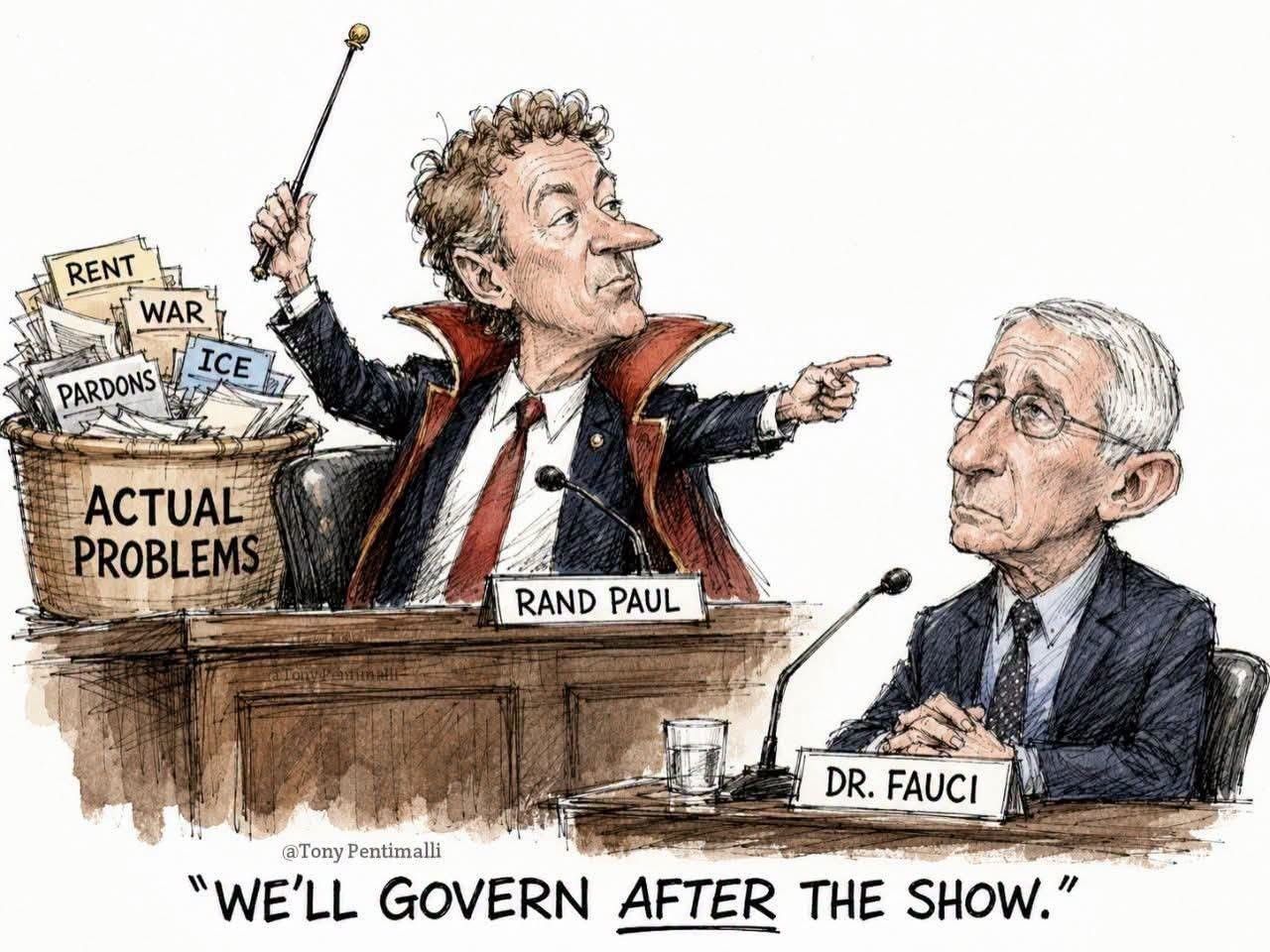
Two retiring Republican senators, John Cornyn and Thom Tillis, are holding out over a different Blanche scandal than his dealings with international pedophile Jeffrey Epstein. They’re mad about a $1.8 billion "anti-weaponization" fund tied to a settlement of Donald Trump's own lawsuit against the IRS, a settlement Blanche oversaw, that barred the government from auditing the president, his family, or his businesses.
He sat next to Trump at the defense table. His job was to protect Donald Trump from the law. He has never stopped doing that job. He just moved from the private sector to the highest echelons of government.
The latest: President Donald Trump said in a social media post today that he has "no objection to temporarily withdrawing" his nomination of Todd Blanche to be the next attorney general.
Context: GOP Sens. John Cornyn (Texas) and Thom Tillis (North Carolina) have indicated they will oppose Blanche unless changes are made to a deal the Justice Department made to resolve a lawsuit involving Trump and his family.
What happened: Some South Republicans have pushed back on Trump's endorsement of Sen. Darline Graham in the upcoming midterm election for her late brother’s seat.
Background: Graham was appointed to finish the remaining months of her brother's term and announced she would run for a full term, which Trump is supporting.
Controversy: A dozen Republicans have filed to run for the party's nomination, and many have criticized the optics of passing the seat along to a family member and Graham’s relative political experience.
'Biggest red flag' in unredacted Epstein files given away by Todd Blanche: legal expert Rawstory.com, July 31, 2026
Judge Emmet Sullivan is reviewing the unredacted records privately and will decide what's worth releasing. However, in a court filing, the DOJ justified its redactions and mentioned an accidental redaction of Jeffrey Epstein's email address.
"Todd Blanche admitted in his filing yesterday that Jeffrey Epstein's email address was redacted. He calls it an inadvertent redaction, but it's been redacted and has since been lifted," Phang explained. "Now, you may not think that's a big deal, but I think it's a very, very, very big deal. And in fact, that is the biggest red flag that you could find from what has happened here."
The main argument in Phang's lawsuit is that the DOJ made improper redactions under the Epstein Files Transparency Act, and she's demanding they either release the files or explain their redactions. The inadvertent redaction of Epstein's email address "shows that the way that the redactions were done here was wrong," Phang said.
"This wasn't some one-off mistake," Phang said. "We know for a fact that the Department of Justice released over and over again, hundreds and hundreds of times, the personal identifying information of several victims." Phang explained that even though the DOJ "wants to say, 'Oops, sorry, we missed it,'" the release of victims' names but not Epstein's email address proves the "process was flawed. We know that it didn't work, and now we know that it also worked to protect the identity of Jeffrey Epstein, the main perpetrator of these crimes."
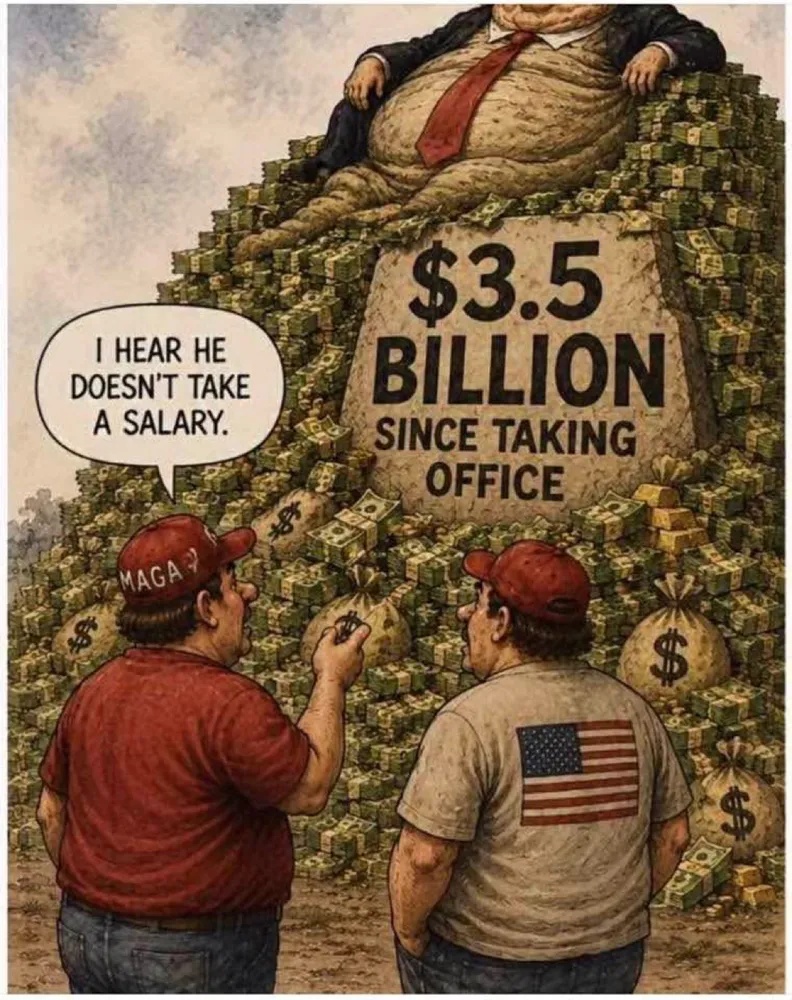
Graphic source: https://bsky.app/profile/wesmontgomery.bsky.social/post/3motjeu3nu32d
Bannon described Trump Organization as 'criminal enterprise', Michael Wolff book claims. This article is more than 7 years old. Former White House adviser says financial investigations will take down president in sequel to Fire and Fury The Guardian, May 29, 2019.
The former White House adviser Steve Bannon has described the Trump Organization as a criminal entity and predicted that investigations into the president’s finances will lead to his political downfall, when he is revealed to be "not the billionaire he said he was, just another scumbag".
In a key passage, Bannon is reported as saying he believes investigations of Donald Trump's financial history will provide proof of the underlying criminality of his eponymous company.
Assessing the president's exposure to various investigations, many seeded by the special counsel Robert Mueller during his investigation of Russian election interference, Wolff writes: "Trump was vulnerable because for 40 years he had run what increasingly seemed to resemble a semi-criminal enterprise." He then quotes Bannon as saying: "I think we can drop the 'semi' part."
This month, the New York Times obtained tax information that showed Trump’s businesses lost more than $1bn from 1985 to 1994. The newspaper subsequently reported that in 2016 and 2017, Deutsche Bank employees flagged concerns over possible money laundering through transactions involving legal entities controlled by the president and Kushner. Some of the transactions involved individuals in Russia.
The bank did not act but Congress and New York state are now investigating its relationship with Trump and his family. Deutsche Bank has lent billions to Trump and Kushner companies. Trump has attempted to block House subpoenas for his financial records sent to Deutsche Bank.
Epstein, Wolff writes, knew Trump had been loaning out his name in real estate deals for a fee and suspected that in his case Trump was fronting for the property's real owners. Epstein threatened to expose the deal. As the dispute increased, he found himself under investigation by the Palm Beach police.
According to Wolff, Trump made only minor improvements and put the house on the market for $125m. It was purchased for $96m by Rybolovlev, part of a circle of government-aligned industrialists in Russia, thereby earning Trump $55m without risking any of his own money.
Capital One bank has asked a federal judge to dismiss a lawsuit from the Trump Organization over the closure of hundreds of bank accounts back in 2021, arguing in new papers that the shutdowns were the product of a monthslong anti-money-laundering review — not retaliation for the Jan. 6 Capitol riot, as the Trump family businesses have claimed.
In a motion to dismiss the case filed Friday in a Florida federal court, Capital One's lawyers wrote that the bank's own filings and the Trump businesses' allegations "make clear that Capital One closed Plaintiffs' accounts for anti-money laundering ('AML') reasons."
The case centers on roughly 385 accounts tied to the Trump Organization, Eric Trump and a collection of affiliated businesses - including a winery, a bottled-water company and a golf course developer - that banked with Capital One for more than a decade before the accounts were shut down in mid-2021.
In an amended complaint filed earlier in July, the Trump-affiliated companies insisted the closures had nothing to do with financial crime or money-laundering, but everything to do with politics. The Trump Organization alleges Capital One moved to distance itself from Donald Trump after the Capitol riot and that the bank's cited anti-money-laundering rationale was invented after the fact to cover for that decision.
Capital One has flatly denied those assertions, with its lawyers arguing in the new filing that the Trump's theory rests on "cherry-picked quotations unsupported by the full context" of the bank's own records, and that nothing in the complaint shows the anti-money-laundering explanation was a cover story.
The bank's lawyers also noted that it kept its reasoning for the closures confidential at the time: it "never publicized the termination decision nor its confidential internal process giving rise to the closure," and gave the Trump companies months - plus several extensions - to move their money elsewhere, which they did.
Large sections of the Trump-linked amended complaint from July remain blacked out under a court-approved sealing order, including an entire portion titled "January 6, 2021: The Political Trigger." The bank says its contract gave it broad discretion. Beyond disputing the facts, Capital One has reiterated in the new court filing it had the right to close any account "at any time, for any or no reason and without notice" - language the Trump companies do not dispute.
The presiding judge, Roy Altman, had already dismissed an earlier version of the lawsuit in March on similar grounds, ruling that a bank's reason for closing an account under that kind of open-ended contract clause generally cannot be second-guessed in court. Capital One has asked Altman to dismiss the new complaint permanently this time, without another chance to refile.
The bank is also pushing back against a new claim the plaintiffs added in July: that Capital One defrauded them by staying silent about its reasoning. Capital One's attorneys say the bank had no obligation to explain itself in the first place, and separately argue that federal banking-secrecy law would have barred it from disclosing internal anti-money-laundering findings even if it wanted to.
A parallel fight over what stays sealed. That secrecy law is also at the center of a related fight over what the public gets to see. In a separate motion filed Friday, Capital One asked the court to keep sealed a portion of one exhibit that it says contains information protected under the Bank Secrecy Act, along with employee names, customer account numbers and unrelated compensation details.
The Trump companies do not oppose sealing the account numbers or that one Secrecy Act-related passage, but are contesting several other redactions Capital One wants to keep in place. A separate case against JPMorgan Chase, filed in January over accounts closed in the same period, makes similar claims. President Trump signed an executive order last August directing regulators to crack down on what he and other conservatives call politically motivated 'debanking.'
Capital One itself has tangled with Trump before: in 2019, during his first term, the president sued the bank alongside Deutsche Bank to block them both from turning over his financial records to a Democratic-led congressional inquiry.
Democrats and some former foreign policy and national security officials argue that cuts to the U.S. diplomatic footprint - coupled with the dismantling of the U.S. Agency for International Development, which provided billions of dollars worth of aid globally - risks undermining American leadership, while leaving a dangerous vacuum for adversaries like China and Russia to fill.
What a patently false, disgusting statement. It's actually offensive, given the hell on Earth that my New York colleagues in particular endured in late March and April of 2020. Dana Bash did her best to push back on this and other nonsense Kennedy peddled. But she’s not a public health expert, and Kennedy excels at the "Gish Gallop," a strategy in which the offender rapidly fires off so many incorrect claims that it's impossible to refute them all in the time allotted. Sometimes one single terrible sentence would take paragraphs or pages to refute—and that's if you had the answers at your fingertips. This is why platforming grifters is always dangerous. In this case, it’s the Secretary of Health and Human Services, which makes this all incredibly serious.
Sometimes, though, all you need is a graph. I sincerely wish Dana Bash had had the above image at her fingertips when she interviewed Kennedy. I made it just now for Inside Medicine using CDC data. It shows monthly all-cause deaths in New York City by place of death. This alone dismantles the both "Covid-19 deaths were overcounted" conspiracy theories and Kennedy's despicable "hospitals were empty" fever dream.
The graph covers January 2018 through December 2025, making the early Covid-19 peak of April 2020 clear, followed by some smaller (but still terrible) peaks by historical standards—namely, the first winter in 2021, and then the Omicron wave in the winter of 2022.
Separating mortality out by place of death tells the story that my New York colleagues reported, and which RFK Jr. now denies. (Aside: when data and anecdote match, you don’t have to wonder whether the narrative is accurate.) In the 26 months leading up to the first Covid-19 outbreak, around 44% of deaths in New York City occurred in hospitalized patients. (It's about 53% if you include outpatient and ER locations in hospitals.) You can see that hospital deaths skyrocketed in April 2020—a historic peak exceeded only by the 1918 flu pandemic (as my colleagues and I showed in JAMA Network Open.) That month, around 60% of all New York City deaths occurred in hospitals. Many, if not most, of those deaths occurred in ICUs. The numbers likely understate the strain because hospitals rapidly expanded ICU capacity during this time. (That's the only reason that our ICUs didn't overflow here in Boston; New York did the same, expanding ICU capacity by around two to three times during that period, but it often wasn't even enough because the virus had spread so rapidly in March.)
The numbers are staggering. In April 2020, there were 24,687 deaths in New York City (all places, including hospitals). That's around 560% of either the April 2018 or 2019 rate. And for a time, things were actually worse than this. (The week ending April 11, 2020, had around 750% of the deaths of a typical early April week in New York City). Of those 24,687 deaths in New York City, a full 14,720 occurred in hospitalized or ER patients. (That's where the 60% figure above comes from.) That's just slightly higher than either 2,366 in April 2018 or 2,275 in April 2019, wouldn't you say?
Generally, there were around 1,600 ICU beds in New York City prior to the pandemic. On any given week in the pre-pandemic, New York City ICUs were often close to full, if not full. During the pandemic, hospitals scrambled to expand, managing to more than double that capacity to around 3,500. It's obvious that even that herculean effort was not adequate to keep up with deaths rates that were 560%-750% of normal. (People died in the ER, or on regular medical wards, not just the ICU. It was a nightmare, despite what Kennedy wishes to believe.) The idea that ICUs were empty during the height—Secretary Kennedy’s preposterous claim on national television—can eff right off.
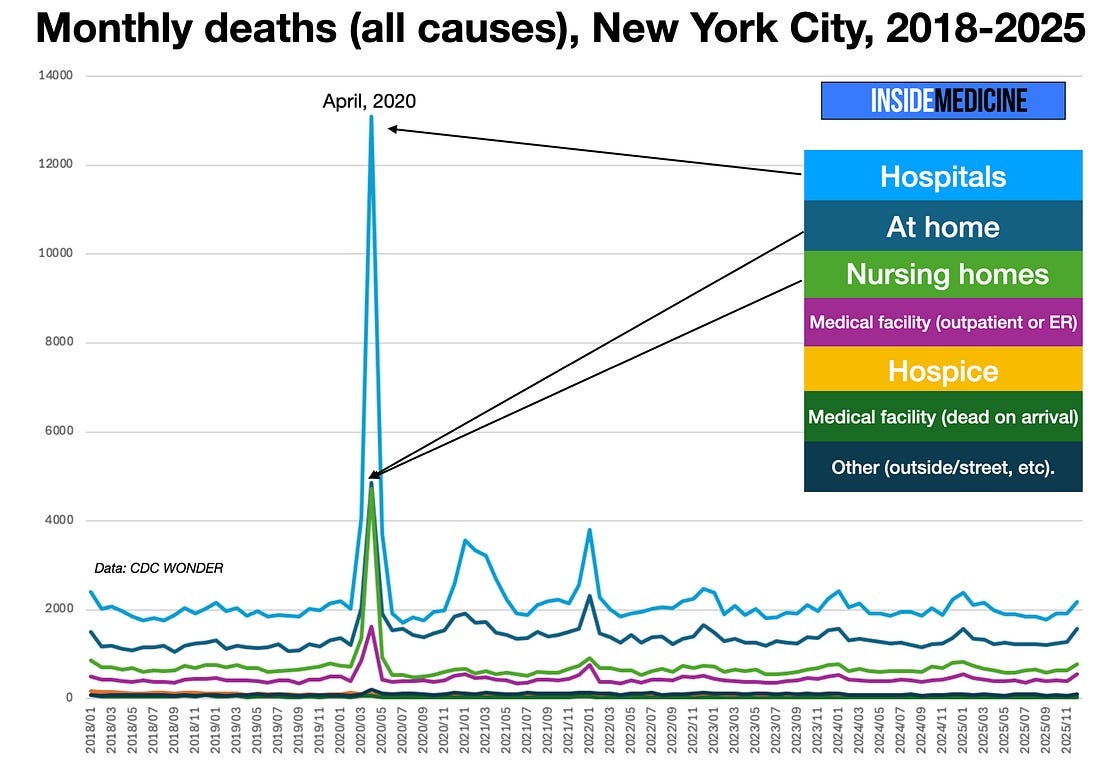
NASA's move was part of a series of relocations launched by the Trump administration across at least six federal agencies that have continued through the summer. The relocations, agency leaders say, will reduce the government's real estate footprint, cut costs and decentralize operations away from the Washington, D.C. core and other cities.
But moving is costing the government money, an NPR review of public records shows, and federal workers say the relocations have been poorly coordinated and are causing work disruptions. The moves have also violated laws that require Congress to authorize relocations, according to two legal complaints filed in July against federal agencies and against senior leaders in the Trump administration.
"You're not supposed to be doing this," said Steve Gutierrez, a representative with the National Federation of Federal Employees, the union representing U.S. Forest Service workers. "But oversight [in Congress] hasn't done anything about it."
NASA employees who were based at Columbia, where they often collaborated on research with faculty, were instructed to report to four new locations spread out across New York City by August, emails reviewed by NPR show. But the federal government has continued to pay more than $2.5 million annually to rent the five, now-empty floors near Columbia, public records reveal. That lease doesn't expire until 2031. "Now they're paying this extra money for us to have seats so that we can return to office," said a current NASA employee who was told to report to one of the new locations. "It made zero sense."
Yet on July 22, as federal firefighters were on high alert as dozens of wildfires were spreading across multiple states, Schulz sent an email to Forest Service staff informing them that the reorganization would begin that week. When asked why the agency was starting the reorganization during wildfire season, the USDA emailed a statement to NPR that did not answer the question. But the statement confirmed that around 600 employees would receive updated assignments by August 20, and of those, "approximately 75 may involve relocation." "You said you weren't going to do this until end of fire season, and now you're doing [it] in the middle of fire season", Gutierrez said.
In 2026, the agency sent an email in May telling workers they would have to report in person by July at a new office in Washington that the government rents. By the time some CFPB staff arrived to begin working on the first three floors of that building, there were not enough desks for all the employees at the agency, current CFPB workers said. And the floors they were assigned to work from did not have functional Wi-Fi, the employees confirmed. Three CFPB workers said the lack of consistent Wi-Fi prevented them from efficiently doing their jobs.
Communication with employees about the requirement to move to new offices has been haphazard, workers at six agencies said. Hundreds of workers with the Army Corps of Engineers have also been subject to mandatory relocations and minimum communication. Employees at that agency are tasked with carrying out infrastructure projects that protect military and public spaces from long-term risks, like erosion, and more immediate problems, including disaster recovery after storms.
In February, Trump-nominated Assistant Secretary of the Army for Civil Works Adam Telle published a memo telling more than 400 of the agency's Manhattan-based workers that they would have to move to an undetermined new location, some of them as soon as August 15, so that the agency could be "optimized for quality, speed and cost to deliver for the American people."In March, the agency announced it was looking for new office space in three cities in New Jersey.
The Corps of Engineers has been in New York since the 1700s. The employees' union, the International Federation of Professional and Technical Engineers (IFPTE) Local 98, opposes the move from New York, saying it could delay ongoing, multi-million dollar infrastructure projects in the region, including one meant to protect more than 80 miles along New York's coastline from flooding. The relocation could also be expensive. It could cost more than $3 million to move just the agency's information technology infrastructure to a new location, agency records obtained by the union show.
Confusion about the move has caused so much chaos that some employees have already resigned, said Daniel Kim, a structural engineer at the agency and president of the union. "These are people that have tons of expertise that is just walking out the door," said Kim. "The lack of communication on this move has been pretty surprising, it's been surprisingly bad."
Union leaders and lawmakers say some of the orders to move employees out of old buildings and into new ones violate laws that require congressional approval before agency leaders make costly real estate decisions or order large numbers of people to relocate.
"You need congressional approval to implement this reorganization," Rep. Angie Craig, D-Minn., told Forest Service Chief Schulz at an agriculture hearing in Washington on July 22, before referencing the lawsuit the employees' union filed against the agency that claims the reorganization is an illegal attempt to further reduce the amount of Forest Service employees. Last year, agencies lost more than 300,000 employees during a government-wide effort to thin the federal workforce.
A similar federal law prohibits the U.S. Department of Housing and Urban Development (HUD) from moving its headquarters away from Washington without approval from Congress. When HUD was formed, its rules also explicitly stated that the agency must be "established at the seat of government."
But after 60 years in Washington, earlier this year, HUD's Trump-appointed secretary Scott Turner began ordering workers to relocate to a new building in Alexandria, Va. On July 27, the D.C. Attorney General's office filed a lawsuit against HUD and Turner. More than 80% of the agency had already been moved out of Washington by then, the lawsuit claims. Since Congress never approved that relocation, the move is unlawful, the lawsuit alleges.
Workers at multiple federal agencies said they fear the relocations will continue to deplete their numbers. "This has just caused a massive amount of chaos, uncertainty, and panic," said a current employee at the CFPB. "We really see this forced relocation as another part of trying to destroy the CFPB and traumatize our workforce into quitting."
U.S. President Donald Trump repeatedly campaigned for his second term as a champion of free expression, vowing in his January 2025 inaugural address to stop what he described as years of "government censorship." Since then, a wave of court rulings has concluded his administration has done the opposite. Reuters identified 75 federal-judge rulings finding Trump's government infringed on First-Amendment rights including freedoms of speech, religion, and the press.
The unprecedented pushback on constitutional grounds has included repeated findings that the administration chilled or squelched the speech of citizens and groups opposing the Republican's agenda. "The President's palpable misunderstanding that the government simply cannot seek retribution for speech he disdains poses a great threat to Americans' freedom of speech," Boston-based U.S. District Judge William Young wrote.
"The President's palpable misunderstanding that the government simply cannot seek retribution for speech he disdains poses a great threat to Americans' freedom of speech," Boston-based U.S. District Judge William Young wrote.
The judge, appointed by Republican President Ronald Reagan, ruled in September that the administration illegally detained, deported and revoked visas of foreign students and faculty because of their pro-Palestinian advocacy. Other judges found federal agencies terminated grants awarded to universities including Harvard for refusing to align with his ideological agenda; retaliated against law firms based on their legal advocacy; and used excessive force at protests.
Trump administration officials have repeatedly called federal judges ruling against them "activists" who are interfering with the president's executive authority. White House spokeswoman Abigail Jackson criticized the First-Amendment rulings in a statement, saying "the federal judiciary has repeatedly endangered and obstructed the election choices of the American people with its unlawful rulings."
LOSING STREAK. The 75 cases that produced lower-court rulings against the Trump administration were among 93 total cases during his second term in which judges addressed First-Amendment arguments, Reuters found. Trump's losing streak mostly came from judges appointed by Democratic presidents, but Republican appointees delivered decisions in 10 cases.
By comparison, during Democratic President Joe Biden's presidential term, Reuters identified just 27 cases in which lower-court judges weighed First-Amendment challenges to his agenda. Judges ruled against his administration in 13 of those. Most of the lower-court rulings against the Biden administration involved its vaccine mandates, which were challenged on religious-freedom grounds.
Reuters tallied the First-Amendment cases by searching federal court records and Westlaw, a legal research service. Both Reuters and Westlaw are owned by Thomson Reuters. When similar lawsuits were consolidated by a court or when a judge issued multiple rulings in the same lawsuit, Reuters counted them as one case. The review focused on civil lawsuits filed against the Trump administration and excluded cases by self-represented litigants.
Some of the rulings are preliminary, meaning that the judge acted on a request for speedy action before hearing the full merits of the case. The lawsuits were frequently filed by Trump's ideological foes or by media organizations, such as when the New York Times and Associated Press asked judges to halt restrictions on their ability to cover the White House or the Pentagon. The AP and the New York Times won at the lower court level, though some of the rulings are on hold pending appeal.
The Trump administration launched appeals in about two-thirds of the cases while electing to let other rulings stand. It chose not to challenge rulings that, for instance, prevented it from interfering with what academics can discuss in classrooms and from slashing longstanding grants awarded to legal and medical organizations that have opposed the administration's agenda.
In appeals of 15 of the 75 rulings that went against Trump, his administration successfully persuaded courts either to put a district court judge's First-Amendment ruling on hold or overturn it entirely. In significant victories for the administration, two appeals courts this year have overturned lower-court rulings that had led to the release of pro-Palestinian campus activists who had attended Columbia University, Mahmoud Khalil and Mohsen Mahdawi.
The appellate judges found the lower courts had no jurisdiction to hear those cases, without ruling on the lawsuit'’ merits. Khali''s lawyers have said he plans to appeal to the U.S. Supreme Court. In one appeal the administration did win on the merits, the San Francisco-based 9th U.S. Circuit Court of Appeals in February overturned a ruling that had blocked the Trump administration from stripping hundreds of thousands of federal workers of the ability to engage in union bargaining with U.S. agencies.
The unions argued that Trump took that action in order to retaliate against them challenging his administration's policies, in violation of the First Amendment. But a three-judge panel said Trump would have taken the same action whether or not he intended to punish unions for their advocacy.
Other appeals courts have been less receptive. In May, the 9th Circuit agreed, opens new tab with a lower-court judge that terminating federal grants awarded to University of California researchers - as part of Trump's anti-DEI push - constituted viewpoint discrimination.
RAILING AGAINST 'CENSORSHIP' Trump rode to his second-term win after railing against an "online censorship regime" that he said the Biden administration imposed when it required media companies to suppress alleged misinformation during the COVID-19 pandemic and after the 2020 election. He echoed themes from his first presidential campaign, including opposition to what he called "cancel culture," as some conservatives complained that social and professional pressures discouraged the expression of their political views.
Hours after his 2025 inauguration, Trump signed an executive order titled "Restoring Freedom of Speech and Ending Federal Censorship," which directed that no federal agency or employee would unconstitutionally abridge Americans' speech rights. Critics say that promise was almost immediately undercut by a flurry of other executive orders and policies seeking to exact retribution against foes or targeting viewpoints the president opposed.
Among those early orders were those directing an end to federal funding his administration deemed as supporting "gender ideology" or diversity, equity and inclusion (DEI), two subjects at the heart of many of the lawsuits alleging First-Amendment violations by the administration. Timothy Zick, a professor at William & Mary Law School and author of a book titled "Trump 2.0: Executive Power and the First Amendment," said no president has taken such sweeping action to suppress speech since President Woodrow Wilson, early last century, oversaw the thousands of deportations and arrests during the First Red Scare, a period of anti-communist and anti-immigrant fervor.
At that time, Zick said, court precedents were far less clear on whether the First Amendment protects speech critical of the government. "Trump is operating in this situation where the First Amendment's boundaries are very clear.
U.S. District Judge Beryl Howell, an appointee of Democratic President Barack Obama, who castigated Trump for targeting the law firm Perkins Coie through an executive order that suspended its lawyers' security clearances and barred them from entering federal buildings based on its past work for his political opponents.
"Settling personal vendettas by targeting a disliked business or individual for punitive government action is not a legitimate use of the powers of the U.S. government or an American President," Howell wrote.
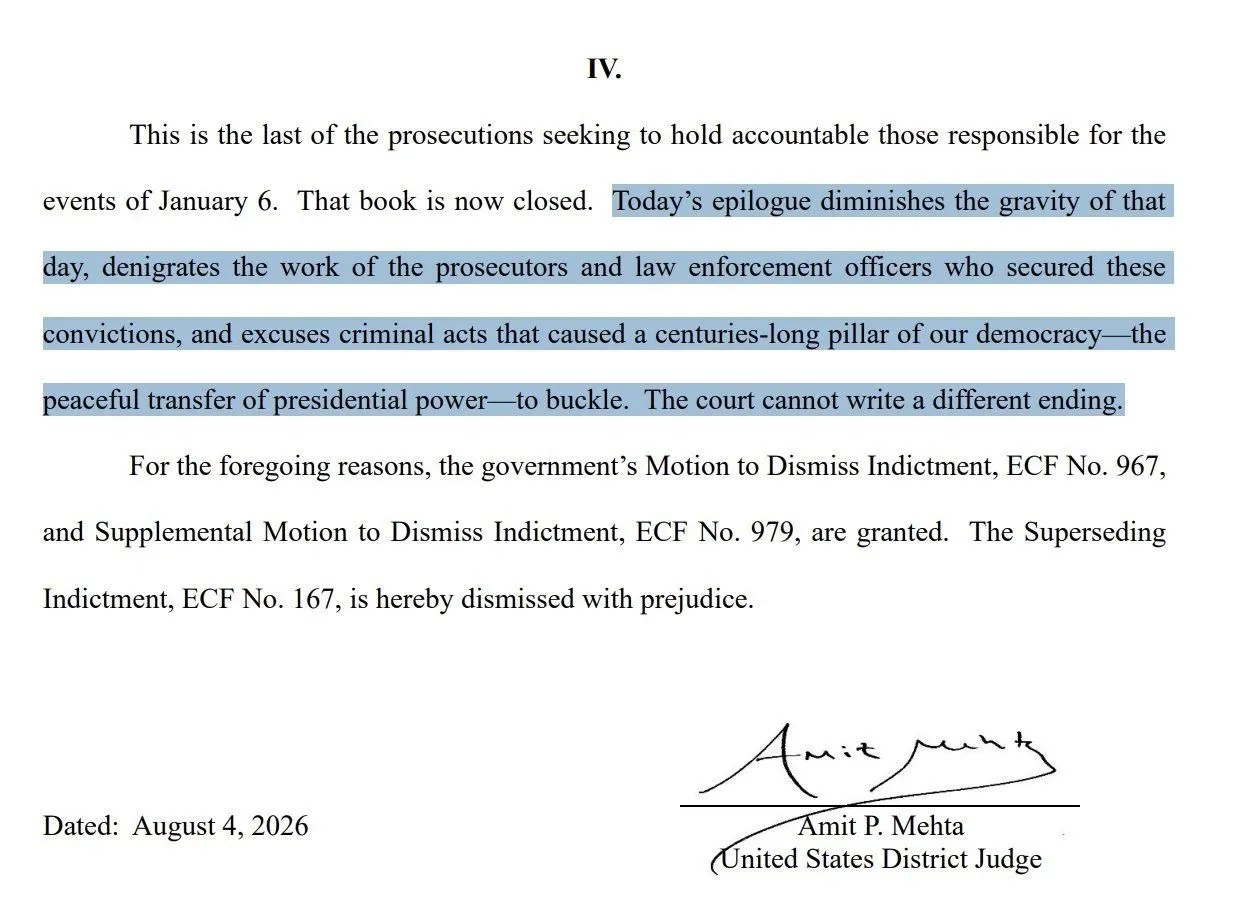
A federal judge decried efforts to rewrite the history of the Jan. 6, 2021, attack on the Capitol as he reluctantly dismissed the seditious conspiracy case against members of the far-right Oath Keepers extremist group at the Trump administration's request. The move Tuesday closes the book on the Jan. 6 cases that were wiped out with Republican President Donald Trump’s sweeping pardons and commutations last year, freeing people convicted of violent assaults on police and other crimes from prison.
The Department of Justice in April acted to vacate the convictions of Oath Keepers founder Stewart Rhodes and others in the seditious conspiracy case, who had their sentences commuted but did not receive pardons. It was a stunning reversal from the Democratic Biden administration, which hailed the guilty verdicts in one of the most serious cases stemming from the Capitol attack.
U.S. District Judge Amit Mehta, who oversaw the Oath Keepers’ trials, criticized the department’s move, writing in his ruling that the government "asks to absolve these Defendants of crimes against the United States itself." But Mehta wrote that he had no choice but to grant the administration’s request. "This is the last of the prosecutions seeking to hold accountable those responsible for the events of Jan. 6. That book is now closed," wrote Mehta, who was nominated to the bench by Democratic President Barack Obama.
"Today's epilogue diminishes the gravity of that day, denigrates the work of the prosecutors and law enforcement officers who secured these convictions, and excuses criminal acts that caused a centuries-long pillar of our democracy - the peaceful transfer of presidential power - to buckle. The court cannot write a different ending,” he wrote.
Juries in the nation's capital convicted Oath Keepers leaders and members of another group, the Proud Boys, of orchestrating violent plots to stop the peaceful transfer of power after Trump’s 2020 election loss to Biden. Rhodes was released from prison in January 2025 after Trump commuted his 18-year sentence.
Rhodes, who did not enter the Capitol on Jan. 6, has denied any wrongdoing and described himself at his 2023 sentencing as a "political prisoner." James Lee Bright, an attorney who represented Rhodes at trial, wrote in a text message that he was "disappointed in the tenor" of Mehta's order, adding that it was "not necessary to inject his personal opinions in such a fashion."
Trump has argued that the Jan. 6 defendants were treated unfairly by the justice system, saying the pardons were intended to end "a grave national injustice that has been perpetrated upon the American people" and begin "a process of national reconciliation."
More than 1,200 people across the United States were convicted of Jan. 6 crimes, including roughly 200 people who pleaded guilty to assaulting law enforcement. Most of the Jan. 6 defendants were granted "full, complete and unconditional" pardons, while Rhodes and other defendants in the seditious conspiracy cases only had their sentences commuted. Trump also ordered the attorney general to seek the dismissal of roughly 450 cases that were pending before judges stemming from the largest investigation in Justice Department history.
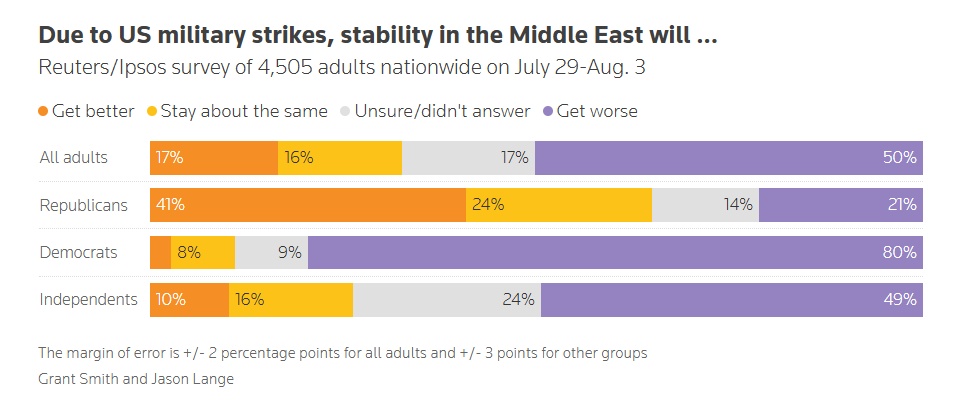
Exclusive: During a trip to Camp David last week, President Donald Trump confronted Defense Secretary Pete Hegseth over the military's munitions shortage.
More: Trump took issue with apparently being misled about the state of the U.S. munitions supply, according to two sources. The White House denies the interaction happened.
What to know: A Government Accountability Office report released today found the U.S. DOGE Service consistently overstated how much its cost-cutting measures saved the federal government.
Details: Nearly half of the lease terminations the group took credit for were already in the works when DOGE started, and billions in contract savings DOGE claimed did not occur.
What to know: The Office of Refugee Resettlement gave the Houston-based Burke Law Group a $150 million no-bid contract to represent unaccompanied migrant children.
Controversy: One of the firm's founders was a Trump appointee, and only two of the firm's 26 employees are attorneys specializing in immigration and asylum law, prompting criticisms of the contract.
A federal judge has sided with the Virginia NAACP in its lawsuit against a county school board's reinstatement of Confederate military names to two schools, saying the decision discriminated against Black students and ordering the board to change the schools' monikers again.
In an opinion filed Thursday in U.S. District Court of Virginia, Judge Michael F. Urbanski said the school board in Shenandoah County violated Black students' rights under the 14th Amendment's equal protection clause, which forbids racial discrimination in state-supported institutions. The decision also violates the Equal Educational Opportunities Act, the court found.
"The Confederate names were restored with complete awareness of their historic legacy and ongoing discriminatory impact," Urbanski wrote. "In the court's view, the affirmative act of reinstating these vestiges of segregation is far more problematic than a passive failure to remove a long-standing name or symbol." The judge ordered the board to settle on new school names "on a racially nondiscriminatory basis with all deliberate speed."
Under President Donald Trump's second administration, some statues honoring Confederate figures have been restored after being removed in 2020. It is part of Trump's ongoing efforts to control how American history is framed at Smithsonian museums, monuments in national parks and in classrooms.
Trying to Kill You August 8, 2026
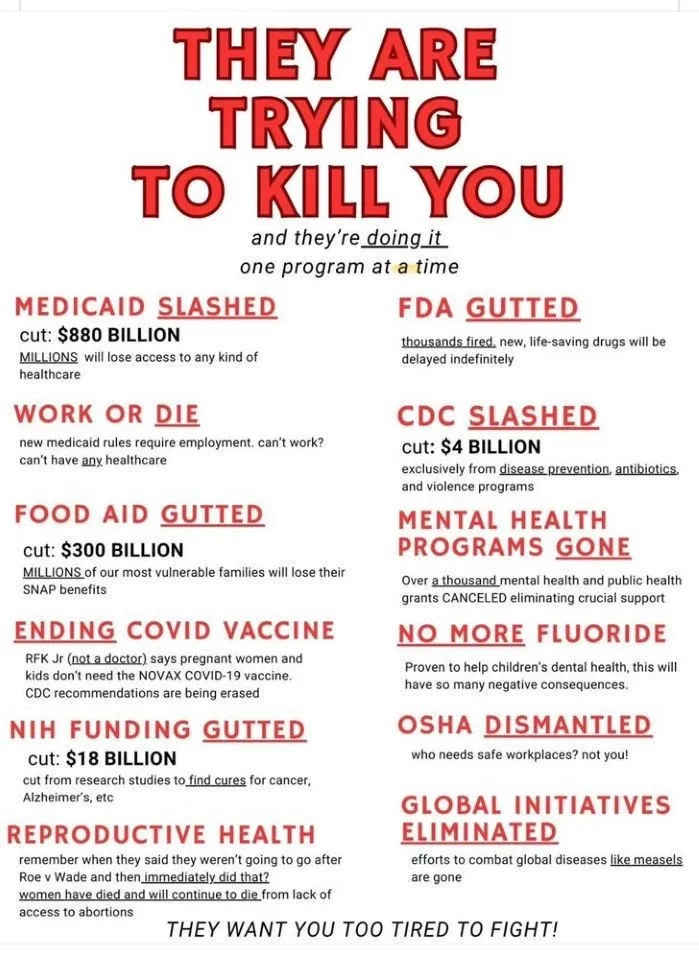
New: The Trump administration issued an executive order that would radically reshape federal guidance on which vaccines should be given to children and when.
Details: The order would recommend 11 vaccines for all children, down from 18, and would recommend splitting the current MMR vaccine into three separate shots for measles, mumps and rubella, a step opposed by medical experts.
Sen. Bill Cassidy (R-La.) blasted an executive order President Trump signed Monday that splits the measles, mumps and rubella (MMR) shot across three separate visits. "I’m a doctor. This executive order is wrong. The President does not have the expertise to make these changes. Vaccines are overwhelmingly safe. Vaccines are effective. Vaccines DO NOT cause autism," Cassidy wrote on social platform X shortly after the order was signed.
"Breaking up vaccines will mean children have to get more shots to get the same protection, not fewer shots. It will increase hesitancy and make children less safe." Trump's order follows a January effort by the Department of Health and Human Services (HHS) to shrink the number of childhood vaccines, which was blocked by a judge in March.
"Parents should listen to their child's pediatrician about vaccines rather than listening to an inaccurate executive order. This is so wrong," Cassidy wrote Monday. Medical experts have decried Trump’s Monday proposal and said splitting up the MMR vaccine could leave children vulnerable to infectious diseases for longer. Separate measles, mumps and rubella vaccines for children are not currently available in the U.S.
States set their own vaccination requirements, and many have already said they have lost faith in the Trump administration and are no longer following recommendations from the federal government.
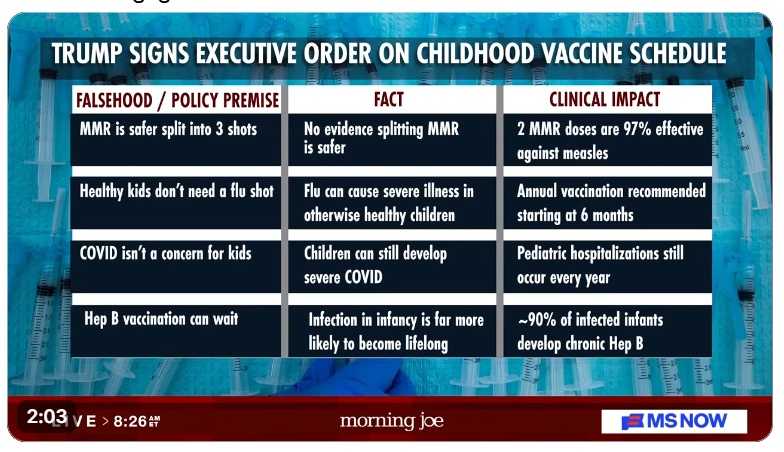
Graphic source: https://bsky.app/profile/vinguptamd.bsky.social/post/3mssusbntx22z
These passages are the CDC MMR Webpage, as of August 12, 2026. If they disappear, you will know they have been removed by RFK Jr.
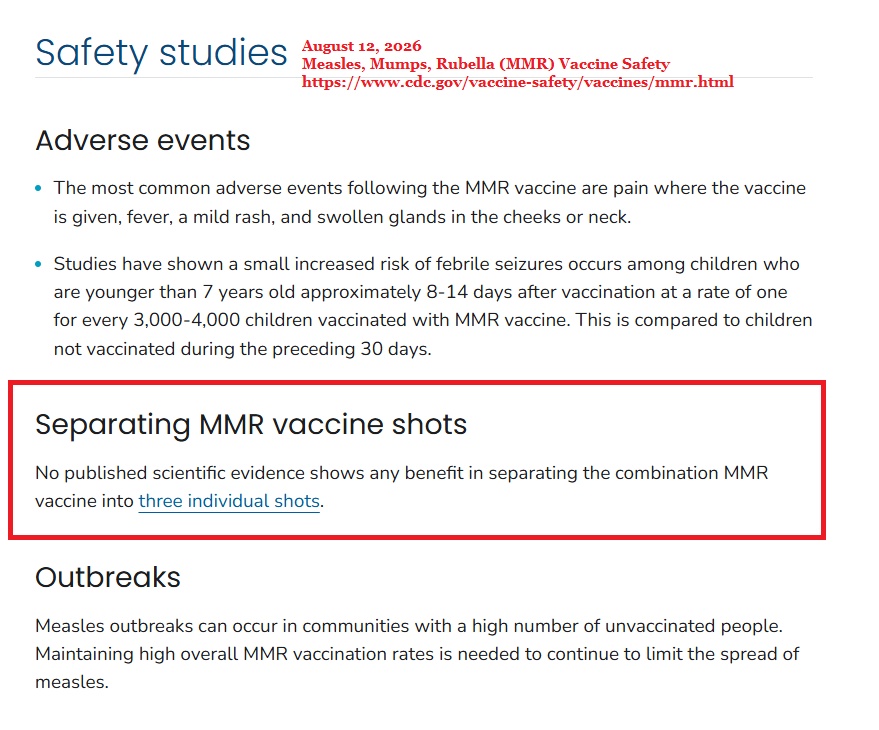
Graphic source: https://www.cdc.gov/vaccine-safety/vaccines/mmr.html
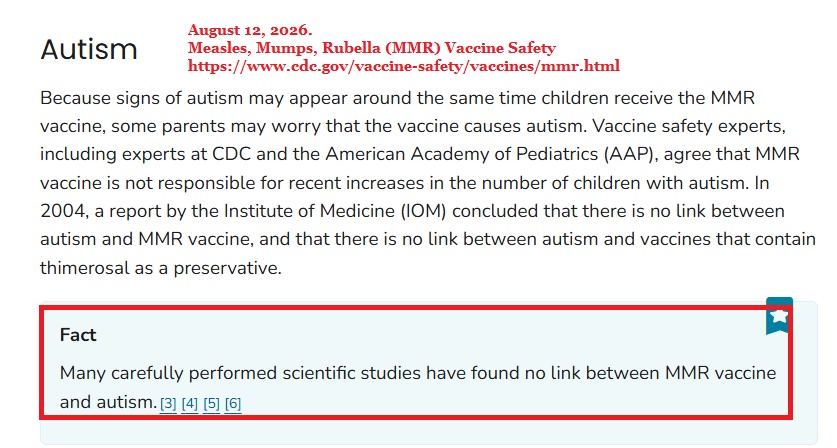
Graphic source: https://www.cdc.gov/vaccine-safety/vaccines/mmr.html
While issuing an executive order on Monday aimed at getting states to revise childhood vaccine recommendations, President Donald Trump and others in his administration repeated several false claims about those vaccines, as well as their relationship to autism.
The order recommends separating the measles, mumps and rubella (MMR) vaccine into three separate single-disease shots and administering childhood vaccines at separate appointments whenever possible.
But many public health experts expressed concern about the recommendations, saying that spacing out the shots could increase the risk that children would become infected with a vaccine-preventable disease before returning for another visit. They noted that childhood vaccines and how they should be given have been rigorously studied around the world for decades, and continue to prove to be safe and effective at protecting children.
Here's a closer look at the facts. TRUMP: "In many cases, we were requiring 72 jabs for our beautiful, healthy, lovely, delicate little children."
THE FACTS: That's misleading. In 2025, the government’s childhood vaccination schedule recommended routine protection against 18 diseases. How many separate injections that added up to between birth and age 18 varied. It depended on things like the brand used, the availability of combination shots and the child's starting age. But unless you counted once-a-year flu vaccines (which some kids can get as a nasal spray) or COVID-19 shots, the number of injections was closer to three dozen.
Those shots have been proven to protect children from preventable and sometimes devastating diseases. Even so, vaccines were never "required," as families could opt out. States do require children to get certain vaccines before enrolling in school, but the state lists of school shots were narrower than the federal vaccine schedule, and many states offer different types of exemptions.
The Trump administration in January cut the national vaccine recommendations to injections against 11 diseases, with additional vaccines now separately categorized for at-risk children or as available through "shared decision-making"with a doctor. This drops the total number of injections to about 23 if children receive only the recommended-for-all vaccinations on the administration's new schedule.
TRUMP: "You have the MMR, we want it in three separate vaccinations given at separate times. Together there could be a possibility they are quite lethal and separately, it looks like they are not at all lethal but just very effective."
THE FACTS: This is false. Doctors say, and years of real-world evidence prove, that the current combination MMR vaccine is both safe and effective at protecting children from illness. Common side effects are mild and include a sore arm from the shot, fever, mild rash and temporary pain and stiffness in the joints. Doctors point out that separate vaccines for measles, mumps and rubella are not available in the United States.
"I'm concerned about an unintended consequence of people under vaccinating because of fear that giving a single dose of the MMR is going to put their child at risk when there's no evidence to suggest that's the case," said Dr. Aaron Milstone, pediatric director of infection prevention at Johns Hopkins Health System and a fellow with the American Academy of Pediatrics. "There are many, many, many years of scientific data highlighting the safety of vaccines in children."
TRUMP: "Large amounts of vaccine, large amounts of like vats of vaccine are currently pumped into your child’s body."
THE FACTS: This is false. Dr. Molly O’Shea, a Michigan pediatrician, said amounts vary slightly by vaccine, but doctors give less than 0.5 milliliters per vaccine -- usually 0.1 to 0.3 milliliters per vaccine. By comparison, a teaspoon is about 5 milliliters. "It's a teeny amount," she said. "So there are no vats."
Trump also said during the executive order signing: "I've seen proof of it. Where they have a vaccination that looks like the size of a bottle of soda poured into a little child's body." A typical plastic bottle of soda contains 500 milliliters, or about 2,500 times more than a typical vaccine. TRUMP: "There's nothing that we lose with this. The worst thing that would happen would be nothing happens. We're not going to lose anything."
THE FACTS: Public health experts have raised concerns that spacing out shots as Trump suggests can lead to an increased risk that children become infected with a vaccine-preventable disease before returning for another visit. Doctors say, and real world evidence proves, that vaccinations save millions of lives.
"Vaccines are among the most thoroughly studied, effective tools we have to protect children from serious vaccine-preventable diseases," said Dr. Willie Underwood, president of the American Medical Association. "Altering a proven vaccination schedule without credible evidence risks weakening public confidence and putting children's health at risk."
Dr. Andrew Racine, president of the American Academy of Pediatrics, said that "delaying or skipping shots is risky, especially as measles continues to spread and children go back to school."
Measles was declared eliminated in the U.S. in 2000, but rates are now climbing as vaccination rates decline. The number of cases this year has already surpassed the record-breaking tally for all of 2025, which was the worst year for measles in more than three decades.
HEALTH SECRETARY ROBERT F. KENNEDY JR.: "In 1970, the biggest epidemiological study at that time in history was performed. And the university scientists from across this country looked at all the 8-year-olds in Wisconsin, about 900,000 children, and they were looking for autism. And they knew what autism looked like. And they came back with an incidental rate of .8 per 10,000. So less than one in 10,000. The rate according to CDC today in this country is one in every 31 children."
THE FACTS: It's true that in the 20th century, only 1 in 10,000 children were diagnosed with autism -- the diagnosis was rare and given only to kids with severe problems communicating or socializing and those with unusual, repetitive behaviors. But the term became shorthand for a group of milder, related conditions known as "autism spectrum disorders," and the number of kids labeled as having some form of autism began to balloon.
Health officials have largely attributed growing autism numbers to better recognition of cases, through wide screening and better diagnosis. In April 2025, the CDC said the diagnosis rate was 1 in 31 children.
During the executive order signing, Kennedy and Trump suggested that childhood vaccines may play a role in causing autism. But studies by the CDC and others have ruled that out. A fraudulent single study that claimed a link between the measles, mumps and rubella vaccine was later retracted by the journal that published it.
There are no blood or biologic tests for autism; it is diagnosed by making judgments about a child's behavior. Research has looked at a variety of other possible explanations, including genetics, the age of the father, the weight of the mother and chemicals in the environment.
"No environmental factor has been better-studied as a potential cause of autism than vaccines," said Dr. Alycia Halladay, chief science officer at the Autism Science Foundation. "That includes vaccine ingredients as well as the body's response to the vaccines. All this research has determined that there is no link between autism and vaccines. This is consistent across multiple studies, repeated in different countries around the world, including those mentioned in today's press conference."
Last year, Kennedy promised to conduct exhaustive studies to identify any environmental factors that may cause the developmental disorder. He said on Monday that his department will deliver research findings "as soon as they are ready."
Human Rights Watch and three other advocacy groups sued the Trump administration on Tuesday to challenge its campaign against the International Criminal Court, arguing that sanctions against ICC judges and prosecutors are undermining the ability to prosecute people responsible for humanity's worst crimes.
The complaint - filed in the Southern District of New York - says that President Donald Trump's executive order last year targeting the Hague-based criminal court and the U.S. sanctions issued against a U.N. human rights expert and three Palestinian rights groups represent a "blatantly illegal attack on international justice and should be struck down," according to a press release.
The lawsuit is the latest example of organizations pushing back on what they call the Trump administration's efforts to undermine international law and prevent efforts to combat impunity by governments around the world.
"The fact that so many leading human rights and humanitarian organizations have come together to challenge Trump's unlawful executive order demonstrates the widespread harm it is causing across civil society groups dedicated to bringing those responsible for grave crimes to justice," said Andrew Loewenstein of Foley Hoag LLP, the lead counsel representing the plaintiffs.
The groups assert that the financial and legal penalties against the ICC have forced them to "curtail a wide range of human rights and legal work in violation of their First and Fifth Amendment rights under the US Constitution and under the Religious Freedom Restoration Act."
Exclusive: Records reviewed by The Washington Post show the Trump administration’s planned construction projects will cost at least $900 million, far higher than previously reported.
Details: The projects will be paid for largely by taxpayers, with at least $500 million coming from federal agencies. Private donors also have contributed to the projects.
The CFPB - conceived by the Democratic senator Elizabeth Warren to protect consumers after the 2008 financial crisis - has long been a target of Republicans. When Donald Trump appointed Russell Vought, architect of the rightwing manifesto Project 2025, to oversee the agency last February, Elon Musk posted, "CFPB RIP," on X.
Another union member and worker, Alexis Goldstein, was also put on administrative leave in February 2025 before she was fired in February 2026 after she confronted staff with Elon Musk's so-called "department of government efficiency" (Doge), questioning their credentials in accessing data at the agency and recording their actions.
"CFPB is illegally retaliating against me for trying to do my job. I acted to protect the sensitive data of Americans and the trade secrets of some of the nation's largest banks and financial institutions from being accessed by individuals from Doge without CFPB credentials and required training," Goldstein said in a statement after her firing in February.
The Trump administration has attempted to dismantle the CFPB since the beginning of Trump's second term. The office of management and budget director, Vought, called for the abolition of the agency. He halted most the work there in February 2025.
The agency deleted nearly 4,000 webpages on its website earlier this year, including all press releases issued by the agency before February 2025.
The battle over the Kennedy Center’s future escalated Thursday as President Donald Trump’s allies on the board took new steps to commemorate him with physical changes to the iconic performing arts institution that could defy a federal court order.
The changes, described by Rep. Joyce Beatty, an Ohio Democrat who is an ex-officio board member, and her lawyers, amount to a dramatic test of U.S. District Judge Christopher Cooper. He ruled in May that letters affixed to the building that spelled out Trump's name were added illegally and he ordered their removal, a decision that the Republican administration failed to persuade courts to overturn. At the same time, Cooper blocked a two-year closure that was set to take effect July 5, saying an earlier board vote authorizing the shuttering was "ill-informed and seemingly preordained."
"This latest development is a transparent effort to circumvent the Court’s ruling, and flies in the face of the statutes that Congress passed," Beatty said in a statement. "I will continue to fight for this treasured national monument."
The Department of Defense Education Activity operates about 160 schools across 11 countries and educates roughly 70,000 students who are children of active-duty military or civilian service members. Conservatives have eyed the schools - which, unlike most public schools, are run by the federal government - as a testing ground for reshaping education.
Historians and educators who reviewed excerpts of the text told The Associated Press it depicts points throughout history in misleading ways, representing Western civilization and Christianity as one and the same and casting Islam as a threat to both. "You've got to wonder a bit whether Western civilization is a Trojan horse for classical Christian education," said Phil Gorski, a historical sociology professor at Yale University.
While some classical educators have pushed to incorporate diverse scholars, critics have argued the movement focuses too heavily on foundational texts from Greek, Roman and other Western writers and gives short shrift to achievements in Asia, Africa and the Middle East.
Susan Wise Bauer, "Whenever you have a system of education where that is the impulse, ... 'This is us, and they are them over there,'" she said, "then the idea of a shared literary heritage becomes a weapon."
Matthew Gabriele, a history and religion professor at Virginia Tech, said the book's description of the Crusades and the conflicts with the Islamic world strips out important details and context to depict Islam as an aggressive religious tradition and downplays the religious motivations and violence of the Christian church.
"It's trying to make a contemporary political point by continuously referencing things that happened in the 21st century," Gabriele said. "The fact that (the book) does this very selectively and only when it suits a particular political project suggests to me that this is not a scholarly history in any kind of real sense."
And last year, the ACLU sued the defense school system over its decision to ban hundreds of books that covered topics like race, gender and democracy. The Pentagon also replaced the education activity's chief academic officer, hiring Tiffany Hoben, who previously worked in the Florida Department of Education under Republican Gov. Ron DeSantis. In Florida, she oversaw the rollout of a civics curriculum that was criticized for claiming America's founders did not intend for a full separation of church and state.
Yesterday: Attorney General Todd Blanche said he will "take the president of the United States' view on something into consideration" in his duties running the Justice Department.
More: Blanche also declined to pledge that he would act independently of the president and said Trump would "never ask me to do something unethical or illegal."
Health data appears to be most affected by administration’s attempt to wipe findings that don’t align with its priorities, tracker shows. A database of federal law enforcement officer misconduct records. A survey measuring physical, sexual and emotional violence against children and youth. Real-time pollution readings collected by air quality monitors from US embassies around the world. These are among the hundreds of federal datasets that the Trump administration has taken down or altered as part of its aggressive campaign to wipe all mentions of data findings that do not align with the administration’s priorities.
Over the past year and a half, at least 28 federal datasets have been deleted and another 338 data collections have been modified, according to an online tracker released last week from dataindex.us, a group of data policy experts, researchers and developers that formed last year to monitor changes to government data.
"We're at a very vulnerable point as a nation," said Denice Ross, former US chief data scientist under the Biden administration and a co-founder of dataindex.us. "We're facing a future where we are not going to have the information that we need to make decisions that will save lives and benefit American communities."
The tracker includes detailed information about deleted or altered datasets from more than 60 federal agencies that span the environment, labor, law enforcement and other topics. But datasets on health appear to be the most affected by the Trump administration's crackdown, comprising about 40% of the total number of terminated or altered data collections tracked by dataindex.us.
One of the main changes to these health datasets is that they no longer collect information on queer and trans people - as part of Donald Trump's executive order "Defending Women from Gender Ideology Extremism and Restoring Biological Truth to the Federal Government".
Multiple Centers for Disease Control and Prevention (CDC) surveys, for example, have removed questions about respondents’ gender identity. These include the National HIV Surveillance System, the primary source of case data for HIV infections, the National Violent Death Reporting System, the CDC Diabetes Prevention Recognition Program, the National Intimate Partner and Sexual Violence Survey and specific surveys evaluating Prep uptake among gay men and in communities of color.
In addition, there are at least four health datasets that are no longer being updated at all, including the Substance Abuse and Mental Health Administration’s (Samhsa) Drug Abuse Warning Network, a surveillance system that doctors and public health researchers used to track drug-related emergency room visits in near real-time to spot emerging overdose trends.
"These data are critical for identifying emerging epidemics and what parts of the population are most vulnerable to different types of health conditions," said Thomas Babor, a professor emeritus at the University of Connecticut who specializes in public health and addiction.
"We need to know what direction the trend is going, whether it's the beginning of an end; we need to learn from prior episodes of epidemics and how they were responded to and what impact the responses had,” Babor said. “Taking down, even temporarily, some of the most important surveys that we have, especially for comparative purposes, is like we’re erasing our institutional memory for public health."
Other deleted datasets include the US Department of Agriculture’s twice-annual survey of farm employers that counted the number of farm workers employed and their wages that informed the minimum pay rates for H-2A visa workers and a National Center for Education Statistics (NCES) survey of the pay and working conditions of teachers and principals at public and private schools across the country.
Christopher Dick, a co-founder of dataindex.us and former chief of the population evaluation, analysis and projections branch at the Census Bureau said they launched the online tracker because it was difficult to know exactly how many federal datasets had actually been deleted.
Government agencies aren't required to notify the public when data collections are terminated, and some datasets have simply stopped updating because of a lack of staffing while others have been quietly pulled from federal websites with little notice. Some federal datasets also change or update on a regular basis, so it can be hard to figure out what is actually permanently deleted compared with a regular update.
The group identified important deleted or altered datasets through a combination of research about how the dataset was used, crowdsourcing from media reports, government employees, and people who used the datasets, monitoring social media, and tracking notices posted about proposed regulations from the Office of Information and Regulatory Affairs.
The dataindex.us tracker is not a complete list, and is probably still an undercount of all the deleted or altered datasets there are, said Ross. But the hope is the tracker is just a starting point. "We want people who depend on different datasets, some of which might be sort of obscure, to let us know what corners to look in because we don't have full visibility," Ross said.
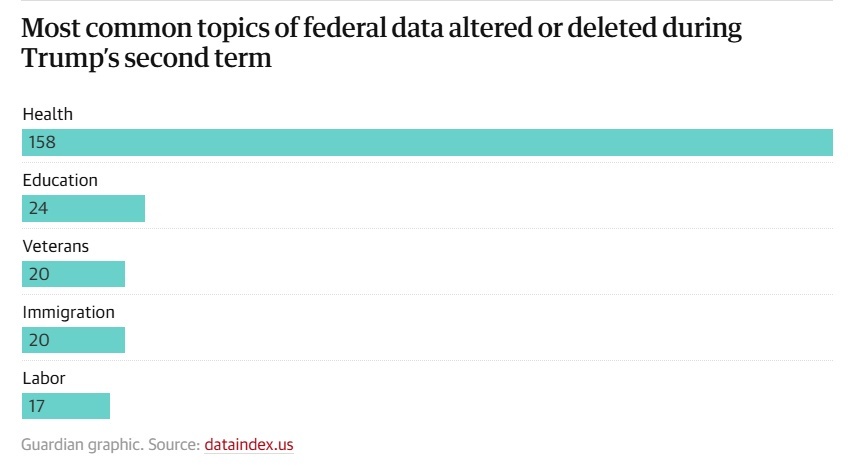
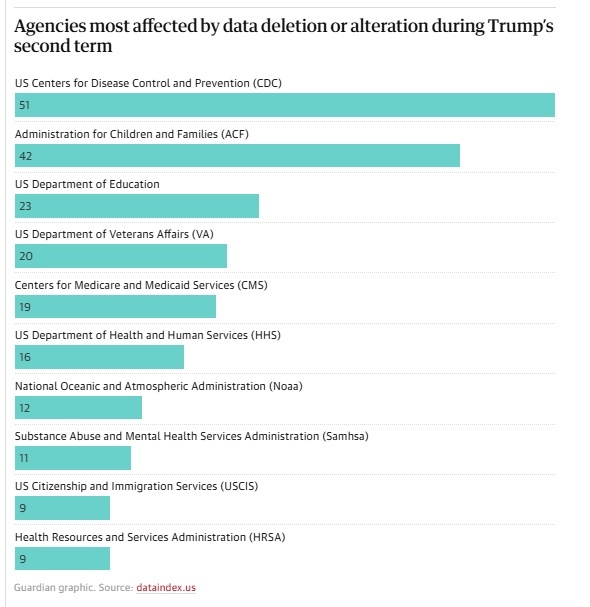
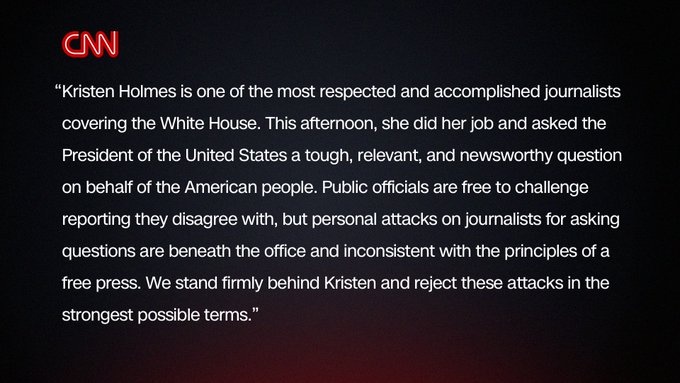
But experts on presidential ethics called the current confluence of business and politics in the White House unprecedented. "We have seen nothing like this before, even the first Trump administration did not have as many complex business interests as the second Trump administration," said Richard Painter, the top ethics lawyer for Republican President George W. Bush.
Some 69% of Americans - including two-thirds of independents and nine in 10 Democrats - said they thought Trump's private business interests were influencing his presidential decisions.
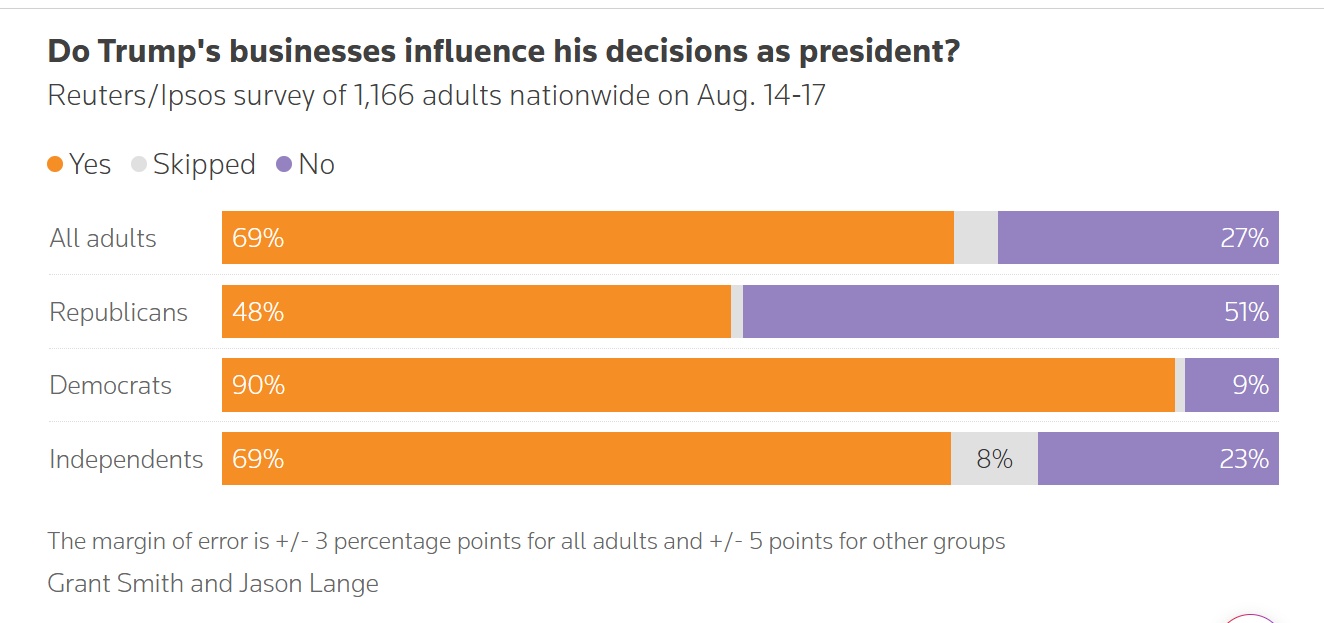
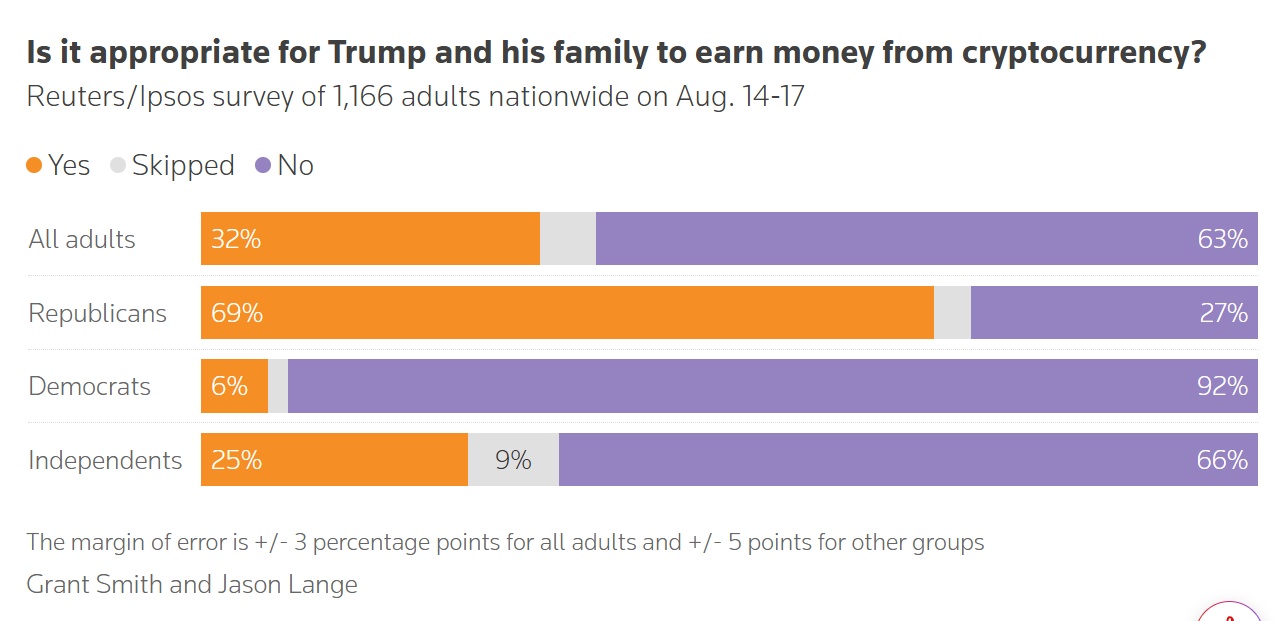
What happened: The Treasury Department today doubled how much government debt it can buy back, pushing bond yields down and boosting financial markets.
And: The buyback strategy will run from Sept. 9 to Nov. 4, the day after the midterm elections. Some economists have suggested that the strategy was an effort to manipulate Treasury yields.
However, skeptics argue that Overton’s policy record raises serious questions about whether she would maintain the FDA’s scientific and regulatory independence in an administration in which critics say loyalty to Trump is of paramount importance.
Reproductive Freedom for All—formerly the National Association for the Repeal of Abortion Laws and NARAL Pro-Choice America—noted that "Overton has an extensive anti-abortion record." The group continued:
She celebrated the overturning of Roe v. Wade as a "huge victory," and has advocated for the politicization of government agencies to help advance a nationwide anti-abortion agenda. She previously worked at America First Policy Institute, an extreme conservative think tank made up of former Trump administration officials, where she authored a brief pushing disinformation about the safety of medication abortion and calling for additional, medically unnecessary restrictions on access to mifepristone.
"Donald Trump is trying to put an anti-abortion extremist in charge of any agency that could seriously undermine reproductive healthcare—including the agency that could roll back access to mifepristone nationwide," Reproductive Freedom for All president and CEO Mini Timmaraju said. "Her nomination is another alarming step in Trump’s plan to weaponize every part of the federal government to restrict abortion nationwide."
"Additionally, Dr. Overton's active role in last week's nonsensical vaccine executive order calls into question her commitment to standing up for sound science and protecting children’s health. That alone is almost disqualifying," added Casisdy, who earlier this year lost a primary race to a Trump-backed challenger.
Chris Meekins, a former Trump health official who is now an analyst at the investment bank Raymond James, told clients that Overton would be "like Makary, but probably worse."
"Being seemingly inexperienced and unqualified is fine if you have self-awareness and humility and a strong team around you," Meekins wrote. "Based off of our DC channel checks, she does not seem to have either."
The latest: President Donald Trump yesterday warned any nation that supports Iran will face “ECONOMIC D-DAY,” his latest threat against nations, including allies, amid his frustrations over the Iran war.
More: Earlier this week, Trump threatened to bomb Oman, a U.S. ally that has acted as a mediator with Iran.
And: Trump also posted a map showing parts of Oman, the United Arab Emirates — another ally - and Iran as "NEW U.S. Territory."
Two fundamentals underpin the business model of a new crypto bank partly owned by the Trump family. The first is that there is almost no risk it can lose money, according to cryptocurrency experts – and the second, they say, is that the sole logical motivation for depositors to put in their funds is the prospect of a financial connection to a US president and his relatives.
World Liberty Financial Trust Company received conditional approval this month from the US office of the comptroller of the currency (OCC) to start a bank. An entity affiliated with Donald Trump and his family members owns about 38% of the company. The agency is led by a political appointee of the US president.
World Liberty is not really a bank, in the conventional sense: it won’t be lending money to businesses or individuals, issuing mortgage or credit cards, or getting federal insurance on deposits.
World Liberty Financial Trust Company received conditional approval this month from the US office of the comptroller of the currency (OCC) to start a bank. An entity affiliated with Donald Trump and his family members owns about 38% of the company. The agency is led by a political appointee of the US president.
World Liberty is not really a bank, in the conventional sense: it won't be lending money to businesses or individuals, issuing mortgage or credit cards, or getting federal insurance on deposits. Democrats have called the matter a stark example of corruption, pointing out that there has never been a case where a US president had an interest in a bank his own administration would approve and regulate.
Patrick Woodall, the managing director of Americans for Financial Reforms, said in a statement on the organization’s website that the OCC "exceeded its statutory authority and longstanding judicial precedent to unlawfully grant a conditional bank charter to a trust bank controlled by the Trump family crypto firm World Liberty Financial (WLF)".
Jeremy Kress, a law professor and bank regulation expert at the University of Michigan's Ross School of Business, said the bank approval was a clear coup for World Liberty. "President Trump controls the bank regulatory process," he said. "He wanted a bank and so the bank regulators approved his bank. That’s, you know, unprecedented."
Hansi Lo Wang, NPR correspondent reporting on voting, the census and USPS
NEW: For the second day, the U.S. Census Bureau's homepage, census.gov, features an unauthored report with analysis that NPR found was conducted not by career civil servants, but a team that included individuals affiliated with a President Trump-aligned think tank, the America First Policy Institute.
A highly unusual Census Bureau report that President Trump is using to reup dubious claims of widespread illegal voting by non-U.S. citizens has ties to a Trump-aligned think tank, NPR has learned.
In a social media post Tuesday, Trump claimed that the bureau's initial analysis of more than 128 million voter records "proves that over 24,000 Noncitizens voted illegally" in the 2020 presidential election and that the final number will "explode" after the statistical agency finishes checking over 32 million more voter records.
The unauthored, seven-page report says it draws on a 2020 commercial voter file and various federal administrative records, but data and election experts say the report is questionable in its methodology and conclusions. Work on the analysis was not conducted by career civil servants at the Census Bureau, and the team behind it included individuals affiliated with the America First Policy Institute, a think tank started by officials from Trump's first administration, according to a Census Bureau employee who NPR has agreed not to name because they fear retaliation at work.
Spokespeople for the bureau, the America First Policy Institute and the White House did not respond to NPR's requests for comment. But AFPI highlighted the analysis in a social media post Tuesday, saying that the think tank "maintains that maximizing transparency is a critical step to restoring confidence in our elections." The report is the latest attempt by Trump officials to push baseless claims of widespread voter fraud
Trump continues to falsely claim the 2020 election was rigged, and in the final stretch before this fall's midterm election has urged his Republican allies in Congress to pass sweeping new voting restrictions. The numbers from the Census Bureau report join a growing list of figures the Trump administration has released in recent months. The figures use disputed or unknown methodology in an attempt to quantify noncitizen voting in federal races, a problem many studies and audits show is incredibly rare.
Secretary of Homeland Security Markwayne Mullin answers questions from reporters on July 17 after remarks about his agency alleging that more than 250,000 non-U.S. citizens are on the voter rolls in just four states. Those states dispute that tally.
Trump's claims of 250,000 non-U.S. citizens on voter rolls leave some states baffled, Last month, the Department of Homeland Security announced it had found 250,000 noncitizens on public voter rolls in California, Nevada, New Jersey and Pennsylvania, but it has yet to publicly disclose how it made those calculations. And election officials in those states expressed doubts about the accuracy of the claims. The latest numbers from the Census Bureau report have also drawn pushback from election experts and officials.
"This analysis is laughable. Census data cannot reliably be matched to voter data," David Becker, executive director of the Center for Election Innovation & Research, said in a text exchange with NPR. "That said, it's good to see the president admit these numbers are so small that they couldn't have changed the outcome in 2020." Using figures from the initial analysis, some 24,000 votes out of 128 million is just shy of 0.02%.
Michael Morse, an assistant professor at the University of Pennsylvania's law school who has researched voter registration files, echoed Becker's criticism over email, writing: "I'd expect that the Census data matching [exercise] is plagued by the lack of unique identifiers in voter records and outdated or incomplete naturalization records. But the brief's lack of transparency makes it difficult to pin down each problem or trust any explanation. Regardless, the estimated rate of apparent non-citizen voting is both a tiny fraction of total votes - and entirely consistent with both types of error."
The state officials who run voting in the United States say they need more underlying information about the report's claims if they are to respond to them. Georgia Republican Secretary of State Brad Raffensperger, for instance, has prioritized building systems to effectively prevent any noncitizens from voting. His office conducted an intensive audit in 2024 that uncovered fewer than a dozen noncitizens who had voted previously in the state. The Census Bureau report, however, estimated the state had 400 noncitizen voters in 2020 alone. Raffensperger wrote this week to George Cook, the bureau's acting director, asking for more information on the report's allegations so his office can investigate them.
"I thank you for your agency's efforts in addressing this fundamental issue of election security and fully support your desire to reassure the public that American elections are only decided by American citizens," Raffensperger wrote, in a letter shared with NPR. "To further that mutual goal, I am asking for all the identifying information utilized by your agency to detect the alleged 400 non-citizens who would have voted in Georgia in 2020."
In Nevada, this is the second time this summer the federal government has published claims about noncitizens on the state's voter rolls without providing evidence or underlying data. In July, DHS claimed the state may have more than 15,000 noncitizens on its rolls; this month, the Census Bureau report claims 250 noncitizens voted in the state in 2020.
"The federal government has once again made sweeping claims regarding noncitizen voting allegations, without showing the public the proof behind the numbers," Francisco Aguilar, the Democratic secretary of state of Nevada, said in a statement to NPR. "These kinds of claims, without fully explaining how they came to these determinations, just cause chaos and fear ahead of a critical midterm election."
The report threatens the Census Bureau's reputation as a nonpartisan statistical agency. Former employees of the Census Bureau are also raising alarms about the report.
"My biggest concern would be there's no author attached to the report, which is not common practice within the Census Bureau," says Misty Heggeness, a former bureau economist whose work is cited in the report. "Usually there are layers and layers of rigor and testing because the Census Bureau is a neutral statistical agency. They want to make sure that they're getting it right and understanding the data. The fact that there's no author on this report leads me to wonder whether or not that did happen."
As a former chief of the bureau's Center for Administrative Records Research and Applications, Amy O'Hara points out the risk of generating an inflated number of noncitizen voters by mismatching voter files with citizenship records from other federal agencies.
"This brief lacks any sort of measures of variance or discussion of bias," says O'Hara, who now directs the Georgetown McCourt School's Massive Data Institute. "While those matches were found, were they the same people between the voter file and the compilation of data from Homeland Security, or do you have people with the same names potentially living in the same state and representing a mismatch?" The report names Data-Clear, an Arlington, Va.-based data firm, as the source of the voter file used in the analysis. That was a surprise to Carolyn Carlson, the firm's president.
Data-Clear provided voter registration records for every state, plus Washington, D.C., to the bureau beginning in the Biden administration as part of a 2024 contract that ended in September 2025. According to the bureau's 2024 request for proposal, the records were supposed to be used for improving "activities related to survey and census data collection procedures," including addressing households not responding to the 2030 census.
Carlson confirms the voter file her firm provided did not include Social Security numbers, a key element for matching records accurately. Asked if there was any indication the voter file would be used to look for noncitizen voting, Carlson replied: "It is not in the 2024 documentation." O'Hara was also taken aback by the report's claim that the bureau is "uniquely capable of compiling and publishing statistics on election crime and other forms of fraud."
"I found that very surprising because even if they observed anomalies in the data, those anomalies aren't necessarily fraud," O'Hara says. The report's release comes after a major brain drain of statisticians, economists and other career civil servants at the bureau following the Trump administration's slashing of the federal workforce. The administration has also been signaling it's preparing to propose major changes to the 2030 census that are likely to put the bureau in the center of another major political and legal fight. O'Hara sees the report as another threat to the bureau's reputation as a nonpartisan statistical agency.
"We are drawing in on the 2030 census that really requires the participation of everybody in the country. Anything that casts a negative light on the Census Bureau's motives or operations or transparency or lack of adherence to policy could be detrimental," O'Hara says.
With the report's title - "Noncitizen Voting in the 2020 Election, A Beginning Analysis" - suggesting similar reports are on their way, Heggeness, the former bureau economist, says the country should be vigilant.
"It's a confusing time for the public. I think it is really hard for the public to trust what's coming out of the administration, the data that they're seeing," says Heggeness, who is now a professor of public affairs and economics at the University of Kansas. "This document really does have a lack of a source and citations and explanation about methods. And if the public sees a document like this that lacks all of those really integral pieces that are generally put out with official statistics, that's a really good sign to question the validity of the document."
The numbers: Eighteen American service members have been killed and 756 have been wounded in the war with Iran, per the latest Pentagon casualty update.
And: The United States and Iran have technically been in a ceasefire in the last few weeks, though the conflict continued. The ceasefire formally ended on Monday.
The moves come at a time when the Trump administration, in its second term, has been progressively combative toward the media - including sharply curtailing Pentagon access for the press corps that covers the Defense Department. Trump or other parts of the executive branch have also, in policy and in the courts, grappled with The Wall Street Journal,The Associated Press and The New York Times — in addition to using the FCC to target broadcast networks.
National Press Club President Mark Schoeff Jr. called the firing of Slavin "another brazen attempt by the Pentagon to dictate coverage of the military" and said it should be immediately reversed.
New: The Trump administration today proposed charging employers $103,625 for skilled worker visas, with the revenue to fund the legal immigration system.
Context: A judge invalidated a similar fee was invalidated two months ago, saying the president cannot unilaterally impose taxes.
Exclusive: Former officials say a White House bunker built in secret more than a decade ago serves the purpose for which Trump has claimed his ballroom project bunker is needed.
Background: Trump has claimed his proposed White House ballroom must be completed for national security reasons, citing a planned military complex underneath the ballroom.
The Trump administration is preparing to revoke the business and tourism visas of up to 200,000 foreigners who have applied for or are currently seeking asylum status in the United States. If it happens, the move would be the largest single mass revocation of visas in U.S. history and would likely face legal challenges.
Unless challenged or revised, the State Department is expected to announce in the coming weeks the revocation of so-called B1 and B2 visas issued between 2016 and 2026 whose holders have sought asylum or are now seeking asylum, according to State Department documents obtained by The Associated Press and two U.S. officials. The action will be taken in coordination with the Department of Homeland Security.
In the past 18 months, the State Department has revoked about 175,000 visas for people who have been convicted or accused of crimes ranging from drunken driving to rape and robbery, as well as for people who have spoken out publicly against U.S. policies, particularly in the Middle East.
According to government documents, an undercover DHS agent attended a meeting of ICE protesters at Prince of Peace in February. The agent captured the license plates of people there and then compiled dossiers including their names, addresses and information about their families and jobs, according to the motion. "It feels weird. It feels like I'm living in 1950s Eastern Europe," Sylvester told NPR. "I don't know that it feels frightening or daunting. It just feels completely out of place and inappropriate."
For months, the documents show, federal agents secretly made recordings of meetings held at churches, libraries, restaurants and schools around the Twin Cities. They infiltrated private group chats, sought the financial records of national labor unions, and gathered information on community members who had not been accused of any crimes.
"Quite honestly, it was breathtaking," says Rachel Levinson-Waldman, who directs the Liberty and National Security Program at the Brennan Center for Justice. "Just the scope of what was being revealed in terms of how deeply it had gone, how many government resources were being devoted to this." "I do imagine people will look over their shoulder a little more and wonder, 'Is there someone here who's trying to gather information?' Or when they see a strange car in the parking lot," Sanders says. "I hope we can resist the kind of suspicion that this is likely to generate."
"I would understand why they would send somebody to that meeting, considering it was open to anybody that wanted to come because they were probably trying to figure out whether or not protesters were going to do something more serious against their agents," Manancero says. "Do I think the government spying on us in that way is maybe bad? Yes," he said. "Am I surprised that they did it? No."
Regardless, Levinson-Waldman says, "Just because something's legal doesn't mean that it aligns with people's sense of what is ethical or what they're comfortable with having the government doing." She says the tactics described in the documents seem to break from decades-long norms and guidelines. They remind her of COINTELPRO, the domestic counterintelligence program run by the FBI, which began in the 1950s and ended in the early 1970s.
As part of that operation, agents conducted intense surveillance on organizations it deemed subversive, including the Communist Party, the Black Panthers and civil rights leaders, including Martin Luther King Jr. and Malcolm X. The abuses of that program, Levinson-Waldman says, led to a series of reforms, including tighter guidelines at the Justice Department on investigative techniques.
The abuses of that program, Levinson-Waldman says, led to a series of reforms, including tighter guidelines at the Justice Department on investigative techniques. Aaron Terr, director of public advocacy with the Foundation for Individual Rights and Expression, says the investigative tactics described in the court motion also raise First Amendment concerns, because this type of surveillance can also sweep up people engaged in perfectly lawful activity.
As part of its investigation, the documents show, DHS obtained the financial records for several nonprofits and labor unions, including the Service Employees International Union and the Communications Workers of America. In its response, prosecutors said requesting these records was "within the authority" of the agency. "These reports raise the question of whether the government is investigating crimes or investigating political movements," Terr says. "When officials are infiltrating political meetings, recording protesters' license plates and examining years of financial activities by these mainstream advocacy groups, it raises the question, do they have actual evidence of criminal activity here?"
One government document presented to grand jurors shows a PowerPoint slide depicting a web of 18 organizations with the label "The Conspiracy." A DHS agent testified to the grand jury that it showed other organizations the defendants in the conspiracy case were affiliated with, according to the motion.
They included a local teachers union, a bicycle repair shop and the Minnesota affiliate of the AFL-CIO, a large federation of labor unions. In a statement, Minnesota AFL-CIO President Bernie Burnham said the government is "bringing back McCarthyism." In its response to the court motion, the government said that it did not actually argue that the AFL-CIO or any other organizations shown in the web were part of the conspiracy. Terr says the image communicates a troubling idea: Be careful who you associate with.
"The consequences of that are that many Americans may be afraid to attend a protest, support an advocacy organization, because they don't want to become the target of a government investigation," he says. In a statement, DHS told NPR it does not comment on the existence or status of ongoing investigations. The agency directed NPR to the U.S. Attorney's Office for the District of Minnesota, which also declined to comment. A hearing in the conspiracy case is set for this week.
"We are an open book here," said Heather Honey, an official at the Department of Homeland Security, who previously worked to push election falsehoods before her current post. "We are acting in very good faith. And we just want to help you."
But more than a month after President Trump touted in a primetime address that his administration had found more than 250,000 noncitizens on the voter rolls of Nevada and just three other states, those states are still asking for proof or even a complete list of the voters federal officials say should be investigated. In the Nevada call, federal officials did more to detail how they arrived at their numbers, but their statements also undermined the broader claim that American elections are rife with noncitizen voters.
DHS initially announced it had found close to 16,000 noncitizens on Nevada's voter list. But a DHS official acknowledged in the meeting with Nevada officials that number was "the ceiling" and each voter still had to be manually reviewed. Then, a day later, DHS provided the state with a list of 185 ID numbers pertaining to voters the agency said it was confident were noncitizens. NPR acquired records and a recording of the video call, first reported by The New York Times, via a public record request.
Nevada asked for more information on that smaller group of 185 voters, and the data points used to match them to noncitizens. DHS declined to provide that. The agency did say it still had more than 14,000 Nevada voters that "need additional review," and it also provided the state with a list of more than 6,000 voter IDs the agency said were "higher confidence" matches but had yet to be reviewed.
NPR has confirmed that officials in Pennsylvania had a similar call with DHS after Trump's allegations in July, but the state has not received a smaller list of potential noncitizens from the federal government.
"It was clear that DHS did not have confidence that the numbers they have stated publicly were accurate," said an official with knowledge of the meeting in Pennsylvania, who did not have permission to speak publicly. Should DHS provide credible proof, the official said the state would notify law enforcement and work to remove unlawful voters from the voter list. Less than three months until Election Day, voting officials are wary of removing voters from lists if they are not completely certain they are ineligible.
California, another state mentioned in Trump's announcement, echoed that concern in a statement to NPR. "The real threat is that eligible voters—your friends, family, and neighbors—are recklessly and mistakenly removed from the voter rolls as a result of the administration's fishing expedition for purported non-citizens," the statement reads. The state said DHS has not provided a response to its questions about the allegations.
Exclusive: The Kennedy Center's ticket sales and fundraising plummeted after the Trump-led board of trustees voted to rename the center after him, confidential documents reveal.
Also: Justice Department lawyers said yesterday that the center may have to be demolished if Trump's planned renovations aren’t allowed to happen.
Kennedy, then a prominent anti-vaccine activist, preceded the visit with a letter to the Samoan prime minister requesting to study the Pacific island nation’s measles, mumps and rubella vaccines after the deaths of two children who had received them. In the letter, he used the words vaccine or vaccination eight times.
The letter raises questions about how truthful Kennedy was in testimony before Congress. During an arduous confirmation process where he needed the support of some skeptical Republican lawmakers to advance, Kennedy also pledged to maintain vaccine policies that, once in office, he moved to change.
Knowingly giving material false testimony to Congress is a crime that carries a possible prison sentence regardless of whether a person is under oath, though it is rarely prosecuted.
Kennedy's Samoa visit has become one of the most contentious events in his career. At the time, he was leading a nonprofit known for its anti-vaccine activism. Critics said the visit fueled anti-vaccine sentiment in Samoa, which later experienced the measles outbreak that killed 83 people, mostly children under 5.
Cassidy said when announcing his vote, Kennedy pledged to maintain a federal vaccine advisory committee “without changes.” Once in office, Kennedy ousted all 17 members of the committee and named his own advisers. Cassidy has acknowledged his trust in Kennedy was broken.
Kennedy for years was chair and chief legal counsel of Children’s Health Defense, a nonprofit group known for its anti-vaccine activism. The group turned its attention to Samoa in July 2018, when two young children died after receiving a tainted MMR vaccine that had been improperly prepared. The two nurses involved were criminally charged the month after the children died. The nurses ultimately pleaded guilty to manslaughter. The Samoan government halted all vaccinations for 10 months, until April 2019. Vaccination rates plummeted.
Months later, with vaccination rates still dangerously low, measles broke out, sickening thousands. Public health experts have said their efforts to address the outbreak were hampered by anti-vaccine activists, some of whom they claim were emboldened by Kennedy's visit.
Exclusive: Senior U.S. officials lobbied to resolve an international criminal investigation into Alejandro Betancourt, a Venezuelan businessman accused of money laundering.
Trump connection: Betancourt has assisted the Trump administration in asserting control over Venezuela's government and oil industries.
Exclusive: The Trump administration canceled an offshore wind project and redirected $900 million in funding to energy company RWE to buy a stake in a Louisiana natural gas project.
Why it matters: The stake is being purchased from a private equity fund owned by a major Trump donor, billionaire Michael Dorrell.
New: A coalition of preservation groups, architectural associations and Tribal governments sent letters to all members of Congress today asking for intervention as the administration moves to loosen review rules.
Context: The Trump administration is seeking to revise laws that govern proposed changes to historic landmarks and Indian tribal sites, removing a requirement for public input.
The latest: District Judge Alvin K. Hellerstein ruled today that Trump waited too long to petition for the case to move from state to federal court.
And: Hellerstein also wrote that Trump had no basis for challenging the conviction on 34 felony counts of falsifying business records to conceal a hush money payment to an adult-film actress.
What happened: The Trump administration has increased the initial federal support for White South Africans who come to the U.S. as refugees from $2,400 per person to $4,500.
Background: Trump stopped virtually all refugee admissions except for White South Africans, whom he has claimed face targeted violence. The South African government denies the claim.
The Trump administration has been deploying an obscure legal maneuver to try to obtain private information on journalists, non-profits and unions, raising alarm over a power the government has asserted without judicial oversight.
In one instance, the government obtained six months of telephone records for Georgia Fort, a Minneapolis journalist. Fort was not notified of the request for her information, nor was she given a chance to contest the government's effort to obtain them, her lawyers said in court papers.
The DHS summons was issued under a statute that does give the agency broad power to demand records, but only in the limited circumstance of there being a need to investigate a customs issue, said Chris Duncan, a former lawyer at the Department of Homeland Security. "These laws have absolutely nothing to do with a domestic situation at a church, a social media post, even an immigration matter," he said.
"It's outrageous conduct on so many levels. It's hard to know where to begin," said John Roth, who served as the inspector general for the Department of Homeland Security from 2014 to 2017. "This is an improper use of the subpoena under any circumstances. This is not a customs case; it is not a customs violation. They are not investigating a customs violation."
"There is no judge in the loop. You don't have that independent authority to scrutinize the demand and to say whether or not it's legitimate," said Caitlin Vogus, a senior adviser at the Freedom of the Press Foundation. "That's very concerning because the information demanded can help the government uncover a journalist's confidential sources," Vogus said.
The episode was the most recent example of an alarming pattern in recent months in which the DHS avoided judicial scrutiny and deployed a summons related to customs enforcement to pressure companies into turning over information on Americans. The US constitution's fourth amendment protects against unreasonable searches and seizures and law enforcement generally must show a judge or a grand jury they have probable cause to believe the materials they want to search will produce evidence of a crime.
But over the last few months, the Department of Homeland Security has undertaken a brazen effort to get around that fundamental safeguard. In addition to efforts to obtain records on Minnesota journalists, the DHS has used 1509 summonses to pressure social media companies to unmask the identities of people who have criticized ICE officers and to obtain financial information on a host of unions and left-leaning non-profit organizations in Minneapolis.
In several cases, the DHS has withdrawn a 1509 summons after it was challenged in court and before a judge could rule on its legality. That may be a deliberate strategy to avoid having a judge rule on the legality of the summons. In 2017, the DHS inspector general issued a report finding "inconsistent - and, in some cases, improper" - use of the 1509 summonses after the @alt_uscis case.
The office of the inspector general review found that officials in Customs and Border Protection's office of professional responsibility were regularly misusing the subpoena and recommended a series of reforms to ensure more oversight over those that were used. The office agreed to the reforms.
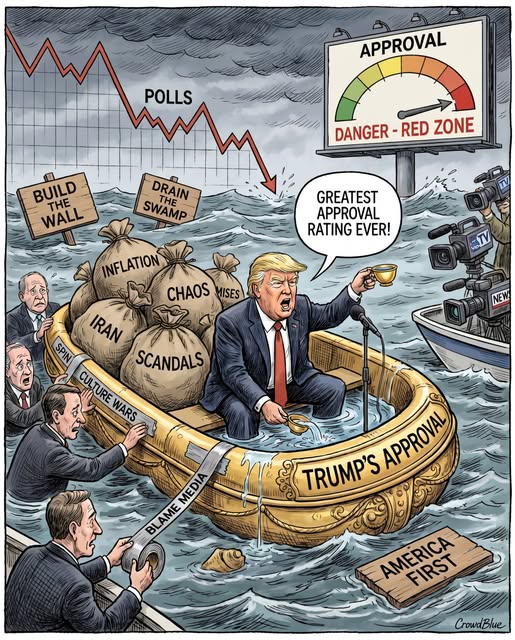
Graphic source: Crowd Blue

| Betty's Home Page | Betty's Public Health Blog Index | Public Health Data Sites | Site Map |
© Copyright 2026 Betty C. Jung
All rights reserved.